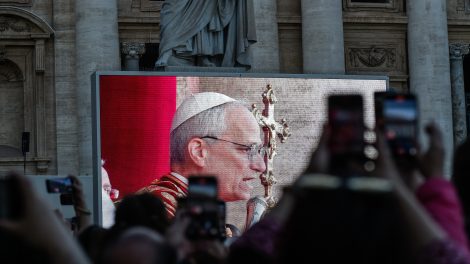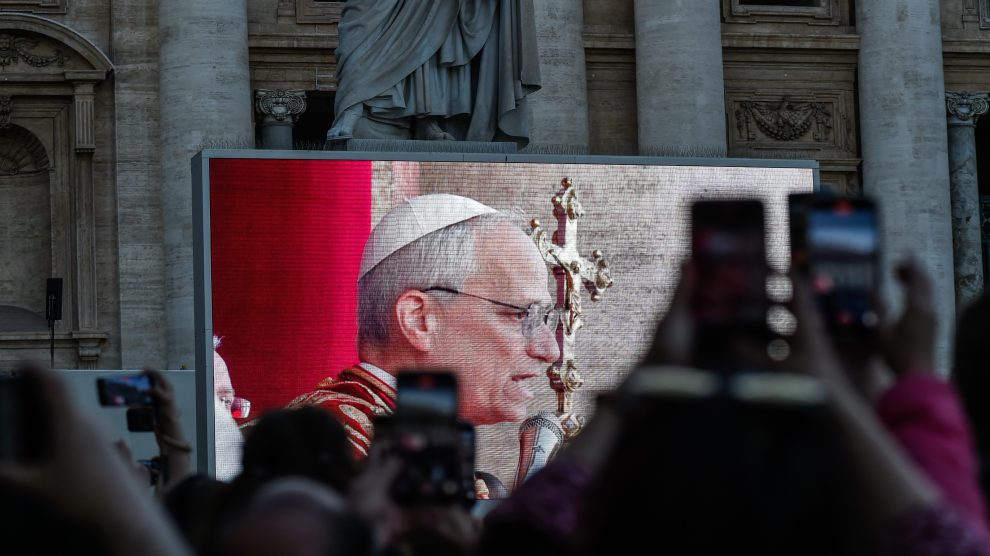
Leo’s direct criticism of Trump. In recent weeks, Pope Leo XIV has moved from cautious distance to explicit engagement with U.S. politics, openly naming President Donald Trump in an appeal to end the Iran conflict.
- Pope Leo has called Donald Trump’s war of choice in Iran a “scandal to the whole human family”.
- The choice of language—invoking the need for an “off-ramp”—suggests a deliberate effort to speak in terms familiar to the American political sphere. T
- his marks a departure from the first months of his pontificate, during which references to his home country remained indirect.
The Pope’s remarks have also become more pointed. His warning that God rejects the prayers of leaders with “hands full of blood” has been interpreted by some observers as a critique of the political and military rationale behind U.S. and allied operations.
- While consistent with a long-standing papal emphasis on peace, the tone and personalization of the message introduce a new level of directness in the Vatican’s public posture.
A constrained diplomatic context. This evolution unfolds within a broader context of limited engagement between the Holy See and the White House.
- Tensions over issues such as the use of force in international crises and immigration policy have gradually reduced the space for constructive dialogue.
- As a result, Vatican appeals risk remaining largely moral in nature, with limited capacity to translate into concrete diplomatic initiatives.
- In the current escalation involving the United States, Israel and Iran, the lack of a direct channel with Washington limits the Holy See’s room to act as a credible intermediary.
- In a weakened multilateral system, mediation requires not only moral authority but also access to key decision-makers.
- This raises a broader question: whether the Vatican can preserve its ethical voice while maintaining the relationships needed for effective mediation.
The value and limits of “terzietà”. A complementary reading is offered by Francesco Sisci, sinologist, director of the Appia Institute, who frames the Holy See’s strength precisely in its structural distance from power politics. In his view, the Pope’s role is not to align with any actor—be it the United States, Iran, China or Russia—but to maintain a form of global impartiality (the so called “terzietà” in Italy) that allows him to speak to all.
- This posture becomes particularly relevant as the mediating capacity of institutions such as the United Nations weakens. As Francesco Sisci notes, “the Pope is the foremost religious leader in the world… he must speak to eight billion people… and cannot take sides in any war,” as doing so would risk opening the door to forms of “holy war” that are by definition irreconcilable.
- In this sense, the Vatican can in principle fill part of the mediation gap by leveraging its universal moral authority and diplomatic network. But this role rests on a delicate balance: as Sisci argues, the Holy See must remain above alignments, maintaining an impartiality that allows it to engage with all actors.
- The current moment suggests that this balance is increasingly difficult to sustain, as the Vatican seeks to ensure its voice is not only heard, but also perceived as a basis for dialogue rather than as part of the broader contestation shaping international politics.
The bottom line: The ongoing Iran war serves as a significant stress test for the bilateral relationship between Washington and the Holy See. The Holy See has not hesitated to express its opposition to this US president, seizing every opportunity to do so.