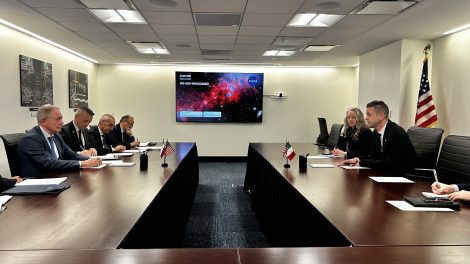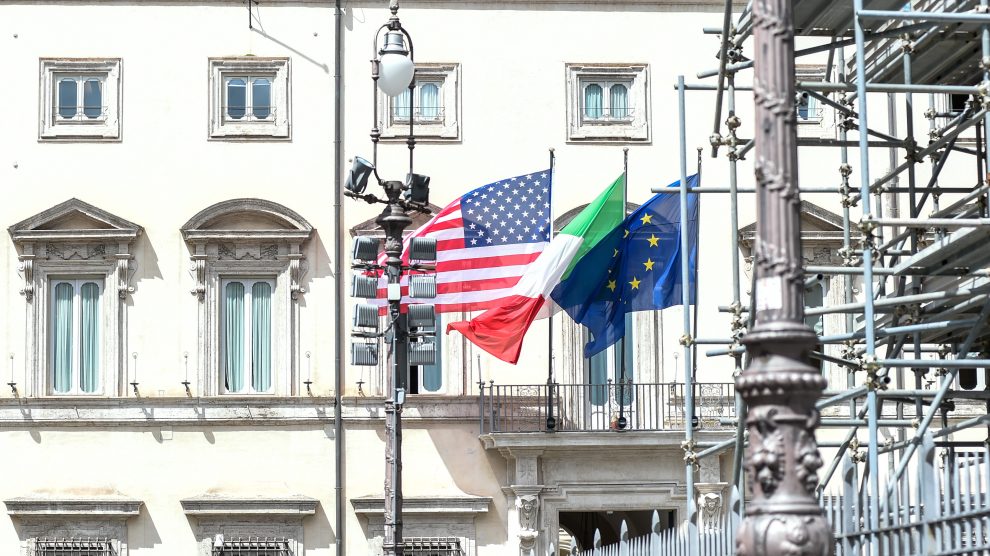
Why it matters: Two back-to-back visits to Washington by Italy’s Industry Minister Adolfo Urso and Undersecretary of Foreign Affairs Maria Tripodi signal a shift: Rome is positioning itself as a core U.S. partner in strategic technologies, from space to AI.
The big picture: These visits are not standalone diplomatic engagements. They are operational follow-ups to the April 2025 joint declaration between Giorgia Meloni and Donald Trump—and point to a deepening Italy–U.S. tech axis.
Space is the headline play. NASA is reshaping its lunar strategy—and Italy is moving early.
- During Urso’s March 30–31 visit, Italy and the U.S. signed a Joint Statement of Intent on lunar surface cooperation with NASA Administrator Jared Isaacman.
- Italy became the first country to secure such an agreement under the new U.S. space strategy.
- What’s inside the deal:
- Italy will build at least one habitable module for a permanent lunar base;
- It will provide navigation and communication systems;
- It will play a role in scientific research and commercial development, with an eye on future Mars missions.
Zoom in: Return to the Moon. The agreement aligns with NASA’s five-pillar strategy:
-
- permanent lunar base (10-year plan, ~$30B)
- low Earth orbit presence
- scientific research
- nuclear propulsion and energy
- Translation: Italy is not just a participant—it’s being positioned as a system-level partner in the U.S. space ecosystem.
Science and tech: building the pipeline. Tripodi’s April 2 visit focused on institutionalizing long-term cooperation.
- She opened the 15th Italy–U.S. Joint Commission Meeting (JCM) on science and technology
- The JCM sets a three-year cooperation framework and funding priorities
- Four priority sectors:
- nuclear energy
- advanced materials
- biotechnology
- frontier technologies (AI, quantum, supercomputing).
What stands out:
- Strong emphasis on applied research and industrial use
- Dedicated funding lines for joint projects
- Italy is the first country to sign a new joint declaration on science and tech with the Trump administration
- This is about moving from research to industrial scaling and competitiveness.
The strategic layer. Read together, the two visits tell a broader story:
- Italy is anchoring itself in U.S.-led technological ecosystems, from space to AI
- Cooperation is shifting from dialogue to co-development and co-investment
- The agenda spans dual-use domains: space, energy, critical minerals, advanced computing
- Urso also agreed with U.S. counterparts to:
- launch a technical working group on critical minerals
- deepen cooperation in energy.
Between industry and geopolitics. The underlying logic is clear:
- Space, AI, and critical materials are now strategic assets, not just economic sectors;
- Italy is leveraging its industrial base to become a trusted, high-end partner;
- Washington, in turn, is selecting partners for its next phase of technological competition.
The bottom line: These visits mark a transition from partnership to integration. Italy is not just aligning with the U.S.—it is embedding itself in the architecture of next-generation technologies, where industrial capacity and geopolitical positioning increasingly overlap.