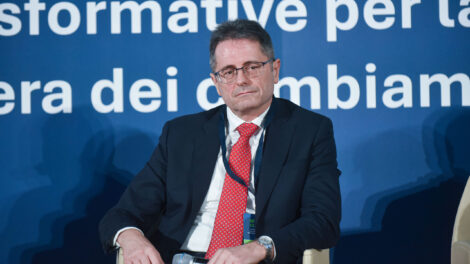
According Stefano Zamagni — economist, professor at the University of Bologna and former president of the Pontifical Academy of Social Sciences — the encyclical represents a historical rupture. For the first time, he argues, a papal encyclical does not merely describe transformations already underway, but attempts to foresee the consequences of new technologies before they become irreversible.
Q: You argue that this encyclical represents something unprecedented, not only in the history of Catholic social doctrine. Why?
A: Because it addresses artificial intelligence before all of its consequences have fully materialized. In the past, encyclicals intervened after social and economic phenomena had already consolidated.
- Here, instead, Leo XIV chooses to move in advance. It is an act of remarkable cultural and political courage.
Q: And this attempt to anticipate the future also emerges through the biblical imagery chosen by the Pope, starting with the Tower of Babel?
A: Exactly. The Tower of Babel symbolizes the delirium of omnipotence: humanity attempting to challenge God and erase human limits.
- On the other side, the Pope recalls the Book of Nehemiah and the rebuilding of Jerusalem’s walls from below, through shared responsibility. That is the great crossroads of our time.
Q: There is also a strong geopolitical dimension in this reflection. How do you interpret it?
A: The geopolitical dimension is one of the deepest layers of the text. Until a few years ago we spoke mainly about international relations. Today we live in a multipolar world where multilateralism itself is in crisis.
- The Pope raises a crucial question: how can this new global order be governed?
Q: A scenario shaped also by hybrid warfare and the military use of artificial intelligence. What do you make of those passages in the encyclical?
A: It is highly significant that the pontiff openly addresses these issues. War today is no longer only conventional warfare: autonomous systems and military robots are increasingly capable of operating directly on the battlefield.
- Think, for instance, of Mythos, developed by Anthropic, a system reportedly capable of identifying vulnerabilities in adversarial protection systems and neutralizing them. It represents a radical transformation. Yet Dario Amodei, himself a Catholic, chose not to commercialize it with that functionality.
Q: Why, according to the Pope, is regulation alone not enough?
A: Because regulation almost always arrives too late. Leo XIV instead introduces an ex ante perspective: intervention must happen while platforms are still being designed.
- But above all, he raises another decisive question: which ethical framework do we want to adopt?
Q: And this is where the reference to virtue ethics comes in?
A: If utilitarian ethics prevails, the risks become enormous, because everything is reduced to efficiency and profit. Catholic social doctrine, instead, is rooted in virtue ethics — the tradition that runs from Aristotle to Thomas Aquinas — and places the human person and the common good at the center.
Q: How do you interpret the section of the encyclical where the Pope connects the AI revolution to the world of work?
A: Here the Pope introduces a very important distinction. Work has an extractive dimension: it provides the income necessary to live.
- But it also has an expressive dimension: through work, individuals realize themselves and their dignity. New technologies may generate greater wealth, but they also risk impoverishing precisely this second dimension.
Q: And so the issue inevitably returns to politics. What message emerges?
A: Leo XIV sends a very strong message: politics must return to the center. The risk is that the world of high tech could end up replacing democratic institutions.
- If politics is emptied out, democracy itself is weakened. Governing transformation cannot become the exclusive task of technology companies. And it is also a call to Catholics: they should stop remaining at the window and return to direct engagement in public life.