Artificial intelligence may imitate the miracle of human life, but it cannot replace it. That conviction lies at the heart of Magnifica Humanitas, the encyclical through which Pope Leo XIV has decided to intervene directly in one of the defining debates of the century.
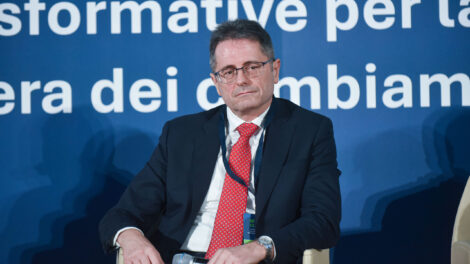
Reading and interpreting the text for Decode39 is Brian Patrick Green, director of the Technology Ethics Program at the Markkula Center for Applied Ethics, where he teaches AI ethics and space ethics at the Graduate School of Engineering. Green is also part of the Vatican’s AI research group.
Q: You are part of the Vatican’s AI research group. What do you believe were the underlying goals and the sensitive issues that pushed the Pope to issue Magnifica Humanitas?
A: Pope Leo recognized that AI is one of the great issues of our time because it has the power to change so many things, often without enough reflection on what we should actually be changing. Without guidance, AI could cause enormous problems. The Pope therefore hopes to offer part of that guidance so that our future may be better.
Q: The very title suggests a kind of “superiority” of humanity over AI, understood as a human creation. Is there a risk that this distinction could disappear?
A: Human beings and machines are not equivalent, and the fact that one thing is magnificent does not mean another cannot also be magnificent. Human beings and AI can both be magnificent, but in very different ways.
- While human beings are easily impressed by powerful technology, we also seem to be moved in the opposite way by those around us who are vulnerable, lonely, and in need of help. We must recognize that every single human life is magnificent. That is easy to lose sight of because we see people constantly, yet every individual life is a miracle. AI can imitate that miracle, but it cannot replace it.
- This distinction risks being lost because AI is increasingly designed to imitate humanity with extraordinary fidelity, even though it will never truly be us.
Q: On the spectrum between a powerful tool and a moral agent, where does AI stand?
A: AI can perform actions autonomously, but the moral responsibility behind AI remains human. AI is a powerful tool, yet despite its power and autonomy, it always works for someone — and that someone remains responsible for it.
Q: Where do Catholic doctrine and the principles followed by major technology companies clash? And where are they compatible?
A: Big Tech is oriented toward profit. The Catholic Church is oriented toward dignity and the common good. Those are very different things, but they can be compatible if the pursuit of profit is subordinated to respect for dignity and the common good.
- Most technology companies are at least aware that if they behave in ways considered too unethical, they will eventually pay a financial price for it, and therefore they try — in most cases — to respect some fundamental moral obligations. Some companies are far more attentive to ethics than others.
- But, as Christopher Olah observed in his remarks, we cannot leave everything in the hands of technology companies. All of us must work to ensure that technology is necessarily ethical — otherwise it will not be.
Q: Donald Trump chose to delay an executive order regulating AI, under pressure from major technology companies. How do you interpret that decision? Do you believe it is a better approach than Europe’s so-called “hyper-regulation”?
A: If everyone were ethical, there would be little need for laws. But not everyone is ethical, and therefore laws are necessary. The way those laws take shape will vary across cultures.
- Right now, the U.S. federal government wants technology companies to remain relatively free from regulation in order to give them greater room to operate within society. At the same time, many American states and much of U.S. public opinion are demanding stronger regulation of Big Tech. That tension cannot last forever.
- European regulation, meanwhile, represents a risky path in the opposite direction: while the United States risks social damage caused by large technology companies, Europe risks economic damage caused by the absence of its own major technology champions.
Q: The encyclical speaks about “disarming AI” and removing it from the logic of the arms race. Is that a realistic goal in a context of strategic competition between major powers?
A: Because of the limits of our imagination, every time humanity invents something new, we immediately think about how it could be used to destroy or harm others. The Pope is asking us to expand our imagination.
- We are not condemned to remain prisoners of our inability to envision beneficial uses, nor are we forced to compete as though we were trapped in an endless arms race. Realistically speaking, if our ethical development does not progress faster than our destructive capabilities, then — regardless of strategic competition — humanity will eventually destroy itself.
Q: Does it make sense to distinguish between defensive and offensive military AI?
A: AI can certainly be distinguished according to its uses, including in the military sphere, as in the case of automated defensive weapons systems. Offensive weapons are often justified because they are said to deter wars, much like nuclear weapons.
- One day AI could play a similar role. But the fact that something is possible does not mean it is right. Relying on fear, death, and destruction is not a way to build a genuine common future. We must imagine something better if we want to live in a better world.