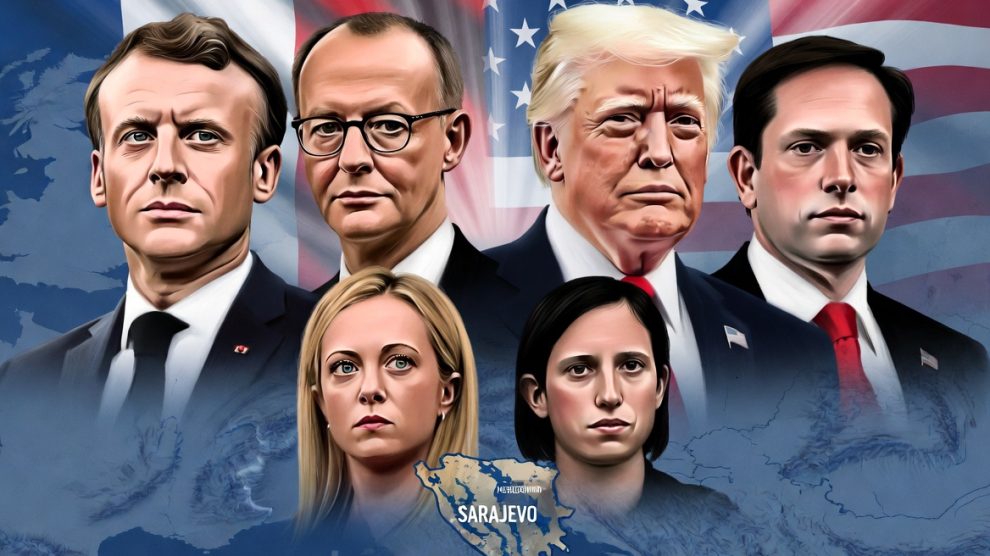
The race to become the next High Representative for Bosnia and Herzegovina has exposed a broader divide among Western allies, with Italy caught at the center of an increasingly political contest.
The Peace Implementation Council (PIC) failed past week to reach an agreement on the successor to Christian Schmidt, postponing a decision that had been expected within days.
Italian diplomat Antonio Zanardi Landi was not appointed. But he was not ruled out either. The delay leaves the race open — and turns the coming weeks into a test not only for Bosnia policy, but also for European cohesion, transatlantic coordination and Italy’s ability to defend its interests in a region it considers strategically vital.
Why it matters:
- The deadlock revealed a split between the United States and key European allies over the future international oversight of Bosnia.
- Washington backed an Italian candidate, while France, Germany and other European partners rallied behind French diplomat René Troccaz.
- The dispute comes at a sensitive moment for Bosnia and for Western engagement in the Western Balkans.
- For Italy, the episode raises questions about its influence within European decision-making on a region directly linked to its security and foreign policy interests.
The big picture: At first glance, the dispute concerns a single international appointment. In reality, it reflects a deeper disagreement among actors that are typically aligned on Bosnia policy.
- The United States pushed until the last minute for Zanardi Landi’s appointment. Secretary of State Marco Rubio publicly endorsed the Italian diplomat, describing him as a highly experienced figure and stressing the need for strong leadership to preserve stability and implement the Dayton peace framework.
- A group of European countries chose a different path: the result was paralysis.
What Washington is saying. The strongest political message came after the meeting.
- In a statement released by the U.S. Embassy in Sarajevo, Washington said the PIC Steering Board’s inability to reach consensus once again demonstrated Europe’s difficulty in speaking with one voice on issues critical to Bosnia’s future.
- The statement also warned that the situation could prompt the United States to reconsider its role within the current international presence in the country.
- That language suggests Washington views the episode as more than a procedural disagreement.
Between the lines: The contest is not simply about two diplomatic résumés.
- According to the positions that emerged around the PIC discussions, the United States, Japan and Turkey supported Zanardi Landi, while a significant group of European countries backed Troccaz.
- The outcome is therefore notable not because a candidate lost — no candidate prevailed — but because a visible fault line emerged among like-minded partners involved in Bosnia’s international governance.
The Italian angle. For Rome, the episode carries an additional layer.
- Italy is among the European countries most directly invested in the stability of the Western Balkans. Geography, security, energy and economic ties make developments in Sarajevo, Belgrade and the wider region matters of direct national interest.
- At the same time, Italy now finds itself in the unusual position of seeing one of its most senior diplomats backed by Washington while several European partners support a different candidate.
- That raises a broader question: how effectively is Italy defending its position in an international process that directly affects a strategic neighborhood?
Zoom in: Zanardi Landi’s credentials were never the central issue. A former ambassador to Serbia, Russia and the Holy See, and later diplomatic adviser to the President of the Republic, he brings extensive experience in the Balkans and Eastern Europe.
- The political significance of the current impasse therefore lies less in the profile itself than in the coalition of countries that chose to support — or oppose — it.
The domestic dimension. The debate also touches Italian politics. The issue extends beyond the government of Prime Minister Giorgia Meloni and reaches the broader political system.
- When a senior Italian candidacy emerges in a strategic arena and receives backing from key partners, the question becomes whether domestic political competition can give way to a more consistent defense of national interests.
- The Balkans are often cited as one of the few foreign-policy areas where such a consensus should be possible.
- Recent international appointments, including the debate surrounding Maurizio Martina’s candidacy for the FAO, have already raised questions about Italy’s ability to act cohesively when national representation is at stake.
What to watch:
- Whether the PIC can reach a compromise in the coming weeks.
- Whether Washington maintains its strong public support for Zanardi Landi.
- How European capitals navigate the current split.
- Whether Italy increases its diplomatic engagement before a final decision is made.
The bottom line: The battle over Bosnia’s next High Representative has become more than an appointment process. It is now a test of Western unity on the Balkans, Europe’s ability to build consensus, and Italy’s capacity to translate its strategic interests into diplomatic influence.