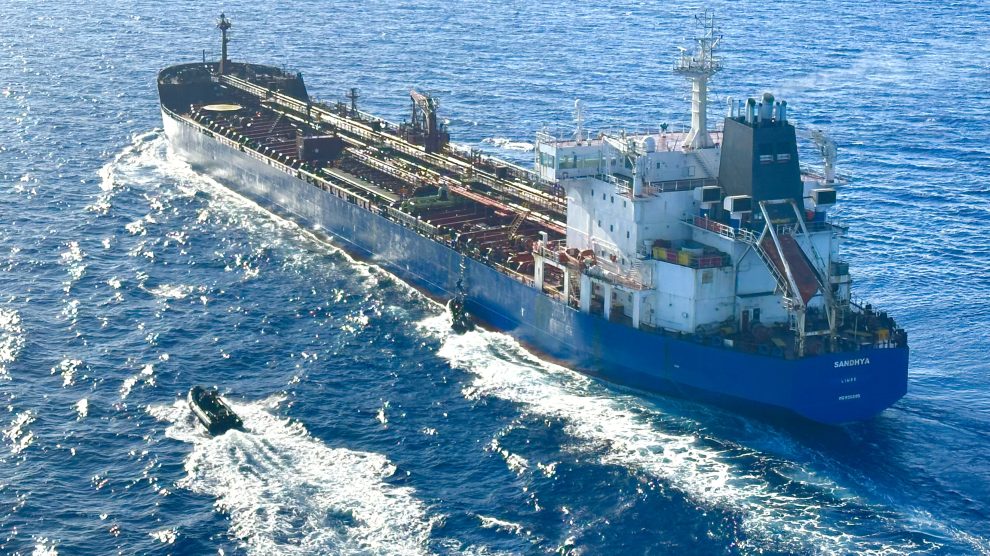
On June 7, a vessel assigned to Operation IRINI carried out a flag verification boarding of the MV Sandhya in the Mediterranean high seas as part of EU efforts targeting the so-called Russian shadow fleet. The inspection followed a similar operation conducted on June 1 against the MV Oneiroi and came less than a month after another boarding of the MV Nelsa on May 11.
Three Boardings in Less Than a Month. Individually, the three incidents attracted limited attention outside specialist maritime and security circles. Taken together, however, they point to something larger than the verification of vessels suspected of sailing under false flags.
- The operations offer one of the clearest indications of IRINI’s ongoing evolution and, more broadly, of the European Union’s growing focus on maritime security in the Mediterranean.
- The inspections were conducted under Article 110 of the United Nations Convention on the Law of the Sea (UNCLOS), which grants warships the right of visit when there are reasonable grounds for suspecting a vessel’s nationality. The purpose is to verify the authenticity of a ship’s declared flag when documentary or behavioural inconsistencies emerge and to share the findings with member states and relevant authorities.
- Operationally, these are procedures firmly grounded in international law. Politically, however, they carry broader significance.
Beyond Libya. Established in 2020 to support the enforcement of the UN arms embargo on Libya, IRINI has gradually expanded its operational scope. Changes in the regional security environment and the growing emphasis on Maritime Situational Awareness have pushed the mission beyond its original Libya-focused mandate while preserving its connection to that theatre.
- The increasing attention paid to maritime networks used to circumvent European sanctions forms part of that evolution. In Brussels, flag verification boardings are increasingly viewed as a practical tool to improve transparency at sea and reduce the grey areas that continue to characterise portions of commercial maritime activity in the Mediterranean.
- The proliferation of vessels operating under questionable registrations or opaque identities is increasingly seen as a challenge extending well beyond individual cases. The concern is that such practices contribute to the gradual erosion of the rules governing maritime spaces, creating gaps that can be exploited by both state and non-state actors.
- As a result, a growing view within European institutions is that the Union cannot limit itself to monitoring these developments. It must also demonstrate a capacity to act using the instruments available under international law.
A Test of Europe’s Strategic Ambition. IRINI’s trajectory reflects a broader debate about Europe’s role as a security actor. In recent months, the European External Action Service has repeatedly stressed the need for a stronger European presence across strategic maritime spaces, while EU High Representative Kaja Kallas has argued that Europe must become more capable of protecting its interests and securing its neighbourhood.
- Against that backdrop, the Mediterranean operation is increasingly seen as one of the few EU instruments capable of producing tangible effects at sea. It is no longer solely about monitoring and reporting. It is also about exercising a degree of practical leverage over suspicious maritime activity.
- Within the operation, this growing assertiveness is viewed as a test of European credibility. The issue extends beyond sanctions enforcement or the Russian shadow fleet. At stake is the Union’s ability to act as a maritime security provider in a region it considers strategically vital.
From Presence to Deterrence. European officials increasingly frame the Mediterranean as an area where Brussels cannot afford governance vacuums or unchecked competition among external powers. In that context, IRINI’s activities serve not only operational purposes but also broader political and deterrence objectives.
- The boardings carried out in recent weeks will not, by themselves, alter the balance of power in the Mediterranean. They do, however, point to a broader trend: the European Union’s willingness to make more systematic use of maritime instruments to protect its interests, uphold rules at sea and reinforce its strategic credibility.
- The transformation remains a work in progress. Yet the cases of the Sandhya, Oneiroi and Nelsa suggest that the shift is already visible on the water.
We told you so… Indeed, in an interview with Decode39 in April, Operation Commander Rear Admiral (UH) Marco Casapieri described IRINI as entering a “new phase”, reflecting the need to adapt to an increasingly complex and evolving threat environment. Recent developments suggest that this transition is already underway.