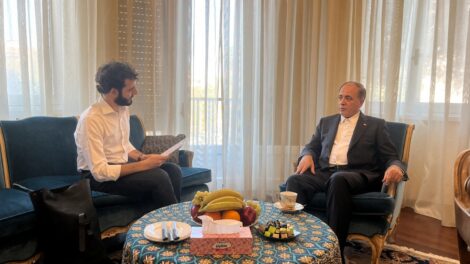
The move: While some observers hope that renewed diplomatic energy could revive efforts to end Russia’s war against Ukraine, Fontaine sees little evidence of an imminent breakthrough.
- “The U.S. administration appears to have given up on the idea of ending the war between Russia and Ukraine, and the Europeans never really led that effort,” he said. “I think there is a lot more fighting ahead of us.”
- His assessment comes as the war enters its fifth year, with both sides continuing military operations despite periodic discussions about negotiations.
Battlefield dynamics. Although the front line has often been described as stagnant, Fontaine argues that recent developments suggest a more nuanced picture.
- According to him, Ukrainian forces have achieved new gains on the battlefield, while Russia has recently lost territory for the first time in several years. Combined with Ukrainian strikes deep inside Russian territory, these developments have slightly shifted momentum in Kyiv’s favor.
- Still, he cautions against interpreting these gains as a turning point. They are unlikely to reverse Russia’s broader territorial advances or create the conditions for meaningful peace talks in the near future.
Why it matters: The assessment highlights a growing gap between diplomatic expectations and military realities. As international attention returns to Ukraine, the conflict continues to be driven primarily by developments on the battlefield rather than by political negotiations.
- Fontaine also points to the increasingly destructive nature of the war, particularly as Ukraine expands attacks against Russian economic and industrial infrastructure.
- While such operations may impose costs on Moscow, he does not believe they will generate diplomatic momentum. “I don’t think negotiations will be fruitful anytime soon, with or without attacks on economic infrastructure,” he said.
Italy’s role: For Italy, Fontaine’s message is one of continuity rather than diplomatic activism. While Rome has consistently supported Kyiv politically, financially, and militarily, he does not see conditions for a meaningful mediation effort in the near term.
- Instead, Italy’s contribution is likely to remain tied to sustaining Western support for Ukraine and helping preserve European unity on sanctions, military assistance, and reconstruction planning. According to Fontaine, countries such as Italy and France can continue to back Ukraine in what he describes as an “existential struggle” while remaining ready to support peace talks when the circumstances become more favorable.
Strategic convergence. Fontaine’s remarks also reveal a broader alignment among Western supporters of Ukraine. While differences persist over the pace and scale of assistance, there is growing recognition that the war is unlikely to end through diplomacy in the short term.
- This convergence is pushing governments to focus less on immediate peace initiatives and more on long-term support, military production, and strategic resilience.
The bigger picture: The interview reflects a reality increasingly visible across Western capitals: despite recurring diplomatic initiatives, neither Moscow nor Kyiv appears ready to make the concessions necessary for a negotiated settlement.
- As a result, the conflict is evolving into a prolonged contest of endurance, military adaptation, and industrial capacity. Recent Ukrainian battlefield successes may alter tactical calculations, but they have yet to transform the broader strategic equation.
What it signals: For now, the end of the crisis in the Gulf is unlikely to unlock a diplomatic breakthrough in Eastern Europe. If Fontaine’s assessment proves correct, Ukraine will return to the center of the international agenda not as a peace process, but as a continuing war in which Western governments (including Italy) will be called upon to sustain their commitment for the long haul.