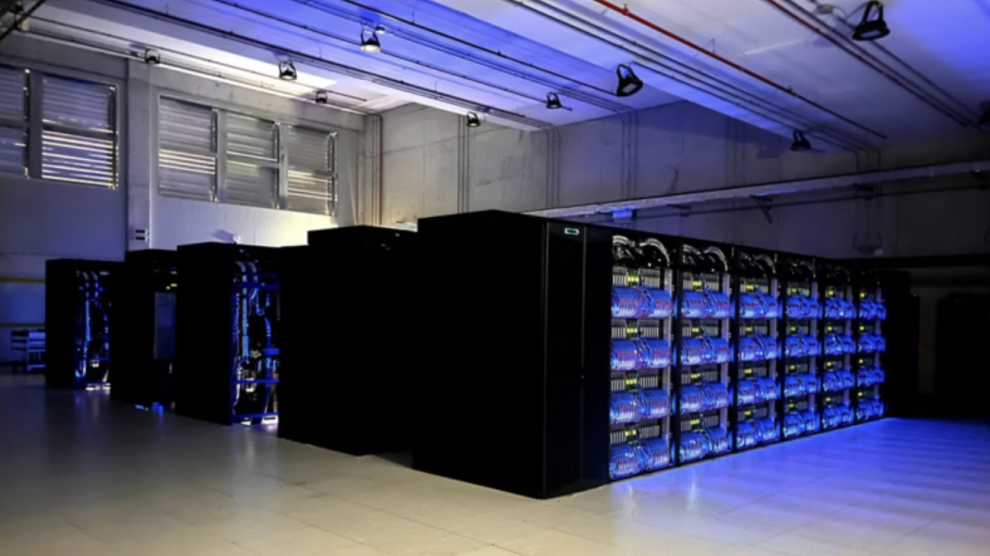
According to Eni, the addition of HPC7 takes its supercomputing platform into the exascale class—a milestone in advanced computing that the company sees as central to both its traditional energy businesses and its decarbonization strategy.
Why it matters:
- HPC7 ranks 6th in the latest TOP500 global supercomputer ranking and is the second most powerful system in Europe, according to the list.
- Eni says it remains the world’s most powerful industrial user of high-performance computing.
- Combined, HPC6 and HPC7 exceed one exaflop of sustained computing performance, crossing a threshold regarded as one of the most advanced in supercomputing.
- The computing platform underpins applications ranging from subsurface modeling and industrial optimization to artificial intelligence and low-carbon technologies.
Zoom in: Crossing the exascale barrier. HPC7 delivers 571 petaflops of sustained performance and 861 petaflops peak, adding to HPC6’s 477 petaflops sustained and 606 petaflops peak.
- Together, the two systems reach 1,048 petaflops sustained—more than one exaflop—and 1,467 petaflops peak.
- The launch also moves HPC7 ahead of HPC6, which entered service in late 2024 and ranked eighth in the TOP500.
The business case: Eni frames advanced computing as a strategic capability across its value chain rather than a standalone technology investment.
- The company says the platform supports:
- Subsurface imaging and geological modeling.
- Optimization of industrial facilities.
- CO₂ storage simulations.
- Development of advanced energy technologies.
- Efficiency improvements in emerging businesses such as biofuels.
- Plasma simulations for magnetic confinement fusion.
- Internal artificial intelligence applications tailored to Eni’s businesses.
- Eni also says the computing ecosystem helps attract external innovation initiatives, citing the experience of its “Call4Innovators” program launched around HPC6.
AI as an industrial enabler. Rather than focusing solely on raw computing power, Eni positions HPC7 as an enabler for increasingly complex predictive models.
- The company says high-performance computing allows it to combine advanced simulations with AI-based applications, accelerating research, industrial processes and decision-making across multiple business lines.
By the numbers: HPC7 is built on HPE Cray EX4000 technology with an AMD-based architecture. Key specifications include:
- 3,480 computing nodes.
- Nearly 14,000 GPUs.
- HPE Slingshot high-speed interconnect operating at 200 Gbps.
- Direct liquid cooling capable of dissipating 96% of generated heat.
- The system has a maximum power consumption of 9.4 MW, including cooling and supporting infrastructure.
Sustainability angle. Beyond computing performance, HPC7 also ranked 11th worldwide in the Green500, which measures supercomputer energy efficiency.
- According to Eni, the system achieves 65.426 GFlops/W, placing it first among machines in its category.
- Both HPC6 and HPC7 operate inside Eni’s Green Data Center, which the company says combines high computing performance with energy-efficient infrastructure through liquid-cooling technology.
What they’re saying: CEO Claudio Descalzi said the deployment of HPC7 demonstrates how supercomputing and predictive technologies are becoming integral to the company’s energy strategy.
- “The transition toward increasingly secure, affordable and cleaner energy from both traditional and renewable sources cannot take place without profound technological progress,” Descalzi said.
- “The adoption of supercomputing and predictive technologies across every activity is fundamental to developing new energy solutions, reducing emissions, maximizing efficiency in exploration and production, and creating value.”
- He added that the rapid deployment of HPC7 strengthens Eni’s digital ecosystem and supports the company’s path toward Net Zero while reinforcing its competitive position.
The bottom line: For Eni, HPC7 is more than a faster supercomputer. The company is positioning exascale computing as core industrial infrastructure, supporting exploration, artificial intelligence, carbon management and next-generation energy technologies while seeking to translate computing power into operational and competitive advantages.