ROME — Italy is relaunching its parliamentary cooperation commission with China, reviving a bilateral forum that had been largely dormant in recent years as Rome looks to keep political dialogue with Beijing alive despite broader geopolitical tensions.
The announcement follows a March visit to Beijing by a delegation led by Giulio Tremonti, chairman of the Foreign Affairs Committee in Italy’s Chamber of Deputies, who told Il Sole 24 Ore that parliamentary diplomacy should help preserve dialogue between Europe and China despite growing geopolitical tensions. The first meeting of the renewed commission is expected to take place in Rome this autumn.
Why it matters: The relaunch signals that Italy intends to preserve parliamentary channels with China even as relations between Beijing and the West remain strained.
- It reflects Rome’s view that legislative diplomacy can complement traditional government-to-government engagement.
- The initiative comes as European countries seek to balance continued economic engagement with Beijing against growing concerns over economic security and strategic competition.
The details: The renewed commission will be co-chaired by Tremonti on the Italian side and Wang Dongming, vice chairman of the Standing Committee of China’s National People’s Congress, on the Chinese side.
- The body was established under a 2001 cooperation agreement between the two legislatures and held regular meetings before its activity slowed in recent years. The upcoming session in Rome will formally restart its work.
What Tremonti says: In the interview with Il Sole 24 Ore, Tremonti argues that parliamentary diplomacy can succeed where traditional diplomacy is increasingly constrained by geopolitical confrontation.
- His objective, he says, is to help rebuild “an international order based on rules, without denying differences and points of disagreement,” while reducing the risk that strategic competition escalates into conflict.
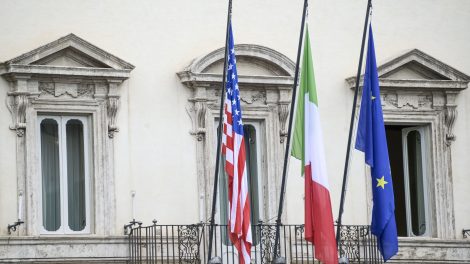
- Tremonti also argues that Europe should recover its role as a bridge between East and West, describing dialogue with China as a strategic necessity rather than an endorsement of Beijing’s positions. He portrays the emerging international order as increasingly tripolar, with the United States, China and Europe each playing a central role.
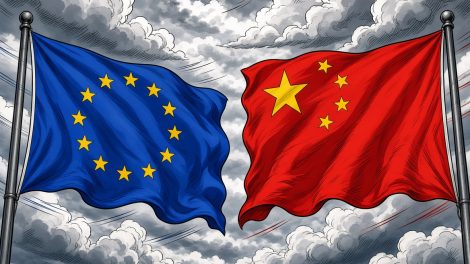
The big picture: Italy’s approach broadly aligns with the European Commission’s China strategy. Brussels describes China simultaneously as a partner for cooperation, an economic competitor and a “systemic rival,” while promoting a policy of de-risking rather than decoupling.
- Within that framework, Rome is seeking to preserve political dialogue with Beijing even as the EU has become increasingly concerned about economic security, critical supply chains, market distortions and its persistent trade imbalance with China.
Between the lines: The message emerging from Tremonti’s interview is that Rome wants to separate political dialogue from strategic competition.
- Rather than signaling a shift in Italy’s geopolitical alignment, the revived commission is presented as a mechanism to keep institutional communication open in an increasingly fragmented international environment.
The bottom line: For Tremonti, the commission is less about bilateral symbolism than about restoring parliamentary diplomacy as a practical tool for managing relations with China at a time when Europe is trying to balance engagement with de-risking.
- The renewed forum offers Italy a channel to maintain dialogue with Beijing while remaining aligned with the EU’s broader strategic approach.