

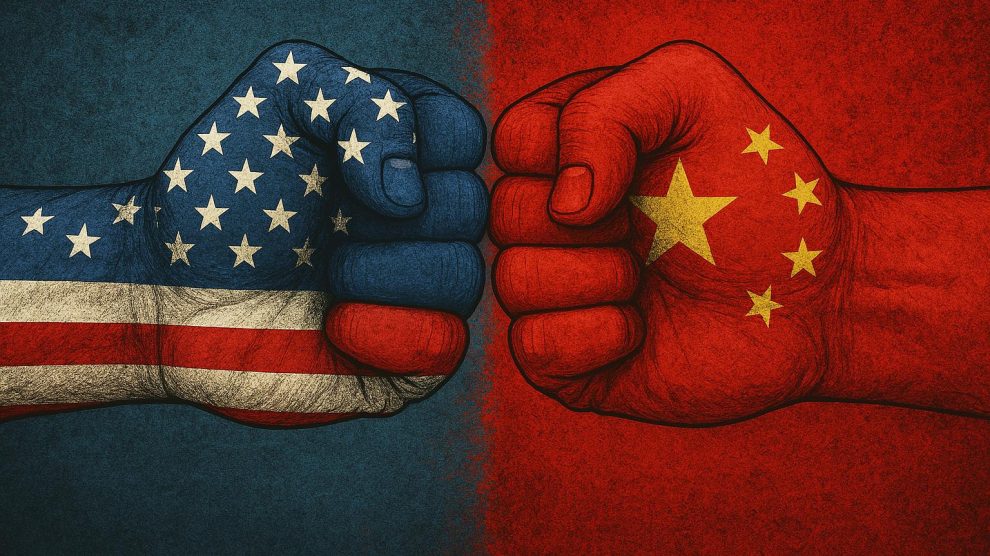
When US Secretary of State Marco Rubio met Chinese Foreign Minister Wang Yi on the sidelines of the ASEAN Foreign Ministers’ Meeting in Manila, the immediate objective was clear: prepare the next phase of high-level engagement between the world’s two largest economies. Rubio described the planned visit by President Xi Jinping as one that should be made “very positive,” arguing that the responsibility of both governments is to manage profound disagreements without allowing them to spiral out of control. Wang echoed the need to “respect China’s core interests,” while Chinese officials described the talks as “pragmatic, positive and constructive.”
That diplomatic effort is unfolding even as Washington hardens its language on what is rapidly becoming the defining arena of US-China competition: artificial intelligence.
- Almost simultaneously with Rubio’s meeting, Michael Kratsios, Director of the White House Office of Science and Technology Policy, publicly accused Chinese AI company Moonshot AI of conducting a large-scale distillation campaign against Anthropic’s proprietary models in order to develop Kimi-3, one of the most capable frontier models released to date.
What’s the catch? According to Kratsios, Moonshot built a sophisticated internal platform capable of carrying out industrial-scale distillation while constantly switching access methods to avoid detection.
- He also alleged that the company had acquired Nvidia GB300-equipped servers and gained access to additional GB300 systems in Thailand, likely to train its frontier models.
- The reference is particularly significant: GB300 systems represent the latest generation of AI computing infrastructure and fall squarely within the broader US effort to restrict China’s access to advanced computing power through export controls. Suggesting that Chinese developers may have leveraged such infrastructure outside mainland China points to a broader concern in Washington: that Beijing may still be able to acquire critical computational resources despite increasingly stringent restrictions.
Zoom in: the message. Yet the administration’s message extends well beyond allegations of intellectual property theft. Kratsios carefully distinguished between distillation as a legitimate engineering practice — which allows developers to create smaller and more efficient models within a competitive ecosystem — and what he described as covert, industrial-scale efforts designed to appropriate proprietary American technology. In doing so, he framed the issue not as a commercial dispute but as a challenge to America’s technological leadership in what Washington increasingly considers the most strategically important industry of the coming decade.
- The rhetoric became even sharper in comments by Under Secretary Jacob Helberg, the architect of the administration’s Pax Silica initiative. Helberg argued that the alleged operation represented “more than a heist of invaluable American intellectual property.” Instead, he described it as “an assault on every economy that prizes the entrepreneur, rewards private capital, and relies on fair and honest competition,” concluding that “lying, cheating and stealing is not innovation or ‘win-win.’”
Why it matters: Such language marks a notable evolution in Washington’s framing of AI competition. The debate is no longer centred exclusively on intellectual property or commercial advantage. Frontier AI is increasingly being treated as critical national infrastructure, placing it alongside semiconductors and advanced computing within the broader architecture of economic and national security.
The strategic context. The accusations against Moonshot also arrive amid an increasingly consequential debate inside the United States itself. Although OpenAI and Anthropic remain fierce commercial competitors, they have broadly aligned in warning policymakers about the strategic implications of Chinese AI development, particularly regarding distillation and the spread of powerful open-weight models.
- Anthropic has argued that open-weight frontier models become inherently harder to secure once their weights are released, while OpenAI has similarly warned about the risks of distillation enabling competitors to replicate proprietary capabilities. Their positions have reinforced a growing consensus inside the administration that AI governance cannot be separated from strategic competition with China.
That consensus, however, is far from universal. Critics within the broader AI ecosystem argue that stricter regulation of open-weight models risks entrenching the largest frontier labs, effectively turning national security concerns into a mechanism for regulatory capture. The debate over AI governance inside Washington therefore mirrors a broader question: how to preserve innovation while protecting technologies increasingly viewed as strategic assets.
- There is also reason for caution before accepting the Moonshot allegations at face value. Kimi-3 was reportedly undergoing internal evaluation months before Anthropic’s Fable 5 had been available long enough to plausibly account for the model’s overall performance through distillation alone. That does not invalidate the administration’s claims, particularly if it possesses intelligence unavailable to the public. It does, however, suggest that any explanation for Kimi-3’s capabilities is unlikely to rest on distillation alone.
What’s behind. All in all, the diplomatic engagement between Rubio and Wang and the White House’s unusually forceful accusations reveal less a contradiction than a structural shift in the bilateral relationship. In this light, the timing and tone of the statements can also be read as part of a broader signaling strategy: preparing the ground for a potential tightening of China’s technological ecosystem.
- According to reporting by the Financial Times, Beijing is considering imposing restrictions on its most advanced domestic companies regarding international access to their open-weight models, in stark contrast with the more open narrative promoted by Xi Jinping during the recent World Artificial Intelligence Conference in Shanghai.
- Washington is increasingly concerned about the industrial partnerships emerging around China’s AI ecosystem. The fear is that market forces and private-sector cooperation — rather than government policy — could cement Beijing’s technological ecosystem across Europe, including Italy, with potentially significant implications for Rome.
The bottom line: The U.S. is no longer attempting to choose between engagement and confrontation. Instead, it is institutionalising both. Diplomacy is intended to reduce the risk of escalation between two nuclear powers whose economies remain deeply interconnected. Strategic competition, meanwhile, is accelerating across the technologies expected to shape future military, economic and geopolitical influence.
- If tariffs defined the first phase of US-China rivalry and semiconductors the second, artificial intelligence is increasingly emerging as the central contest of the next decade. Xi’s expected visit to Washington may help establish new guardrails for managing bilateral tensions. It is unlikely to alter the trajectory of a technological competition that both capitals now regard as fundamental to their long-term national power.