

The United States has put science and technology at the heart of its national security strategy. But Washington’s new blueprint is about more than winning the race for the next breakthrough: it is about choosing where to compete, protecting America’s advantages and building a wider technological ecosystem with allies and partners.
Why it matters: The new National Security Science & Technology Strategy (NSSTS) explicitly treats U.S. scientific and technological leadership as a national security objective.
- The strategy rests on four pillars: focusing techno-strategic competition, building technological resilience, accelerating innovation and protecting the U.S. science and technology ecosystem.
- Its priorities range from AI and quantum technologies to semiconductors, biotechnology, nuclear energy and space.
- But the underlying logic matters more than the list itself: technological leadership is increasingly viewed as an instrument of military power, economic security and international influence.
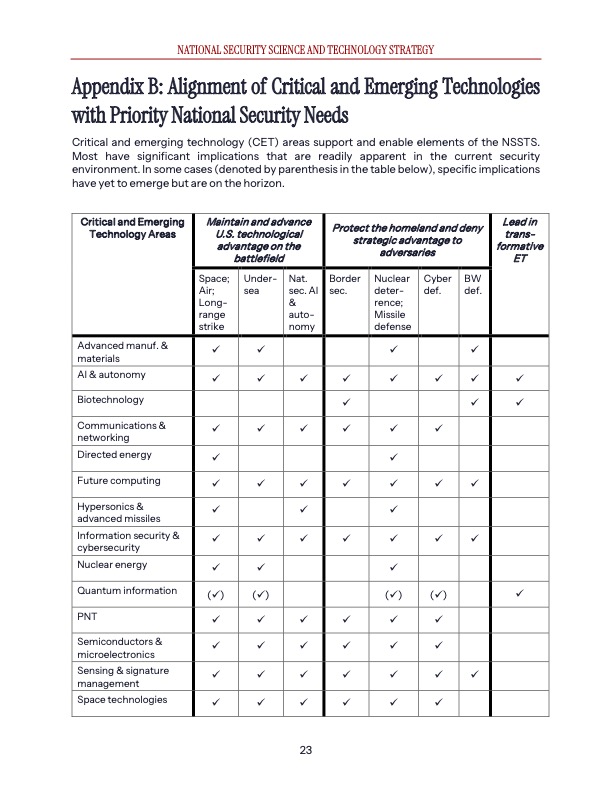
The big picture: Washington does not intend to compete with its rivals everywhere on equal terms. The NSSTS calls for the U.S. to “shape technology competition toward areas of U.S. strength” — effectively seeking to determine where and how technological competition unfolds.
- That can mean developing capabilities competitors would struggle to match.
- It can also mean combining small numbers of sophisticated systems with larger numbers of cheaper, technology-enabled assets.
- The strategy explicitly considers how U.S. technological choices can force competitors to redirect resources. Advanced U.S. strike capabilities, for example, could push rivals to spend more on costly air and missile defenses rather than offensive capabilities.
Zoom in: Beyond the battlefield. This is as much about imposing costs as achieving technological superiority.
- Washington argues that the U.S. should avoid forms of competition in which an adversary can counter American moves more cheaply. The goal is not to mirror every rival capability, but to compete where U.S. strengths can produce the greatest strategic advantage.
- That logic extends well beyond the battlefield. The NSSTS links technological leadership to resilient supply chains, critical infrastructure, research security, investment screening, export controls, talent and the ability to influence international standards and governance.
The alliance factor: Allies and partners are part of the strategy, not an afterthought. The document explicitly describes their science and technology capabilities as a “force multiplier” for the United States.
- Washington wants deeper cooperation on critical and emerging technologies.
- It calls for coordination on research and investment security and stronger shared supply chains.
- And it wants to work with like-minded partners to shape technology standards, norms and governance.
- The result points toward a technological ecosystem that is relatively open among trusted partners while becoming more selective toward strategic competitors.
The tension: America’s openness remains one of its biggest technological advantages — and, according to the strategy, one of its vulnerabilities.
- Washington wants to keep attracting global talent, private capital and academic cooperation while preventing foreign adversaries from exploiting that openness to acquire intellectual property, sensitive data or advanced capabilities.
- Hence the parallel push for stronger research security, foreign investment screening, outbound investment restrictions, export controls and supply-chain protection.
What we’re watching: The strategic contest will therefore not be decided solely by who develops the next breakthrough first.
- The bigger test will be whether Washington can connect research, industry, capital, defense and allied capabilities into an ecosystem capable of sustaining technological advantage over time.
- For U.S. allies, that also changes the equation. Their value will increasingly depend not only on political alignment or military capabilities, but on what they can contribute to the scientific, industrial and technological architecture Washington is trying to build.