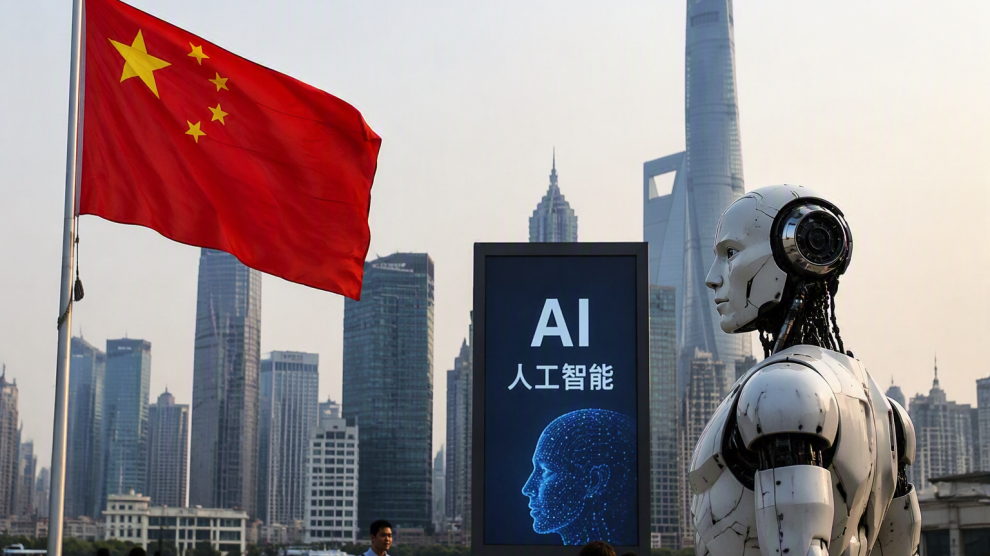
Artificial intelligence could be used to destabilise China’s political system, attack critical infrastructure, extract sensitive information and alter the balance of power on the battlefield. It could also make governing society more difficult as technological development moves faster than the rules designed to contain its consequences.
That assessment emerges from an article by Chen Yixin, China’s Minister of State Security, published in the latest issue of China Cybersecurity Magazine.
Chen identifies six categories of risk which, taken together, provide an unusually clear indication of how China’s security establishment is interpreting the acceleration of AI — and, more importantly, what it fears could escape the Communist party’s control.
Regime security comes first. Chen begins with the security of the political system. “Hostile forces” and people with ulterior motives, he argues, could use deepfakes, AI-generated text and images and automated accounts to produce political content cheaply and at scale, disseminate information deemed harmful and exacerbate social divisions.
- The tools may be new, but Chen describes the threat in language familiar to China’s security establishment: “public-opinion wars” and “cognitive warfare” directed against the country’s political, institutional and ideological security.
The fact that Chen starts here is telling. His immediate concern is not that China might lose the AI race. It is what increasingly powerful and accessible technologies could do to the state’s ability to manage the circulation of information.
- AI dramatically lowers the cost of generating, manipulating and distributing content on a large scale. For a political system that treats the management of the information space as an almost existential security function, the implications are political before they are technological.
A similar logic applies to cyberspace. Chen argues that AI allows governments and organisations to identify vulnerabilities more rapidly, automatically assemble attack chains and conduct sophisticated cyber operations with fewer resources. Lower technical barriers would, in turn, increase the exposure of China’s critical information infrastructure.
Data constitute another vulnerability. Chen describes how foreign intelligence agencies could deploy crawlers, data mining and profiling tools to collect critical national data, trade secrets and personal information.
- The threat, in his account, does not necessarily originate abroad. Chinese users who process sensitive material through foreign AI products or transfer data overseas could themselves create new channels through which valuable information leaves the country.
The American constraint. This is where domestic security starts to converge with international technological competition.
- Chen warns that countries holding advantages in AI theory, model architecture and computing power — in practice, above all the United States, which leads in these fields — could invoke national security to justify technology controls and entity lists, impose their own standards and consolidate closed-source ecosystems. The result would be more restricted access to advanced technologies and the progressive fragmentation of AI supply chains.
The concern exposes a tension likely to shape China’s approach to AI for years. Beijing has every reason to resist an international technology system in which other countries can restrict its access to the most advanced capabilities. At home, however, the model outlined by Chen envisages an increasingly expansive role for the state in supervising data and the information environment.
- The issue, then, is not whether AI should be controlled. It is who controls it, under whose rules, and with what consequences for China’s ability to close the technological gap.
Why Beijing cannot afford to slow down. Some of Chen’s concerns are less specific to China. He points to algorithmic opacity, data poisoning, the amplification of existing biases, misuse of personal information and the difficulty of assigning responsibility when decisions are automated. Behind them sits a broader problem: technological development is moving at a pace that laws, ethical standards and regulatory systems are struggling to match.
- That concern overlaps with the debate opened in recent days by technology companies themselves, which have called for a deeper reassessment of the direction of AI development, approaching the question of whether its advance should be slowed.
The Trump administration has pushed back against that position, with President Donald Trump describing it as a “sick conspiracy”. China’s foreign ministry has responded to the concerns expressed by US AI companies in strikingly similar terms. “Alarmism and concern only serve to obstruct the process of global artificial intelligence governance,” its spokesperson said at a press conference.
- Beijing’s interpretation goes further. Such alarmism is seen as serving the interests of companies that want to slow development and prevent Chinese competitors from closing the existing gap.
- That makes a significant slowdown politically and strategically difficult for the party-state to contemplate. China’s answer is instead to control the process as it unfolds — across its social, economic, political and ultimately military dimensions.
The military imperative. Chen himself explains why the stakes extend beyond technological competition. AI, in his account, is pushing warfare towards an era of “intelligentisation”, in which algorithms will play a growing role in the ability of armed forces to collect information, make assessments and identify targets.
- Artificial intelligence is already moving beyond a supporting function. Chen sees it assuming a more central position in intelligence fusion, decision-making, target identification, military operations and cognitive warfare.
- This military dimension makes the logic of restraint still harder for Beijing. A government convinced that AI will influence the distribution of military power cannot easily choose to slow its development simply because it also recognises the political and social risks involved.
- The task becomes one of managing those risks without sacrificing capabilities that China regards as increasingly important to its economic competitiveness, intelligence apparatus and armed forces.
The party’s answer: control the acceleration. Seen together, Chen’s six risks suggest that Beijing does not regard AI as a discrete technology sector that can be separated from the other components of national security. Political information, digital infrastructure, data, technological dependencies, social order and military capability increasingly belong to the same strategic calculation because all depend, to varying degrees, on control over algorithmic systems and the resources that sustain them.
- Chen’s proposed response follows directly from that diagnosis. He calls for stronger “Party control over the internet” and “Party control over data”, and for China to transform the advantages of party leadership into more effective AI governance.
- This is a long way from accepting that technological development should be slowed. Chen’s objective is instead to establish the political conditions under which acceleration can continue.
The rivalry with the United States is clearest in his concerns over technology controls, standards, computing power and closed ecosystems. Yet his argument points to something more fundamental than competition between Washington and Beijing.
- For China, acquiring increasingly advanced AI capabilities will be of limited strategic value if doing so means losing control over the data, information and processes on which those capabilities depend.
This is where China’s AI policy meets the security logic of the Communist party. Beijing wants to develop a technology that is likely to become increasingly consequential for the economy, intelligence and warfare, while retaining the authority to determine who can use it, what data it can process and what information it can produce and distribute.
The bottom line: For Minister Chen, the race is therefore not simply about building better models or securing more computing power. China’s challenge is to accelerate without surrendering control over the forces that acceleration unleashes.