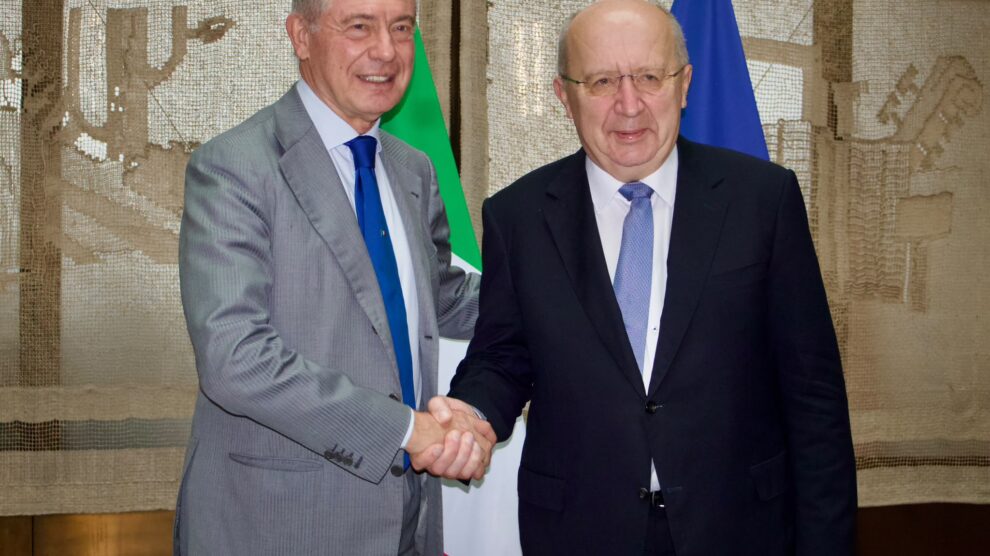
ROME — Italian Industry and Made in Italy Minister Adolfo Urso met European Commissioner for Defence and Space Andrius Kubilius in Rome to discuss the future of European access to space, the EU Space Act, the IRIS² programme and cooperation on satellite communications, Earth observation and defence-related space capabilities.
The meeting took place at Palazzo Piacentini during Kubilius’ visit to Italy, the first stop of the European Commission’s Launch Tour, which will take him to European launch sites, manufacturing facilities and testing infrastructure.
Why it matters: Italy is calling for greater European cooperation to strengthen the EU’s autonomy in access to space, support competitiveness and make full use of existing capabilities, including the Ariane and Vega launchers.
What they’re saying:
- Urso called for ambitious European space programmes and stronger cooperation. “Europe must play a leading role in space exploration through ambitious programmes,” the minister said.
- “In the current international context, strengthening European autonomy in access to space requires greater cooperation to support European competitiveness, making the most of existing capabilities. We must fully utilise the launchers currently in operation, Ariane and Vega, supporting the objective of achieving a higher number of missions per year.”
- “Italy, thanks to a mature industry, infrastructure of excellence and an integrated supply chain, can make a decisive contribution to future European programmes,” he added.
- Kubilius highlighted Italy’s contribution to European space programmes and infrastructure. “Italy is one of the main EU member states active in the space sector across all space domains,” the commissioner said.
- “Italian industry makes EU space systems possible, from Copernicus to Galileo, secure connectivity and European access to space. Through the EU Recovery and Resilience Facility (RRF), Italy has made substantial investments that have accelerated competitiveness and growth and created capabilities at national level that are important assets for European space systems.”
- “I am convinced that together with Italy and all EU member states we will be able to define a functional European Space Act and continue to invest ambitiously in EU space infrastructure. Space is an enabler of competitiveness, resilience and autonomy. A strong partnership with the EU is essential to ensure services for all and greater access to European and global markets,” he added.
The big picture: European access to space. During the meeting, Urso reiterated Italy’s support for the development of a European roadmap for the future of access to space.
- The roadmap would be aligned with the “Long-Term Vision for European Space Transportation,” the strategy shared by EU and European Space Agency member states at the Paris summit last September.
- The strategy aims to ensure autonomous, reliable and economically sustainable access to space by 2045.
- Italy also stressed the need to make full use of the Ariane and Vega launchers currently in operation, supporting the objective of increasing the annual frequency of missions.
Zoom in: The EU Space Act. Italy acknowledged improvements introduced in the latest version of the proposed EU Space Act, while reiterating that several important issues remain open. These include the regulation’s scope of application, governance and obligations for companies.
- Urso stressed the need to safeguard member states’ competencies and responsibilities regarding authorisation and supervision, avoiding administrative overlaps and ensuring proportionate rules.
- The objective is to support the competitiveness of the sector without creating additional burdens for the industrial supply chain.
Secure connectivity: IRIS². On IRIS², the European secure satellite connectivity programme, Urso confirmed Italy’s commitment to the programme’s success.
- He underlined the importance of greater participation by Italian industry and of making full use of Italy’s technological and infrastructure capabilities, starting with the Vega C launchers and the Fucino Space Centre.
Satellite communications and Earth observation. The meeting also addressed satellite communications and Earth observation services. On the future regulation of mobile satellite services, Italy reiterated the need for rules consistent with European security and strategic autonomy objectives, while ensuring adequate participation by industries from different member states.
- Regarding the future European Earth Observation Governmental Service (EOGS), Urso confirmed Italy’s support for the development of an autonomous EU capability to support security and defence.
- He also stressed the importance of providing for a dedicated satellite mission and enhancing the role of the European Union Satellite Centre (SATCEN) in defining the programme’s priorities.