
The Council of the European Union has extended the mandate of EUNAVFOR MED Operation IRINI until March 31, 2029, assigning the Italy-led naval mission an expanded strategic role in the Mediterranean.
The renewed mandate, announced on October 13, reflects Brussels’ growing focus on maritime security, hybrid threats and the protection of European strategic interests.
Why it matters: IRINI is increasingly becoming a key operational instrument of the EU’s maritime security architecture, extending its activities beyond the enforcement of the United Nations arms embargo on Libya.
- The new mandate explicitly includes efforts to constrain Russia’s shadow fleet, strengthen maritime domain awareness and support the protection of critical maritime infrastructure.
- It reinforces the EU’s ability to monitor suspicious maritime activities and respond to emerging security challenges across the Mediterranean.
- It also consolidates Italy’s central operational role in European maritime security, as the mission operates under Italian command from its headquarters in Rome.
The big picture: Brussels has identified three strategic priorities for IRINI’s next phase: safeguarding EU interests through credible protection and deterrence, supporting UN resolutions aimed at stabilizing Libya, and strengthening Mediterranean partnerships through training, capacity building and naval diplomacy.
- Countering the Russian shadow fleet has become an increasingly important European security priority, given concerns over sanctions enforcement, maritime safety and environmental risks.
- Protecting undersea cables, pipelines and other critical infrastructure is also gaining strategic relevance as hybrid threats increasingly affect Europe’s maritime domain.
- IRINI will continue monitoring violations of the UN arms embargo on Libya and illicit oil smuggling, preserving its original mission alongside its expanded responsibilities.
The Italian connection: The mandate renewal formalizes an operational evolution already documented by Decode39.
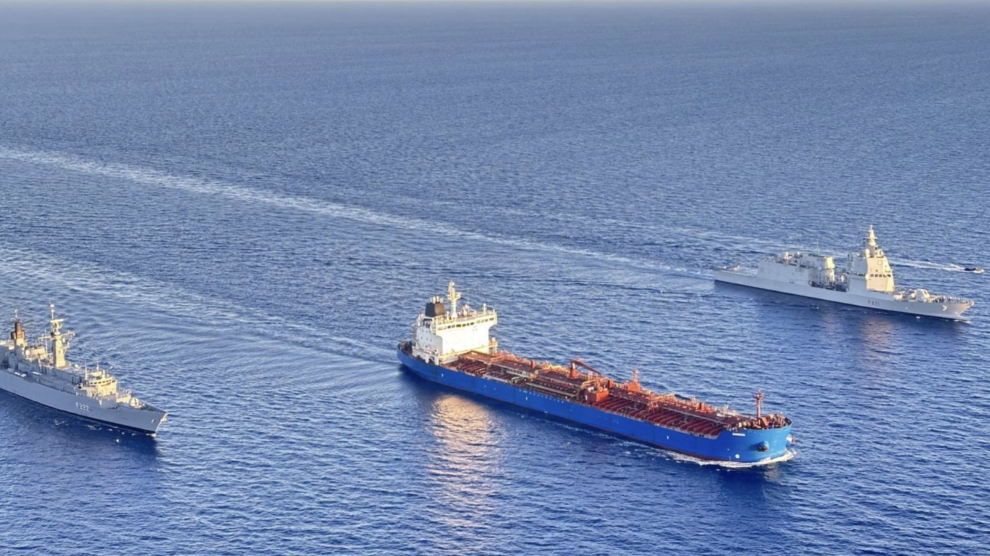
- In August, an Italian-led IRINI boarding operation targeted a sanctioned Russian shadow fleet tanker, while a separate agreement between IRINI and the Italian Navy strengthened cooperation on protecting critical Mediterranean infrastructure.
- The broader strategic shift had already been outlined in an April interview with Decode39, in which Rear Admiral Marco Casapieri, IRINI’s Operation Commander, described the mission’s adaptation to evolving hybrid threats and its growing role in European strategic resilience.
What’s next: Under its renewed mandate, IRINI will maintain the flexibility to scale up its activities in response to emerging contingencies, while expanding cooperation with Mediterranean partners.
The bottom line: The extension to 2029 signals that Brussels increasingly sees maritime security in the Mediterranean as part of Europe’s wider strategic competition.
- For IRINI, the shift means moving beyond Libya-focused enforcement toward a more comprehensive role in protecting European interests, infrastructure and maritime connectivity.