The European Commission is looking to strengthen the continent’s independent access to space, and Italy is emerging as a key industrial and political partner in that effort. During a two-day visit on 12–13 November, Defence and Space Commissioner Andrius Kubilius met Italian ministers and visited major industrial facilities, assessing the capabilities that could underpin Europe’s future space strategy.
The mission: Kubilius’ visit to Italy was part of the European Commission’s Launch Tour, launched in September to gather input from national governments and industrial stakeholders ahead of a future European action plan on access to space.
- The mission combined institutional discussions in Rome with visits to key industrial sites, including Thales Alenia Space’s Space Smart Factory and Avio’s facilities in Colleferro, before moving to Piedmont, one of Italy’s main aerospace hubs.
- The objective goes beyond industrial consultation. Brussels wants to understand what Europe can already deliver, where critical gaps remain and how to build a more reliable and competitive launch ecosystem.
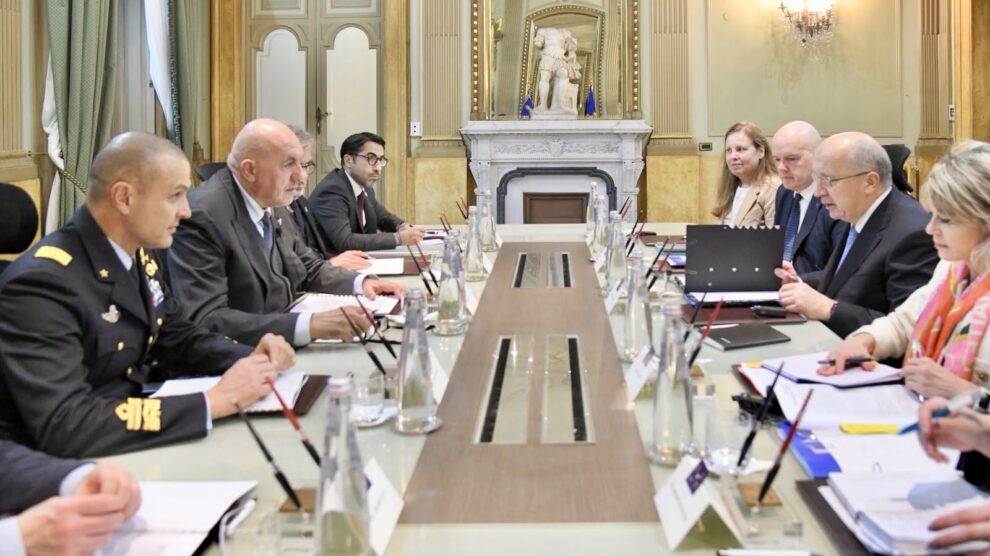
Political alignment: In Rome, Kubilius met Enterprise and Made in Italy Minister Adolfo Urso to discuss European launch capabilities, the development of launchers, EU regulation and the prospects for Iris², the European secure connectivity programme.
- Urso stressed the need to make full use of existing European launch systems, particularly Ariane and Vega, while increasing the annual frequency of missions and supporting the development of new solutions, including micro-launchers.
- The message reflects a central challenge for European space policy: ensuring that existing industrial capabilities are fully exploited while investing in the next generation of launch technologies.
- Kubilius also met Defence Minister Guido Crosetto, focusing on the increasingly close relationship between space capabilities and security requirements. The involvement of the Italian Space Agency, represented by its Commissioner Mario Cospito, further underlined the importance of coordination between governments, institutions, major companies and smaller industrial players.
Industrial capabilities: The industrial visits provided a practical assessment of Italy’s contribution to Europe’s space ambitions.
- At Thales Alenia Space’s Space Smart Factory in Rome, Kubilius examined a new production and integration facility designed to increase automation and respond to growing demand for satellite systems. Developed with support from Italy’s National Recovery and Resilience Plan and the Italian Space Agency, the facility represents an investment in the industrial capacity needed to scale up European satellite production.
- Leonardo was also involved in the visits, with Massimo Claudio Comparini, Managing Director of the group’s Space Division, highlighting the strategic relevance of an industrial ecosystem that spans satellite manufacturing, infrastructure management and space services through Thales Alenia Space and Telespazio.
- The visit then moved to Colleferro, where Avio produces the Vega launcher. Its role is particularly relevant to Europe’s efforts to diversify launch capabilities and reduce dependence on external providers.
Strategic convergence: The presence of Urso, Crosetto and representatives of the Italian space sector points to a significant convergence between industrial policy, defence requirements and European strategic autonomy.
- Italy’s contribution is not limited to launcher production. Its industrial base covers several critical segments of the space value chain, from satellite manufacturing and launch systems to orbital infrastructure and services.
- This breadth gives Rome a relevant position in discussions over the future direction of European space policy. It also creates an opportunity to strengthen the links between civilian programmes, commercial markets and defence-related requirements.
- The challenge will be translating this convergence into coordinated investments, industrial cooperation and sustainable demand for European launch services.
Beyond launchers. The discussions also touched on Iris², secure connectivity and Earth observation, highlighting how access to space is increasingly connected to Europe’s wider security and technological agenda.
- Satellite infrastructure is becoming essential not only for telecommunications and environmental monitoring but also for secure communications, intelligence and military operations.
- The distinction between civilian and defence space capabilities is therefore becoming less pronounced. For the European Union, developing independent access to orbit is increasingly a matter of economic competitiveness and strategic resilience.
- Piedmont’s role in the mission reinforced this broader perspective. The region’s concentration of major industrial groups, specialised companies and research centres illustrates the importance of national aerospace districts in building a stronger European supply chain.
What it signals: Kubilius’ Italian mission highlights the growing importance of industrial readiness in shaping Europe’s space ambitions. Political commitments to strategic autonomy will have limited impact without sufficient launch capacity, competitive manufacturing and a stable market for European technologies.
- Italy is positioning itself as a significant contributor to that effort, with capabilities spanning launchers, satellites and space services. The next test for Brussels will be turning the consultations into a coherent industrial strategy capable of aligning national strengths with common European priorities.
- The underlying message is clear: Europe’s autonomy in space will depend not only on political ambition, but on its ability to mobilie the industrial capabilities it already has.
(Photo: X, @KubiliusA)