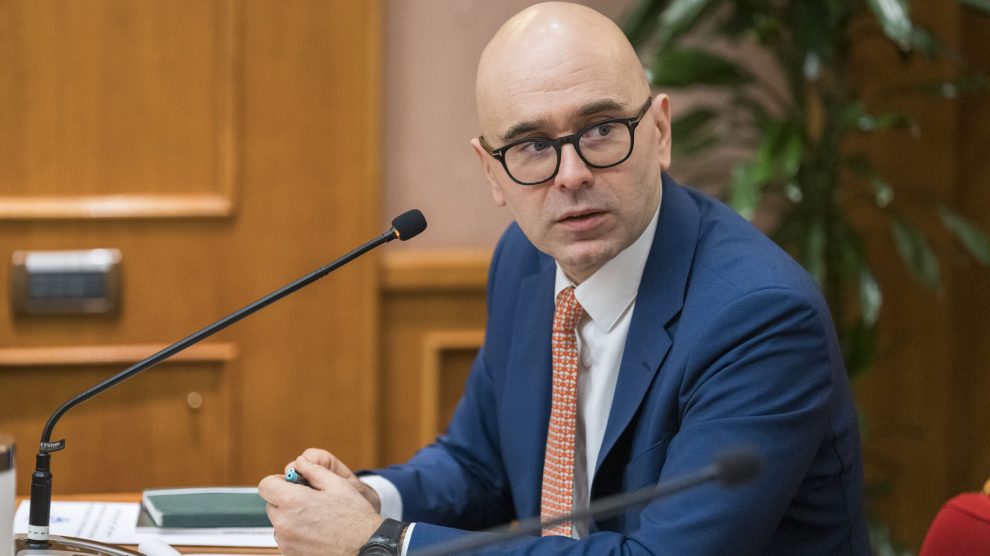
Over the past twelve months, Centemero has led the Assembly through one of the most turbulent geopolitical phases in its recent history: the spillover of wars on Mediterranean countries, the reconfiguration of energy routes, the rise of AI and digital manipulation, and Pope Leo XIV’s highly symbolic visit to Turkey and Lebanon — a trip intersecting directly with PAM’s mission of interreligious dialogue and regional stabilisation.
The big picture: PAM is consolidating itself as a global diplomatic interface, not only for Mediterranean countries but also for Central Asia, Latin America and Africa. Under Centemero’s leadership, the Assembly has strengthened its policy pillars: economic security, counterterrorism, digital governance, food and water resilience, and interfaith dialogue.
- The creation of a Mediterranean Development Bank — proposed by Centemero in Marrakech — signals PAM’s attempt to move beyond dialogue and into regional economic integration, in partnership with the World Bank and IMF.
Why he matters: Centemero’s presidency reflects a broader Italian diplomatic push:
- anchoring the Mattei Plan inside multilateral frameworks,
- reinforcing Italy’s role in stabilising the Eastern Mediterranean and the Middle East,
- addressing global threats such as disinformation, cyber manipulation, and the misuse of artificial intelligence.
- His tenure also coincides with Pope Leo XIV’s new Mediterranean diplomacy — a factor that, while spiritual, has profound geopolitical implications and aligns with PAM’s interreligious initiatives.
- Meanwhile, PAM’s growing involvement with the UN — from peace operations to counterterrorism — positions the Assembly as a bridge between parliaments in fragile regions such as the Sahel and sub-Saharan Africa.
Q: Your first year as President of the Parliamentary Assembly of the Mediterranean has just concluded. What’s your assessment?
A: It has been an intense and compelling year. Since my election in Rome during the XIX Plenary Session, I have worked to consolidate the role and efficiency of PAM, which will celebrate its twentieth anniversary of activity in 2026.
- At the Economic Forum in Marrakech, where I participated both as PAM President and as a member of the World Bank’s Parliamentary Network, I pushed for a stronger focus on Euro-Mediterranean and Gulf countries. I proposed the creation of a Mediterranean Development Bank — a multilateral financial institution dedicated to promoting economic growth, regional integration, and strategic investment. The World Bank and IMF will be key partners for the next edition.
- At the UN’s 80th Session, we met with senior officials, including Jean-Pierre Lacroix, UN Under-Secretary-General for Peace Operations, and Natalia Gherman, Executive Director of the Counter-Terrorism Committee. We discussed Middle Eastern stability and received a request from the UN to help maintain continuous contact with parliaments in the Sahel and sub-Saharan Africa. We also presented our report on spyware.
- In Cyprus, PAM was confirmed as the lead organisation for the Parliamentary Counter-Terrorism Coordination Mechanism. Beyond institutional meetings, we conducted intensive diplomatic activity and election observation missions. I also delivered PAM’s “Champion of Peace and Humanitarian Assistance” award to Prince Albert of Monaco for his global humanitarian engagement.
- Recently, at FAO, we reiterated our commitment to the World Parliamentary Summit against Hunger and Malnutrition (Africa, 2026), addressing water scarcity, desertification and food security — issues central to the Euro-Mediterranean and Gulf regions.
- We also strengthened PAM’s Centre for Global Studies (San Marino), which now produces advanced analyses on AI and emerging technologies. And we launched a campaign against disinformation, hate speech and racial and religious discrimination, including reports for parliaments and media on digital manipulation and AI misuse — fully aligned with UN, EU and Italian priorities.
Q: How do you interpret Pope Leo XIV’s visit to Turkey from a geopolitical and interreligious perspective?
A: The Pope’s first apostolic journey to lands that hold ancient Christian roots is a powerful signal for peace and dialogue between religions and peoples. In Turkey, he stood as a bridge between Christians and Muslims. In Lebanon, under the motto “Blessed are the peacemakers,” he brought together Catholics, Orthodox, Sunni, Shia, Alawite and Druze communities to rebuild a country devastated by war.
- These two visits confirm Pope Leo XIV’s strategic vision for the Mediterranean — the cradle of civilisation and religions. The Holy See participates in PAM through its apostolic nuncios, and we support every form of dialogue promoted by any member of our organisation.
Q: And in Lebanon? You were supposed to be there at the same time…
A: In Lebanon, the Pope delivered a remarkable message — urging the country to offer its youth concrete prospects after years of suffering, and showing solidarity with those fleeing war. His call not to remain indifferent to such tragedies concerns us all. As politicians, we must listen.
- I hoped to meet him there, a country to which I am personally tied, but scheduling constraints made it impossible. I hope to make amends.
Q: PAM is preparing thematic forums and an analysis on Israel–Palestine. With what goals and tools?
A: At the end of January, Abu Dhabi will host the PAM Women’s Forum. In March, the Marrakech Economic Forum will return, followed by the Plenary Session in Podgorica in May.
- We are also preparing the PAM Youth Initiative, a new platform uniting youth organisations from Mediterranean and Gulf countries with parliamentarians, to promote dialogue among new generations and identify future jobs and skills.
- All these forums aim to strengthen parliamentary dialogue. The tools are those of parliamentary diplomacy, but we are developing digital platforms that will make PAM one of the most technologically advanced parliamentary organisations. A tech-humanist approach is crucial for fostering social and economic progress across the region.
- I can say with pride that PAM has become a global reference point for parliamentary diplomacy and a consolidated cooperation platform with Central Asia, Latin America and Africa.
Q: The Mediterranean is at the centre of the Italian government’s Mattei Plan and new energy strategies linking Egypt, Cyprus, Greece and Israel. Can these developments stabilise the region?
A: The Mediterranean has always been a crossroads of trade and exchange. The Mattei Plan, which PAM fully supports, is a concrete commitment to help Africa grow through stronger economic, energy and diplomatic ties.
- It can become a model of development cooperation to replicate in other vulnerable regions — one based on equal partnership. Healthcare, education, energy, agriculture and infrastructure are the pillars of stability and prosperity. Where these are present, stability follows.
The bottom line: Under Giulio Centemero, PAM is evolving from a regional assembly into a multiregional diplomatic ecosystem, bridging Europe, the Middle East, Africa and Central Asia. Its agenda blends economic development, counterterrorism, digital governance, interreligious dialogue and the Mattei Plan’s strategic vision.
- In an increasingly fragmented Mediterranean, PAM’s role is becoming structural: a platform to stabilise regional dynamics, empower parliamentary diplomacy, and integrate Africa’s development into Europe’s long-term strategic horizon.