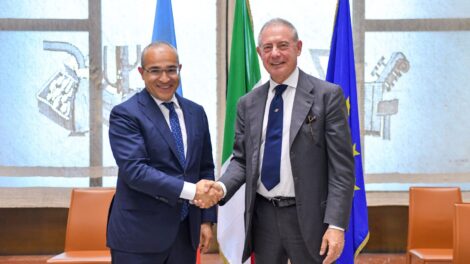
“Mr President, we are living through a historical phase marked by instability without precedent. According to the Global Peace Index 2025, this is the worst situation since World War II,” Crosetto said.
The global security landscape at a glance. According to Global Peace Index 2025’s data:
- 59 active conflicts worldwide
- 78 states involved in wars beyond their own borders
- 17 countries that in 2024 alone recorded more than 1,000 conflict-related deaths
Why it matters: The minister’s words are not mere rhetoric. They point to a reading of the international environment as a systemic crisis rather than a collection of isolated regional conflicts. This shift in perspective has direct implications for how Italy conceives and organises its military instrument.
The big picture: Crosetto emphasised that public attention tends to focus mainly on Ukraine and the Middle East, while the true novelty lies in the broader context. “The overall framework is unprecedented in the post-war period,” he explained, highlighting the speed at which crises evolve and multiply.
- This, in his view, makes it necessary to fundamentally rethink the military instrument: “We are called upon to build a force capable of operating effectively in a domain that changes every day, in a context that changes every week, with conditions that shift too rapidly.”
Between the lines: For the Minister, the real challenge is not only responding to crises, but preventing them.
- “Once crises erupt, as current ones demonstrate, it becomes increasingly difficult to stop them. And when they do stop, it is even harder to heal the wounds,” he said, citing Kosovo as an example of an international mission that has lasted for decades without eliminating the root causes of instability.
- Crosetto also pointed to the growing role of hybrid warfare and external actors: “There are actors who influence national situations from the outside. Hybrid warfare is not played out only on the Ukrainian chessboard, but also in Africa, the Middle East and the Balkans.”
- This, he warned, requires Italy’s defence posture to adapt rapidly — a point also made by President Mattarella on Monday, speaking at a year-end event with ambassadors.
The technological dimension adds another layer of risk. The minister recalled how a recent cyberattack showed that “a civilian ship carrying 650 passengers can be turned into a potentially destructive instrument.”
- He added, “Just imagine if that ship, instead of passengers, were carrying gas or oil, once someone takes control of it,” underscoring the potential impact of cyber warfare on critical infrastructure.
Zoom out — In Gen. Portolano’ words. If Crosetto outlines the political and strategic framework, Chief of Defence Staff General Luciano Portolano provides its operational translation.
- Today, Italy is the leading European contributor to international military missions, both within NATO and the European Union, and also the leading provider of blue helmets among Western countries.
By the numbers – Italy’s overseas military footprint:
- 7,400 personnel deployed
- 17 operations and 22 missions
- Presence in 25 countries
“Military operations conducted as part of the missions assigned to the Armed Forces represent the true core business of Defence,” Portolano explained, stressing that he is a direct witness to “the sacrifices made by our service members deployed across multiple theatres of operation, an effort carried out with a strong sense of duty and responsibility, often in extreme operational, environmental and climatic conditions.”
- “Our soldiers, sailors, airmen, Carabinieri and Guardia di Finanza personnel, far from their loved ones, ensure a constant and valuable contribution to Italy’s interests and to the security of Italians,” he added, noting that they offer “in every circumstance the finest image of our country abroad.”
The takeaway: In outlining the strategic environment, Portolano described an international security context that is complex and unpredictable, shaped by a fluid set of circumstances and challenges affecting virtually every part of the world, with direct and indirect consequences for national security.
What’s next? The message that emerges is consistent: faced with a more unstable and fragmented world, Italy is responding through operational presence, adaptability, and the integration of military, technological, and strategic dimensions.
- As Crosetto put it, this means asking service members to change their mindset every month, every week, because the nature of confrontation and threats evolves at the same pace.