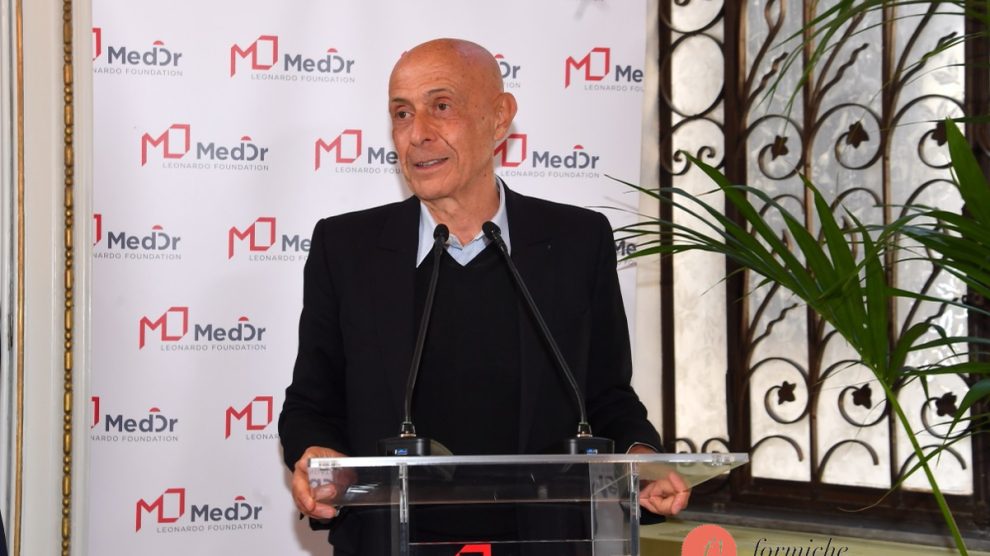
As wars persist in the heart of Europe and the Mediterranean, and strategic competition intensifies among major powers, Minniti argues that the West — and Europe in particular — can no longer interpret reality through the lenses of the past.
Why he matters: A former Italian Interior Minister and long-time strategist on security and international affairs, Marco Minniti has consistently emphasized the link between geopolitical shifts, internal stability, and global power transitions. As President of the Med-Or Italian Foundation, his analysis bridges security, diplomacy, and the Global South, offering a systemic reading of how unilateralism, narrative warfare, and power realignments are reshaping the international order.
Q: You often speak of a change already underway, marking the definitive end of an old international balance. What are the defining features of this phase, and why can it no longer be read through the categories of the past?
A: Everything that is happening is the sign of a deep process affecting the planet as a whole. We are witnessing, even in these days, what we can define as a change of era: nothing will be the same as before. An old balance has ended forever, even though we do not yet glimpse the prospect of a new world order. But this process did not begin now; it has already been underway for some time. After all, the fact that two wars have been taking place simultaneously — one in the heart of Europe and another in the heart of the Mediterranean — was already a very clear signal of this historic fracture. Nothing that belongs to the past will return, and continuing to interpret what is happening through old lenses risks leading us astray.
Q: In a few days it will be exactly one year since Donald Trump’s return to the White House, and perhaps his leadership is part of the dynamics mentioned above. In what ways is the new administration distinguishing itself, and what role does narrative play in current US foreign policy?
A: The choice made on November 5, 2024 by the American people, electing Donald Trump by majority, expressed the willingness to agree with a profound change in the United States’ approach to the world, summed up in the slogan “America First.” This does not mean a return to isolationism, because in a totally interconnected world the leading economic and military power cannot isolate itself. Rather, it means a radically unilateral approach, which clearly affects relations with others.
- And in this Trumpian dimension, storytelling weighs as much as action, sometimes even more, so much so that even when the United States has played a mediating role, the narrative has always been that of the other side’s surrender.
- This happened, for example, in the case of direct contacts with the Houthis: Trump negotiated safe passages solely and unilaterally to protect US interests, but told the story that the Houthis had surrendered, while in reality they continued to bombard Israel to demonstrate that no surrender had taken place.
- The point is that the Yemenis had an agreement with the United States and, in practice, had settled accounts with Washington, but not with others.
- For the US, however, this was sufficient. This intertwining of action and narrative is an integral part of the radical unilateralism of today’s America, also demonstrated by the unilateral US withdrawal from 66 international cooperation agencies.
Q: Here, Venezuela — with the arrest of regime leader Nicolás Maduro — seems to become the testing ground for this new doctrine. What is the logic behind this operation, and what risks does it entail?
A: While making it clear that I feel no nostalgia whatsoever for “dictator Maduro” and that condemnation of that system must be unequivocal, the Venezuelan affair is an evident expression of this radical unilateralism, which Trump translates into the so-called “Monroe Doctrine.” Originally, the Monroe Doctrine served to prevent European powers from exerting influence in Latin America; today, the principle is reinterpreted in a new key, with regard to China, Russia and, in certain respects, Iran.
- We are not facing a “regime change” but a “regime adjustment” — that is, not a change of regime but an adjustment of the regime, consistent with American interests.
- Opposition figures such as Edmundo González Urrutia and María Corina Machado have in fact been sidelined: the former has not even been mentioned, despite having been considered the winner of the previous elections, while of the latter the American president said that she does not have the respect of her country.
- Trump has triggered a modification of the internal power balances of the Maduro system. It is a challenge that makes one’s blood run cold, because the military operation, although technically exceptional, was the simplest part.
- Now the complex phase concerns the management of internal power: Delcy Rodríguez will have to build new balances with the other factions of the regime, from Interior Minister Diosdado Cabello, who represents the socialist wing, to Defense Minister Vladimir Padrino López, whose very name evokes historical ties with Russia.
- But beware: democratic transition, in the plan proposed by the Trump administration, is the final phase — probably not even considered necessary — as long as the regime aligns itself with America First interests.
Q: The latest news tells us that Caracas has begun the process of releasing Venezuelan and foreign political prisoners. What does this mean?
A: It is certainly a positive and important signal. The hope is that the release of all political prisoners can proceed, and therefore of all Italians unjustly detained in Venezuela. And here the thought immediately goes to Alberto Trentini.
- Then the explanation of the gesture provided by the Venezuelan authorities gives the clearest sense of what regime adjustment means.
- It is no coincidence that the president of the Venezuelan National Assembly, Jorge Rodríguez, brother of Vice President Delcy Rodríguez, spoke of a unilateral act of national pacification that speaks to the world.
- While it is evident that there has been American and international pressure on this type of situation, there was also an intention to publicly thank three mediators:
- first, former Spanish prime minister Zapatero, historically a point of connection between Maduro’s Venezuela, Spain and Europe as a whole;
- President Lula of Brazil, who at this moment, also in the collective imagination of South America, represents the strongest alternative to the Monroe Doctrine;
- and finally Qatar, which once again confirms itself, in a scenario very far from the Middle East, as the “necessary friend” that cannot be done without in all borderline situations around the world.
- In essence, there is a highly significant novelty — the release of prisoners — and everything is explained within a framework of continuity of the system, both through the acknowledgements and through the announcement of the unilateral act. This is the deep meaning of regime adjustment.
Q: What risks does this entire process entail?
A: The risk is that someone may have negotiated with the United States and that this suspicion becomes an internal political weapon, fueling the anguish of betrayal and undermining the unity of the ruling group, while opening space for claims by armed groups that benefit from destabilization.
- Let us not forget in this regard the internal factions of the regime or the groups just across the Colombian border such as the FARC and the ELN, the highest and most organized expression of armed guerrilla warfare.
Q: If the process were to generate instability or insurrection, would the United States be ready to assume direct responsibility, even militarily? And how does all this square with MAGA ideology?
A: Here a clear contradiction emerges. If the transition were to go badly and produce destabilization, the question is precisely this: can Trump’s United States assume military responsibility for a country that could slide into conflict and become a strategic problem?
- This clashes with one of the founding elements of MAGA thinking: criticism of the United States acting as a global promoter of democracy.
- Recent history teaches us that the West has been good at overthrowing brutal dictatorships, but much less effective at managing what comes next. Libya, Iraq and Afghanistan are glaring examples. The idea of no longer spending American blood and resources on this type of operation is an integral part of the formation of Trumpian thought.
- There are those, such as Defense Secretary Pete Hegseth, who argue that Venezuela is not Iraq, but the question remains open: are we really sure that a scenario of structural destabilization is not possible?
- Meanwhile, let us not forget that last night five Republican senators joined Democratic lawmakers in voting to advance legislation that would require the Commander-in-Chief to seek congressional approval before undertaking any further military action in Venezuela.
Q: In this equation, oil appears to be one of the central factors. Between rising prices and early signs of cooperation from Venezuela’s PDVSA, how much does crude oil matter?
A: Bringing US oil majors back into Venezuela is a clear objective, but rebuilding extraction capacity and exploiting the country’s enormous oil potential — the largest in the world — requires investments estimated at around $100 billion. We are talking about years, not months. An immediate exchange is possible, but full-scale production takes time, and the majors themselves are asking for guarantees.
- Trump, who always favors immediate narratives, is aware of this and has accordingly calibrated his rhetoric on this front. At the same time, one of the key elements of his energy policy has been the attempt to keep oil prices below $50 per barrel, because American consumers are very sensitive to fuel prices.
- Could he succeed in the short term? It is a challenge, because there are also studies indicating that the continuation of the Venezuelan embargo could instead drive prices up. Here too, everything moves on a razor’s edge.
Q: What are the consequences of all this for Russia and China?
A: The loss of influence in Venezuela produces significant effects, especially for Russia, which had extremely deep relations with Caracas. It is a sharp blow. The same applies to China, which is linked to Venezuela primarily through oil. But for Beijing the discussion does not stop there: radical American unilateralism in Latin America can push other countries in the region to strengthen ties with China, starting with Brazil.
- It should not be forgotten that Chinese leader Xi Jinping was the absolute protagonist of the G20 in Brazil, with the proposal of the Bi-Oceanic Corridor to connect the Pacific and the Atlantic.
- In Brazil’s case, however, the geopolitical dimension also intertwines with a delicate internal political contest: President Luiz Inácio Lula da Silva sees Trump as the main international sponsor of his political rival Jair Bolsonaro, currently detained in Brazilian prisons and for whom Trump has called for a pardon.
- As a result, the relationship with the new US administration takes on an almost existential value for the Brazilian president.
Q: American unilateralism could also imply an implicit recognition of other global spheres of influence. What effects does this message have on major open strategic dossiers?
A: More generally, when Trump states that there is a Western Hemisphere in which the United States “deals the cards,” he implicitly acknowledges that there are others in which different actors operate with different degrees of centrality.
- China, for example, understood immediately after the fall of the Berlin Wall that the contest was no longer US-USSR but Washington-Beijing. Since then, it has followed the strategy of “hide your capabilities and bide your time.” In this framework, Venezuela strengthens China’s position, and Beijing could feel more confident on the dossier it considers its top priority: Taiwan.
- The same pattern is reflected in Russia with regard to Ukraine. Here too, the time factor is central. The entire Western debate today is built around the hypothesis of a ceasefire, which Moscow has categorically rejected.
- The recent meeting of the “Willing” was important, and it is important to continue working on future security guarantees for Kyiv, but we are operating in a hypothetical realm because the fundamental prerequisite is missing.
- And Russia has just declared that any presence of European troops on Ukrainian territory could constitute a legitimate military target.
- We should not forget that even autocratic leaders have a deep sense of politics: Vladimir Putin, in the twelve months preceding the US elections, maintained a surprisingly low profile, waiting for the outcome of the vote. I
- n a context marked by crucial elections in the West over the past year and by a perception of fragility within the Euro-Atlantic camp, waiting may appear — from a Russian and Chinese point of view — a rational choice in order to negotiate in the future from a position of greater strength.
- All of this, of course, without renouncing military pressure, including through the deployment of new weapons systems such as the Oreshnik hypersonic missile, positioned also in Belarus.
Q: Another current issue, broadly linked to everything discussed so far, is US attention toward Greenland and the implicit message to Europe. What does this tell us about transatlantic relations and the role of the European Union?
A: Looking at Greenland, for Trump, means sending a message to Europe: you are taken into account, but you are marginal. This is consistent with what is written in the National Security Strategy, which refers to the risk of the decline of European civilization. In radical American unilateralism, no one is spared, not even NATO. Let us recall that one of the last acts of the previous Democratic majority was to bind any unilateral US withdrawal from NATO to a congressional vote.
- Greenland has above all an economic and geostrategic value: rare earths, melting ice, new routes. The United States is opening to the logic of free association agreements, seeking a direct relationship with the local Inuit population and excluding Denmark.
- This is something that has already occurred with some Pacific islands. But it is interesting to note that after Trump’s statements, local parties favoring stronger ties with Copenhagen gained strength in the latest elections. This shows that risks are always present.
Q: In this scenario, what room does Europe have?
A: European leaderships must understand that the American strategic choice should not be experienced as a threat, but as an existential and irreversible challenge. If the idea takes hold that each European country can respond better on its own to radical American unilateralism, then the game is lost from the start.
- A telling example is Hungary: the upcoming elections, expected by April, represent a crucial turning point, because for the first time Viktor Orbán does not start as the frontrunner.
- This is where the European Union should demonstrate that it has a recognizable political identity and the capacity to exert influence, not only internally but also externally. European leadership should act as a support base for Hungarian pro-European forces, against one of the Union’s main vulnerabilities.
- And it is through unity that Europe can play a central role, especially in its relationship with the Global South. There is a part of the world that looks to the European Union as an indispensable interlocutor.
- This is why it is fundamental, for example, that the assembly of EU ambassadors approved the agreement with Mercosur, with — in light of France’s opposition — the important favorable vote of Italy.
The bottom line: “While hard power prevails, European soft power remains reassuring. But to make it work, a new idea of Europe is needed, capable of holding together internal challenges and global projection,” Mr Minniti said.
- “Only in this way can our continent play a central role in the new world order — which, let us remember, cannot be built without the Global South, and the Global South cannot be left entirely in the hands of China and Russia.”