As Taiwan’s role in global technology supply chains becomes increasingly strategic, European countries are reassessing how economic security, industrial policy and geopolitics intersect. Italy’s parliamentary mission to Taipei highlights Rome’s efforts to position itself within this evolving landscape.
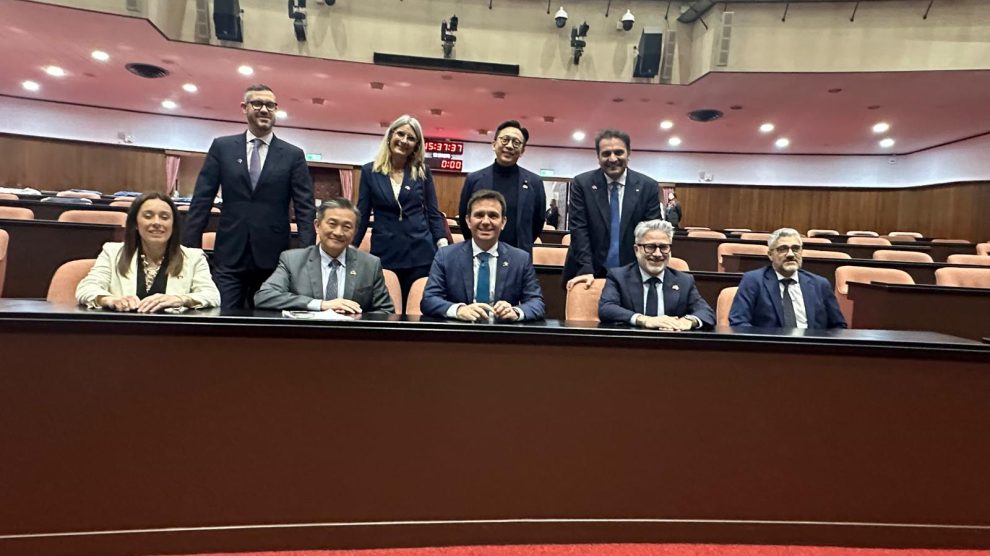
The mission: From 8 to 12 January 2026, a large and politically diverse Italian parliamentary delegation visited Taiwan. The mission was led by Alessandro Cattaneo, a member of Italy’s lower house and of the European People’s Party, and included MPs from six different parties.
- Cattaneo stresses that the visit was “not symbolic,” describing it as evidence of broad parliamentary interest, cutting across party lines, in understanding Taiwan and the wider Indo-Pacific context. He frames the delegation’s political diversity as proof of a shared institutional willingness to engage with Taipei “beyond party affiliations.”
What they did: The delegation met senior Taiwanese officials, including the foreign minister, the deputy defence minister, the minister for economic development and parliamentary leaders.
- Cattaneo describes the level of interlocutors as “extremely high” and recalls visiting Taiwan’s democratic institutions as an experience that was, in his words, “emotionally striking.” He portrays Taiwan as a “young but strong democracy,” conscious of its history and identity despite constant pressure from China.
Zoom in: technology and security. Technology was central to the mission. Cattaneo says the delegation set out to explore artificial intelligence and semiconductors, noting his own background as an electronic engineer and Taiwan’s global leadership in the sector. His assessment is blunt: Taiwan, he says, is “five years ahead of its direct competitors.”
- He points to what he considers a decisive figure: around 95% of microprocessors used for artificial intelligence originate in Taiwan. For Cattaneo, this explains why “to deal with Taiwan means dealing with the most strategic asset in the world.” Supply chains and microchips, he argues, are no longer neutral.
- Control over data centres, big data and advanced processors, Cattaneo adds, increasingly translates into strategic influence over knowledge, social development and political models.
The bigger picture: Pax Silica. This reading closely mirrors the logic underpinning the U.S.-backed Pax Silica initiative, which seeks to reorganise technological supply chains among like-minded partners. The concept is built on the assumption that economic security and national security are now inseparable, treating silicon, computing power, critical minerals and energy as shared strategic assets.
- While Italy is not a formal architect of Pax Silica, Cattaneo’s remarks align with its core premise: control over AI and semiconductor value chains is no longer just an industrial issue, but a systemic one for democratic resilience. In this sense, Taiwan sits at the centre of an emerging geopolitical architecture where technology, security and alliances increasingly overlap.
Between economics and values: Cattaneo also underlines Taiwan’s economic performance, recalling annual growth of around 7.5% and describing its fundamentals as “textbook-solid,” with significant room for further expansion. He notes that Italian companies are already present on the island, from food and fashion to machinery and logistics.
- A concrete signal of this momentum is the recent opening of the Italian Chamber of Commerce in Taiwan. Cattaneo highlights that around sixty Italian industrial players joined within weeks, reading this as evidence of strong mutual interest. He stresses that Taiwan views Italy as a reliable industrial partner and points to a sense of natural affinity between the two sides.
What we’re watching: Cattaneo places the Taiwan mission within a broader Italian trajectory in the Indo-Pacific. He cites recent trips by Prime Minister Giorgia Meloni to Japan and South Korea, as well as defence-related engagements in South and Southeast Asia, as part of a coherent strategic direction.
- For him, the conclusion is straightforward: Italy cannot afford to ignore the Indo-Pacific.
- The Taiwan visit, he argues, adds substance to Italy’s regional presence and is intended to translate into longer-term projects that combine strategic interests with shared democratic values.