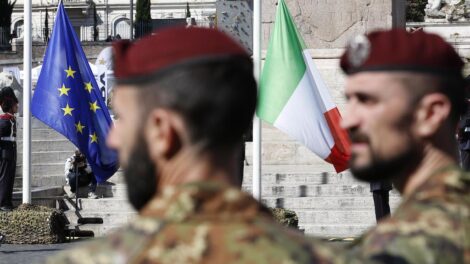
Rome and Berlin are moving beyond coordination toward a structured strategic partnership, signing new agreements on competitiveness, defense and resilience — and positioning themselves as agenda-setters inside the EU.
Decoding the news: Italy and Germany have concluded a high-level intergovernmental summit in Rome, with Prime Minister Giorgia Meloni and German Chancellor Friedrich Merz overseeing the signing of a package of political and operational agreements aimed at deepening bilateral cooperation.
At the core of the summit was the adoption of a Protocol launching a reinforced strategic cooperation Action Plan, alongside:
- a security, defense and resilience agreement,
- a joint document on European competitiveness, which Italian officials say will be formally transmitted to the European Commission ahead of the Feb. 12 informal EU meeting on competitiveness.
The summit was followed by a joint plenary session, press statements and the leaders’ participation in the Italy–Germany Business Forum in Rome.
Why it matters: The summit marks a shift from ad hoc coordination to institutionalized cooperation between Europe’s two largest manufacturing economies.
- Rome and Berlin are aligning not only bilaterally, but also feeding joint policy input directly into EU-level decision-making.
- The move comes amid broader efforts to rebalance Europe’s internal leadership dynamics and accelerate reforms on competitiveness and security.
By the numbers:
- Bilateral trade exceeded €153 billion in 2024.
- Combined German FDI in Italy and Italian FDI in Germany now surpass €100 billion, underlining the depth and balance of the relationship.
- Italy and Germany remain each other’s most important industrial partners within the EU.
What was agreed:
- Competitiveness and industrial policy: Italian sources describe the joint competitiveness document as a shared push by Europe’s two main manufacturing powers to reduce bureaucracy, speed up approval procedures and strengthen the single market. The paper calls for a more ambitious EU trade policy and will feed into discussions at the February European Council.
- Security, defense and resilience: The newly signed agreement on security, defense and resilience introduces a more structured coordination between the two administrations and aims to deepen industrial cooperation. Italian officials frame it as a concrete contribution to European security, with a focus on interoperability, production capacity and long-term deterrence.
- Defense industry cooperation: Officials point to existing and emerging industrial platforms as the backbone of the partnership, including land systems cooperation and joint projects in advanced defense technologies. The goal, according to Italian sources, is to move from cooperation to shared capability-building at European level.
- Energy and hydrogen: Energy remains a priority pillar, with Italy and Germany among the core partners of the Southern Hydrogen Corridor linking North Africa to Central Europe. Italian officials describe the project as both an industrial opportunity and a strategic infrastructure for Europe’s energy transition and security.
- Africa and external projection: A notable upgrade concerns cooperation in Africa. Italian officials confirm the launch of new joint projects in the central Sahel and the Lake Chad region, integrating Italy’s Mattei Plan with German development initiatives.
- The summit also institutionalized a bilateral dialogue on humanitarian assistance, stabilization and development cooperation, reflecting what sources describe as a “shared strategic interest” in Africa.
- Agriculture: Agriculture formally enters the list of priority areas under the bilateral Action Plan, reflecting a broader focus on food security, supply chains and sustainable transitions.
- Digital, innovation and research: The Action Plan reinforces cooperation on research, innovation, artificial intelligence and emerging technologies, with Italian officials stressing the need for simpler EU digital rules and stronger European technological sovereignty.
The business angle. The Italy–Germany Business Forum, held alongside the summit, brought together companies and policymakers for sectoral sessions and B2B meetings covering advanced industry, infrastructure, energy, defense, transport and aerospace.
- The forum concluded with joint interventions by Meloni and Merz, underlining what Italian sources describe as a “fully aligned political and industrial track.”
Between the lines: German media have increasingly portrayed Meloni as a central European partner for Merz.
- According to Handelsblatt, Rome is emerging as Berlin’s closest ally as tensions persist in the Franco-German relationship, particularly on industrial and energy policy.
- Der Spiegel has reported on a joint Italy–Germany policy paper advocating sweeping cuts to EU bureaucracy, deeper capital markets integration and a more assertive EU trade agenda — a framing Italian officials privately embrace as evidence of a “new center of gravity” inside the Union.
What they’re saying:
- “The two main manufacturing economies of the European continent are the foundation of the competitiveness and resilience of the European Union’s industrial base,” said PM Meloni.
- “Our objective is to protect peace and stability in Europe. Our partnership is not exclusive, but rather aims to include other like-minded allies and partners.”
- “We underscore our commitment, as NATO Allies, to maintaining credible deterrence and defense against all threats to Euro-Atlantic security, while at the same time strengthening the European pillar of the Alliance and remaining united in our support for Ukraine in its defense against Russian aggression, added Chancellor Merz.
- “We share the responsibility, as founding states of the European Union, to work to promote European integration, enabling the European Union to act effectively in order to protect European values and interests.”
What’s next: Italian officials say the Rome summit formalizes a medium-term trajectory rather than a one-off alignment. The immediate next step will be bringing the joint competitiveness agenda to Brussels on Feb. 12, while implementing the new Action Plan across defense, energy, Africa and industrial policy.
The bottom line: The Rome summit elevates the Italy–Germany relationship into a pragmatic, results-oriented strategic partnership — designed to shape EU policy from the inside while strengthening Europe’s economic and security foundations.