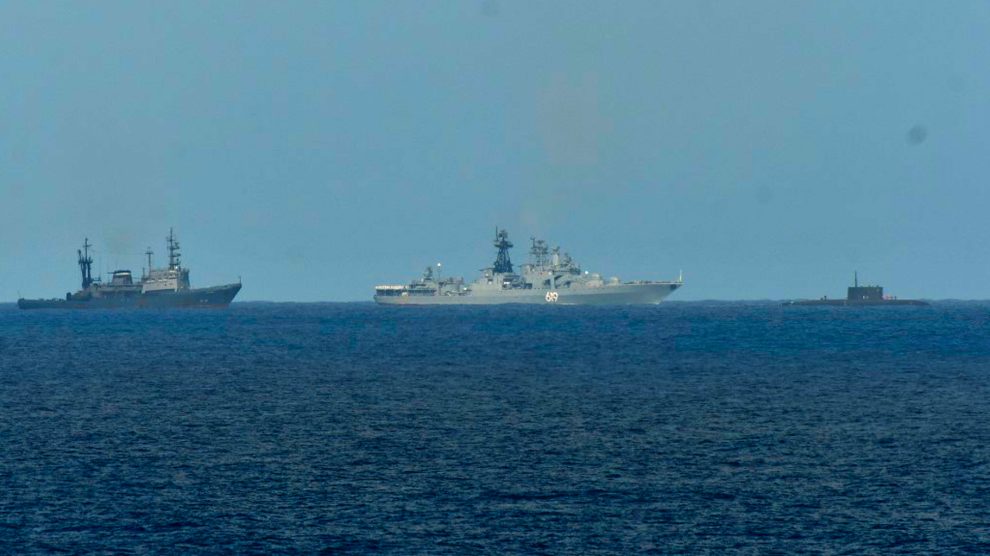
Decoding the news: The Mediterranean is once again at the center of strategic competition between NATO and Russia. Close monitoring of Russian military assets by the Alliance, combined with actions targeting Moscow’s so‑called “shadow fleet,” marks a qualitative shift in maritime vigilance and strategic communication.
The news: A vessel from Standing NATO Maritime Group 2 (SNMG2), the Italian frigate Virginio Fasan, monitored and shadowed the Russian Kilo‑class submarine Krasnodar in the Mediterranean, escorted by surface units including the destroyer Severomorsk.
- NATO Maritime Command directly released the news and images of the operation.
- This was no coincidence: the Alliance is deliberately increasing the visibility of its surveillance and deterrence activities against Russian interference at sea.
Why now: The decision to publicize the operation reflects NATO’s increasingly assertive communication posture.
- Not just operational deterrence, but narrative deterrence.
- The aim is to demonstrate situational awareness, readiness, and coordination—especially in a space like the Mediterranean that is increasingly exposed to hybrid pressure.
Zoom in – Virginio Fasan: The Italian unit referenced by NATO is a FREMM frigate configured for Anti‑Submarine Warfare (ASW), built by Fincantieri, commissioned in 2013, and based in La Spezia. In recent years it has operated continuously between the Mediterranean and the Red Sea, from Operation Mediterraneo Sicuro to the protection of commercial shipping against Houthi attacks, including the downing of a drone near Bab el‑Mandeb during the EU mission Aspides. The ship’s operational profile reinforces NATO’s message: advanced technological capabilities, readiness, and sustained presence.
The big picture – SNMG2: Standing NATO Maritime Group 2 is one of the Alliance’s permanent naval forces.
- It operates primarily in the Mediterranean and the Black Sea.
- It monitors vital sea lines of communication linking Europe, the Middle East, and North Africa.
- Alongside SNMG1, it forms the backbone of the NATO Response Force’s maritime component and the Alliance’s Cooperative Security approach.
Not just at sea: NATO’s vigilance posture extends beyond the maritime domain.
- In 2025, allied air forces conducted more than 500 scrambles along the eastern flank and in the Arctic.
- Italy also contributes to Baltic air policing with Eurofighter aircraft deployed at Ämari.
- Integrated deterrence: sea, air, and strategic communication.
Meanwhile, in the Mediterranean: The regional picture is becoming more complex.
- A tanker suspected of belonging to Russia’s shadow fleet was seized near Marseille.
- Off the coast of Crete, Ukrainian drones struck a Moscow‑linked vessel—the first attack on a “dark fleet” ship outside the Black Sea.
What it shows: The Mediterranean has become a space of energy and geopolitical competition.
- The Suez–Gibraltar route is increasingly crossed by opaque trafficking aimed at evading sanctions.
- The maritime dimension of the war in Ukraine now extends well beyond the Black Sea.
Between the lines: The Mediterranean is now one of the main theaters where security, energy, and strategic competition intersect.
- From tracking Russian submarines to targeting shadow fleets.
- From military deterrence to managing hybrid threats.
- NATO is signaling its intent to control this space not only with ships, but also through transparency and communication.
(Photo: X, @NATO_MARCOM)