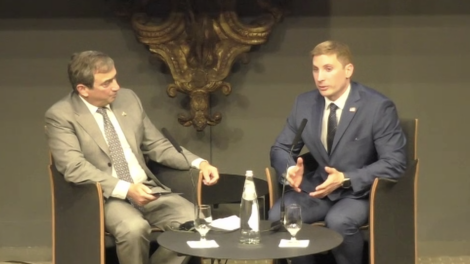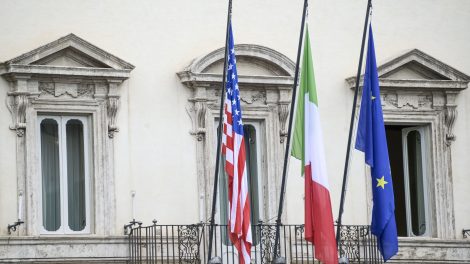
In this context, Italy has carved out a leading role as Foreign Minister Antonio Tajani was the only European to deliver remarks during the opening session. This is not just a matter of diplomatic visibility. Italy’s prominent role strengthens transatlantic coordination at a time of tensions and mistrust, and places Rome at the center of a decisive moment in the contest for industrial competitiveness, strategic autonomy, and the geopolitical weight of the west.
Opened by Vice President J. D. Vance, the summit signaled a strategic shift: critical minerals are no longer merely a technical supply issue, but a central pillar of international industrial policy. This is a solid foundation for new alliances aimed at de-risking from China. After a year of strained transatlantic ties, the summit offers a chance to rebuild Western cohesion around shared vulnerabilities. From defense to clean energy and advanced manufacturing, technological leadership now depends on resilient, diversified, and politically trusted supply chains.
The proposal emerging from the summit was a preferential trade agreement for critical minerals among allies, including coordinated price thresholds aimed at reducing China’s dominance. The plan aims to spur private investment in mining and processing, sectors that cannot compete with cheaper Chinese supply, and to shape supply chains for materials vital to EVs, semiconductors, and defense, However, these measurescould raise costs in the short term heightens trade tensions with Beijing. This issue is a long-standing priority for Secretary Rubio, who together with Senator Mark Warner, promoted bipartisan legislation to strengthen domestic and allied supply chains, calling for greater U.S. support for mining and processing and warning that China’s dominance creates serious strategic vulnerabilities.
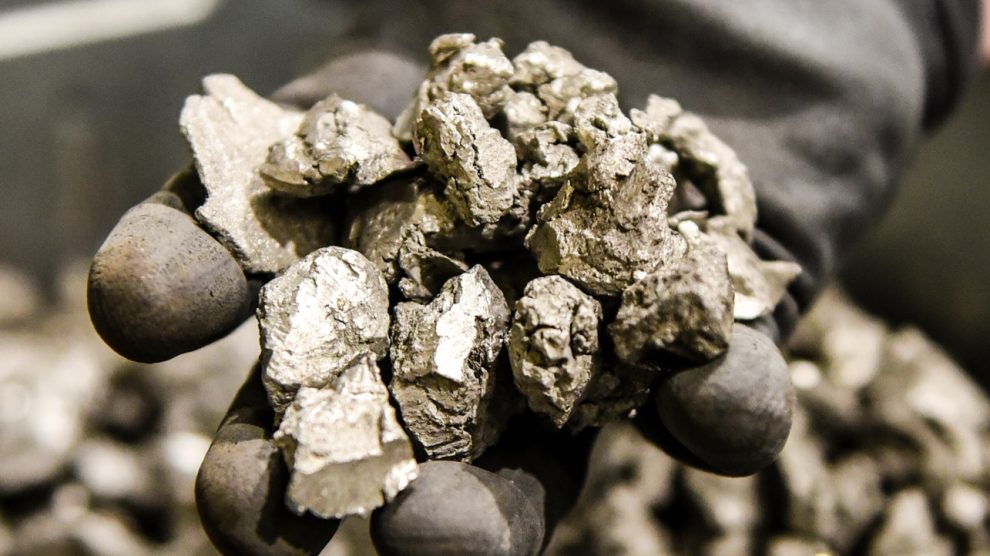
China dominates the global production and processing of critical minerals, controlling output in 19 of 20 key strategic materials and holding an average refining market share of around 70%, according to the Export-Import Bank of the United States’ Supply Chain Resiliency Initiative. This includes more than 60% of rare earth mining and over 85% of processing capacity, giving Beijing significant influence over market conditions and turning industrial dependence into geopolitical leverage. China’sstructural dominance is reinforced by state subsidies, export controls, and market intervention, enabling it to generate supply disruptions and price volatility.
The meeting is aligned with Pax Silica, a U.S.-led initiative launched in December 2025 to secure supply chains for AI, semiconductors, and critical minerals, reducing dependence on China. It marks a shift from managing interdependence to actively shaping value chains through state-backed financing, strategic offtake agreements, and allied coordination. It marks a shift from the passive management of interdependence to direct intervention in value chains through public funding, long-term purchasing agreements, and coordination among allies, reinforced by strategic stockpiling programs. These efforts are further supported by new strategic storage initiatives such as Project Vault. The strategy thus integrates supply security into U.S. foreign economic policy, with a key role played by the Export-Import Bank of the United States, which allocated, just a few days ago, $10 billion to establish a Strategic Critical Minerals Reserve.
To achieve these goals, the United States needs to coordinate with the EU and other allies to build supply chains that are sustainable, strategically solid, and alternative to China. Meanwhile, the EU is trying to reduce risks through diversification and recycling under the Critical Raw Materials Act, but progress is slow and dependence on China, especially for rare earths and permanent magnets, remains acute. Of 26 priority minerals, 10 rely entirely on imports, and none of the 17 rare earth elements are mined within the EU, according to a recent report by the European Court of Auditors. Without secure access to critical raw materials, European competitiveness, the green transition, and strategic autonomy will remain difficult goals to achieve, as also emphasized in the Draghi Report.
For Italy, Europe’s second-largest manufacturing economy and the world’s fourth, secure critical mineral supply chains are vital for energy, digital technologies, and defense. Ahead of the meeting, Italy and Germany jointly urged the European Commission to accelerate efforts to reduce strategic dependencies. This dovetails with Italy’s Piano Mattei, which ties its Africa policy to Western supply chain security by positioning the country as a political partner, transit corridor, and industrial gateway for African resources.
Only a deeper transatlantic compact could turn “de-risking” into real industrial coordination through joint risk assessments, aligned policies, and shared stockpiling. At the same time, greater European processing capacity, especially recycling, would help gradually reduce external dependence. However, these goals must be backed by public funding on both sides of the Atlantic. Success depends on the ability to link economic security with industrial strategy and alliance policy, paving the way for resolving other outstanding issues in transatlantic relations.