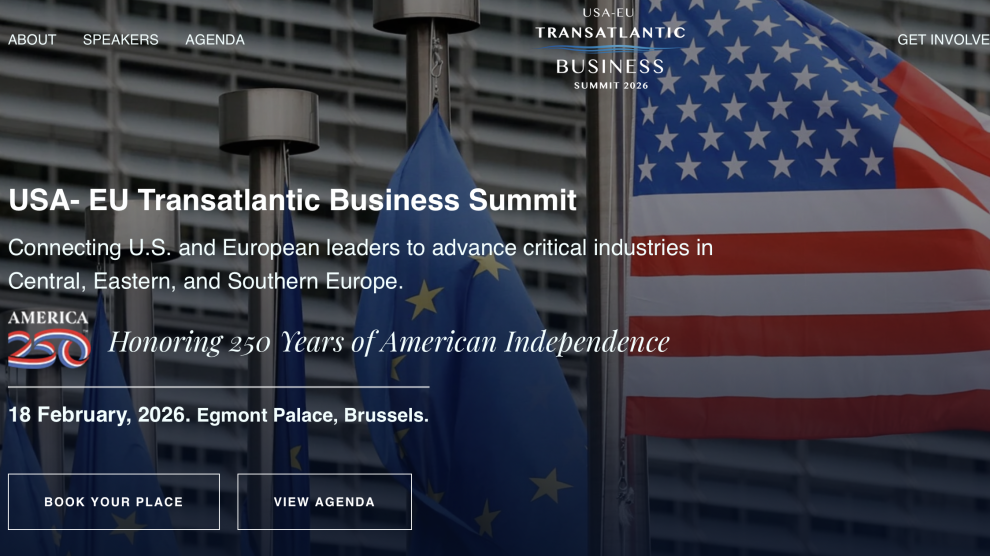
A summit at a critical moment. Organized by the Polish & American Women Entrepreneurs Association, with Formiche/Decode39 as media partner, the Brussels event aims to move beyond political declarations toward concrete forms of transatlantic cooperation in strategic sectors such as defense, trade, energy, health, food systems, manufacturing, and critical raw materials.
The initiative is part of a broader Western effort to strengthen supply-chain resilience and industrial competitiveness amid geopolitical fragmentation and intensifying economic competition. In this sense, the USA-EU Transatlantic Business Summit aspires to function as an operational platform as well.
Focus on deregulation, industry and energy. Discussions will focus in particular on deregulation, productive capacity, and energy — themes that have become central to European and American economic strategies following recent crises. The presence of senior public officials, corporate executives, and regulators is intended to connect policy frameworks with the operational needs of the productive sector (program available).
- “The transatlantic relationship remains the backbone of the global economy, but it must evolve to stay strong,” said Agata Golubiewska, President and CEO of the Polish & American Women Entrepreneurs Association and Summit Founder.
- “This Summit aims to translate shared priorities into tangible cooperation, while highlighting the growing strategic importance of Central, Eastern, and Southern Europe and stronger partnerships with Africa.”
The strategic role of Central and Southern Europe. One of the summit’s distinctive features is its focus on Central, Eastern, and Southern Europe, regions increasingly regarded as strategic pillars of the European Union thanks to their manufacturing capacity, energy infrastructure, and logistics networks. Their importance has grown as companies and governments seek to diversify supply chains and reduce dependencies on geopolitically risky areas.
Africa and Italy’s transatlantic bridge. At the same time, the agenda integrates a broader global perspective through the participation of African leaders and institutions. Africa is playing an expanding role in transatlantic economic relations, particularly in energy, critical raw materials, logistics, and emerging trade corridors.
- Within this context, Italy is asserting a leading role. In recent days, the Mattei Plan marked its two-year milestone at a summit in Addis Ababa that confirmed international interest in the initiative.
- Prime Minister Giorgia Meloni was also a special guest at the African Union summit held in the Ethiopian capital. One of the vectors of Italy’s Africa strategy internationalization is precisely cooperation in third regions, where Rome aims to act as a transatlantic bridge.
High-level participation. Speakers at the Brussels event include senior representatives from European institutions, the U.S. administration, academia, and industry.
-
- Among them are EU Commissioner for Health and Animal Welfare Olivér Várhelyi;
- Nigeria’s Minister of Trade and Investment Jumoke Oduwole;
- former Chairman of the U.S. Export-Import Bank Kimberly Reed;
- officials from the U.S. Department of Commerce; and representatives from the energy, manufacturing, and regulatory sectors.
- African business leaders and policymakers will contribute to discussions on infrastructure, energy development, and investment opportunities.
Women’s leadership in transatlantic dialogue. Beyond economic and geopolitical dimensions, the summit highlights women’s leadership in transatlantic dialogue, in line with the mission of the organizing association.
- The program includes panels dedicated to women-led enterprises and innovation, linking the theme to the celebrations of the United States’ 250th anniversary and to the growing role of women in shaping transatlantic economic and political networks.
- Partners and the “Semiquincentennial” framework: Institutional partners include America250.org — which is also connecting the anniversary with Italy under the “250/165” framework — as well as initiatives focused on economic deregulation in Europe and capacity-building in Sub-Saharan Africa.
- Their participation underscores the summit’s ambition to strengthen transatlantic ties while integrating emerging partners into a more interconnected economic framework grounded in a “Semiquincentennial” transatlantic friendship.
From alliance to operational platform. In a context where global trade is increasingly shaped by security considerations and geopolitical competition, the Brussels meeting aims to test whether transatlantic cooperation can evolve from a traditional alliance into a more flexible platform capable of addressing challenges related to supply chains, industrial policy, and strategic partnerships on a global scale.