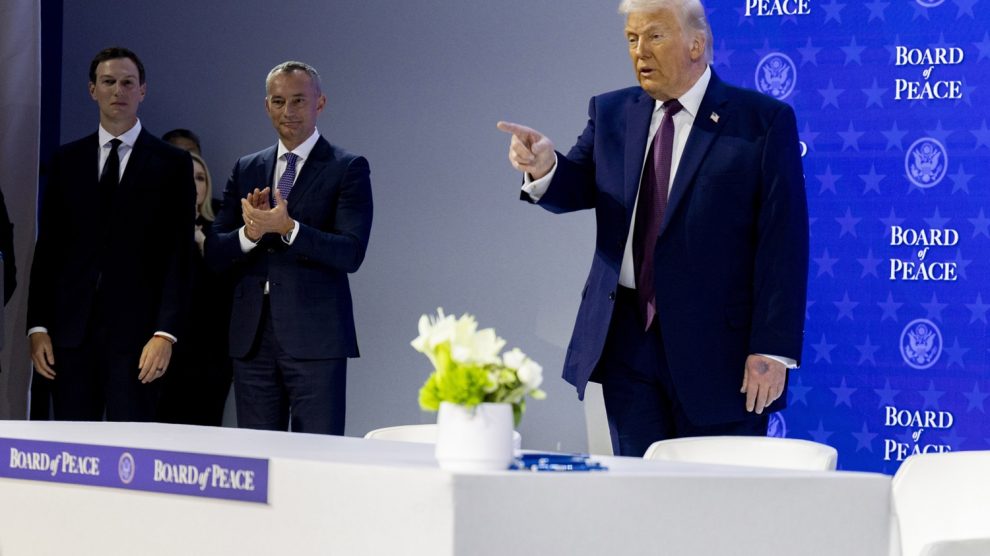
Decoding the news: Italy is the only major Western country trying to balance participation and distance from Donald Trump’s Board of Peace — joining as an observer to protect its Mediterranean interests while avoiding full endorsement of a controversial initiative many allies distrust, while involving key figures such as Foreign Minister and Deputy Prime Minister Antonio Tajani at today’s event in Washington, D.C.
What’s happening: Rome said constitutional constraints prevented full membership in international bodies where states are not on equal footing — a reference to Trump’s role as life chair with veto powers.
- “I am in Washington to represent Italy as an observer at this first meeting of the Board of Peace in order to be present when decisions are being made regarding the reconstruction of Gaza and the future of Palestine,” Tajani said during a visit to Tirana on Wednesday.
Zoom in: Italian officials framed the move as pragmatic rather than political alignment.
- Before the Board of Peace meeting, Tajani also met in Washington with Nickolay Mladenov — the U.S.-proposed director-general of the Board of Peace and former U.N. Special Coordinator for the Middle East Peace Process — a Bulgarian diplomat who has long overseen international coordination on Gaza.
- Tajani said he outlined Italy’s commitments on Gaza’s reconstruction, strengthening Palestinian institutional capacities, and ensuring food, health and education security for the Palestinian population.
- He highlighted Italy’s Food for Gaza initiative, developed with the FAO and the World Food Programme, as a set of operational tools that Rome is ready to place at the international community’s disposal.
What to watch, pragmatically: A European diplomatic source described the Board as imperfect, but currently the only concrete framework addressing Gaza’s stabilisation — a reality that made absence riskier than participation.
- Italy saw itself as a frontline Mediterranean actor that could not afford to be excluded from decisions shaping the region’s future.
- “We cannot fail to be part of a strategy that will continue to see us on the front line, listening to what is being done,” said Tajani,
Between Washington and Brussels: The decision triggered criticism at home and scepticism across Europe.
- Opposition parties accused Prime Minister Giorgia Meloni of excessive proximity to Trump, while several EU countries declined to join the initiative amid fears it could sideline the United Nations.
- Italy’s approach reflected a broader European dilemma: how to engage with U.S.-led initiatives without legitimising a parallel diplomatic architecture.
- “We must do what we have always done to build peace and stability in the entire Middle East,” add the Italian Foreign Minister.
The big picture: For Rome, the calculation was geopolitical.
- Participation allowed Italy to maintain influence over Gaza’s reconstruction, safeguard its Mediterranean role, and remain aligned with Washington — without formally endorsing a format that challenges traditional multilateralism.
- As one European diplomats put it, staying in the room mattered as much as shaping the outcome — this is also why the EU’s Mediterranean Commissioner Dubravka Šuica is present at the Board of Peace meeting in Washington.
.