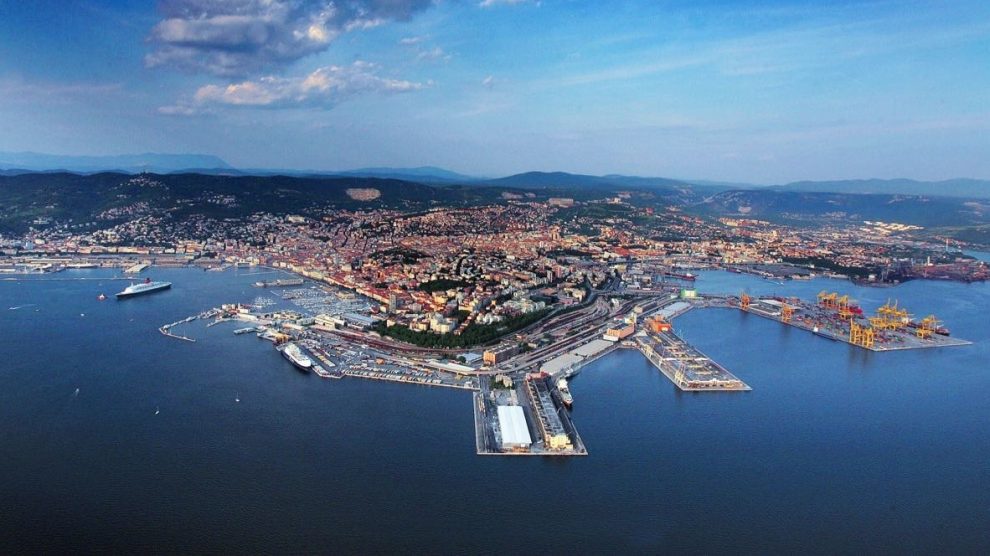
In the span of two days, the Adriatic city of Trieste is hosting three international gatherings that, together, illustrate how infrastructure, diplomacy, and regional cooperation are converging around a new geography of connectivity.
The big picture: A logistics and infrastructure forum organised by the Trieste Summit Association on March 16, an institutional conference on the India-Middle East-Europe Economic Corridor (IMEC) promoted by Italy’s Foreign Ministry on March 17, and the 30th anniversary conference of the Central European Initiative (CEI) are taking place within hours of each other in the northern Italian port.
- Taken together, the events offer a glimpse into Italy’s broader effort to position Trieste as a junction between European transport corridors and emerging Indo-Mediterranean connectivity networks.
Why it matters: Global competition over infrastructure, trade routes and supply chains is increasingly reshaping geopolitics.
- From the EU’s Global Gateway to China’s Belt and Road Initiative and the IMEC project announced in 2023, countries are competing not only through markets and technology but also through corridors linking ports, railways, digital networks and energy infrastructure.
- Trieste sits at a particularly strategic intersection of these dynamics.
- Historically, the main maritime outlet for Central Europe during the Habsburg era, the port today connects the Mediterranean with rail networks stretching into Austria, Germany and Central-Eastern Europe — making it a natural candidate for new connectivity strategies linking Europe to the Middle East and Asia.
Adriatic and Balkan connectivity. The first event, organised by the Trieste Summit Association (Formiche/Decode39 are media partners) under the title Priority Actions: Upper Adriatic Interoperability & Balkan Connectivity, focused on strengthening infrastructure coordination across the northern Adriatic and the Western Balkans.
- Ports, rail operators, logistics companies and infrastructure authorities discussed how to improve transport corridors connecting the Adriatic to Central and South-Eastern Europe.
- A key theme was the integration of the Upper Adriatic port system — including Trieste, Koper and Rijeka — with railway and logistics networks reaching into the Balkans and beyond.
- During the forum, Italy’s special envoy for IMEC, Ambassador Francesco Maria Talò, provided an update on the corridor initiative, highlighting how regional infrastructure planning in the Adriatic could intersect with broader connectivity strategies linking Europe with the Middle East and India.
Italy’s IMEC strategy. The following day, the focus shifts to the Indo-Mediterranean dimension.
- Italy’s Ministry of Foreign Affairs is hosting the Developing an Indo-Mediterranean Perspective through the IMEC Network forum at the Generali Convention Centre in Trieste.
- The meeting will open with remarks by Friuli-Venezia Giulia governor Massimiliano Fedriga and Italy’s deputy prime minister and foreign minister, Antonio Tajani.
- Government officials and institutional representatives from Europe and the Middle East are expected to take part, including Romania’s foreign minister, Oana Țoiu, and the UAE minister of state, Saeed Alhajeri, alongside European and international economic actors.
- The forum will present Trieste as a potential European hub within the IMEC framework and explore three key pillars of corridor development: logistics and transport of goods, digital connectivity and energy infrastructure.
Central Europe in focus. Trieste will also host the conference marking the 30th anniversary of the CEI Executive Secretariat, an organisation created in the early 1990s to foster political and economic cooperation among Central European and Balkan countries.
- Foreign ministers from across the region — including Romania, Serbia, Ukraine, Moldova, Slovenia, Croatia and Bosnia and Herzegovina — are expected to attend the gathering.
- The conference will examine the role of regional cooperation in advancing European integration and strengthening connectivity across Central and Eastern Europe.
- For Italy, which hosts the CEI Secretariat in Trieste, the anniversary event underscores the city’s longstanding function as a diplomatic and institutional bridge between Western Europe, the Balkans and Eastern Europe.
The strategic takeaway: Seen together, the three events map three overlapping layers of regional cooperation.
- The first concerns infrastructure integration across the Adriatic and Western Balkans.
- The second reflects Europe’s broader effort to develop new corridors connecting the Mediterranean with the Gulf and the Indo-Pacific through IMEC.
- The third highlights the continued importance of Central European cooperation frameworks such as the CEI in supporting regional stability and EU integration.
All three converge in Trieste. For Italy, that convergence is not accidental. It reflects a strategic effort to transform the historic Adriatic port into a platform where European, Mediterranean and Indo-Pacific connectivity initiatives intersect — and where infrastructure diplomacy increasingly shapes geopolitical influence.