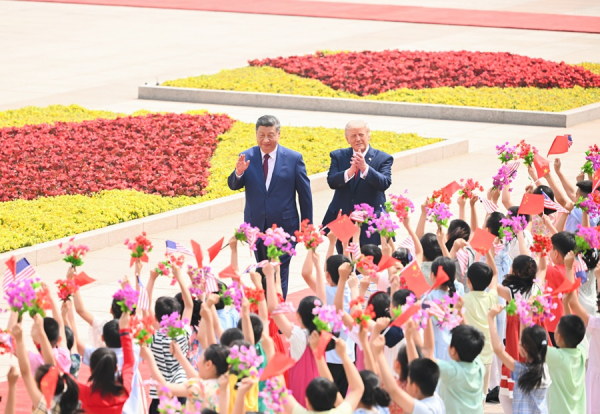
The first signals emerging from the summit between Donald Trump and Xi Jinping suggest Beijing is reconsidering the costs — though not necessarily the foundations — of its relationship with Iran after Tehran’s decision to militarize the Strait of Hormuz collided with Chinese energy interests and complicated the dynamics of the U.S. operation against Iran.
What stood out most was the unusually explicit language of the White House readout following the meeting. The statement said Xi had “made clear China’s opposition to the militarization of the Strait and any effort to charge a toll for its use,” expressed interest in purchasing more American oil “to reduce China’s dependence on the Strait,” and agreed that “Iran can never have a nuclear weapon.”
The specificity of the language was notable in itself, particularly because U.S. readouts do not typically attribute such precise positions directly to Xi.
Why it matters: China has been Iran’s main economic lifeline through years of sanctions, primarily through energy purchases. But Beijing also depends heavily on the broader Gulf region for crude imports, with roughly 40-50% of Chinese oil imports transiting through Hormuz.
- The Trump-Xi summit highlighted Beijing’s growing concerns over Gulf instability and China’s own energy vulnerability. At the same time, China still appears far from abandoning Tehran altogether, in part because its “indirect” support for the Islamic Republic remains relatively low-cost.
- The Hormuz crisis has made the balancing act China tried to maintain in the Gulf significantly more difficult.
- For years, Beijing managed to combine several objectives simultaneously:
- discounted Iranian crude imports through “teapot” refineries;
- stable relations with Gulf monarchies;
- political distance from direct involvement in regional conflicts;
- and limited but tangible support for Tehran.
- That formula became more fragile once Hormuz itself moved to the center of the confrontation.
- Still, the emerging picture is not one of strategic alignment between Washington and Beijing against Iran.
The expert’s take: Theo Nencini, research fellow at ChinaMed, believes China remains inclined to preserve what he describes as “indirect” support for the Islamic Republic: oil purchases by smaller Chinese refiners, distant diplomatic cover and limited operational support.
- “I don’t see why this support should disappear,” Nencini said, arguing that continuing to back Tehran costs Beijing relatively little while allowing the Chinese leadership to preserve strategic leverage in the region.
- According to Nencini, that support also includes limited intelligence cooperation, satellite capabilities — including Iran’s possible military use of the BeiDou system — and some components usable for missile fuel production.
Xi’s message to Trump. “From the Chinese perspective, Iran is not the real party responsible for the current situation,” Nencini said.
- In his reading, Xi arrived at the summit positioning himself as the leader of a country that has remained politically and strategically “external to the conflict,” while also signaling to Washington that prolonged instability around Hormuz would create direct problems for China’s economy and energy security.
- “If you do not resolve the Hormuz situation quickly, I will face difficulties. And if you do not want to aggravate tensions further, you should find an agreement with Tehran,” would have been, according to Nencini, the implicit message from Xi to Trump.
- For that reason, Nencini argues, the Chinese leader likely encouraged Trump to identify a “negotiating space” with Tehran rather than continue along a purely escalatory path.
- “One should never forget that all parties remain in constant contact,” Nencini said. “Despite the ceasefire, the contours of a real negotiation with Iran still appear poorly defined.”
Energy first. Energy is now at the center of the evolving U.S.-China-Iran equation. Days before the summit, the U.S. Treasury sanctioned Hengli Petrochemical, one of China’s largest refiners and a known processor of sanctioned Iranian crude.
- The move highlighted a contradiction that is becoming increasingly difficult for Beijing to manage: benefiting from discounted Iranian oil while simultaneously trying to shield Chinese companies from U.S. sanctions exposure.
- Against that backdrop, Trump’s offer to expand U.S. energy exports to China takes on broader strategic significance.
- For years, cheap Iranian crude helped sustain China’s industrial economy. But that oil also carries mounting risks: sanctions pressure, Gulf instability and growing scrutiny of Chinese firms involved in trade with Tehran.
- Greater access to American energy could offer Beijing an alternative supply source less exposed both to Hormuz disruptions and sanctions enforcement.
- Nencini cautions, however, that the truly significant scenario — even if still unlikely — would be one in which Washington offered terms attractive enough to persuade Beijing to take a more concrete distance from the Islamic Republic.
- “Oil?” Nencini suggested, pointing to energy as the possible centerpiece of any broader strategic bargain.
Between the lines: The sequence of events following the summit suggests Tehran quickly understood the pressure coming from Beijing. Reports that Iranian authorities had begun allowing Chinese vessels to transit through the Strait emerged almost simultaneously with the release of the Trump-Xi statement.
- The central point is that by threatening Hormuz indiscriminately, Tehran ended up putting pressure on the energy security of its most important economic partner. For years, China absorbed part of the diplomatic and commercial costs tied to its relationship with Iran because the partnership still served Chinese interests.
- The Hormuz crisis increased the price of that balancing act.
The nuclear file. The summit also carried implications for the Iranian nuclear dossier. On May 10, Iran’s ambassador to China, Abdolreza Rahmani Fazli, said Beijing could act as a guarantor of a future agreement between Iran and major powers, while also arguing that any deal should ultimately receive UN Security Council approval.
- The comments reflected Tehran’s assumption that China would remain the Islamic Republic’s principal diplomatic anchor. The language used during the Trump-Xi summit complicated that expectation.
- Beijing reaffirmed support for Iran’s civilian nuclear activities, but by endorsing alongside Washington the principle that Iran cannot obtain a nuclear weapon, the Chinese leadership appeared less willing to offer unconditional diplomatic cover amid heightened regional tensions.
- At the same time, China’s approach still appears driven more by risk management than by any rupture with Tehran.
- A study prepared for the U.S.-China Economic and Security Review Commission by CENTRA Technology noted that Chinese diplomats historically favored a strategy of “delay and dilution of sanctions rather than outright obstruction,” while still supporting some UN measures targeting actors linked to Iran’s nuclear and missile programs.
The bottom line: China still appears determined to preserve its relationship with Tehran. But the Hormuz crisis exposed the limits of a strategy built on combining cheap Iranian energy, Gulf stability and insulation from U.S. sanctions pressure at the same time.