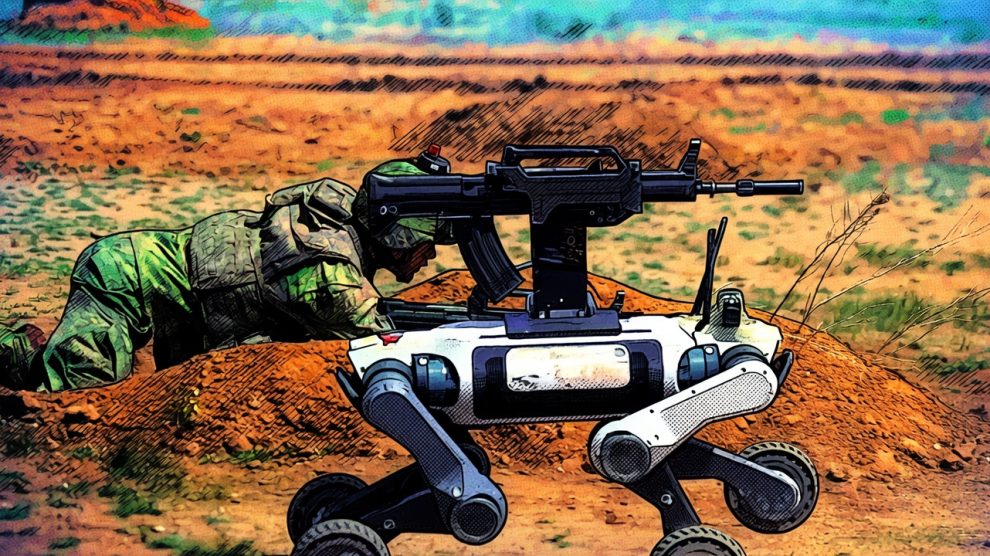
In the deserts of Inner Mongolia, surrounded by armoured vehicles, tactical drones and robotic quadrupeds, China recently offered one of its clearest demonstrations yet of what its strategists call intelligentised warfare. During the Steppe Partner 2026 exercises with Mongolia, soldiers, autonomous systems and AI-assisted command structures operated as parts of a single ecosystem.
From the battlefield of the future. The most striking image was that of an armed robotic dog moving alongside troops. The real message, however, was not about a single platform. Beijing appears intent on showing that the integration of humans, machines and algorithms is no longer confined to laboratories or defence exhibitions. It is becoming part of operational military planning.
- The demonstration comes as governments across the Indo-Pacific adapt to a rapidly changing technological environment. Taiwan has unveiled new robotic platforms designed for surveillance and armed support missions. The United States continues to strengthen its regional deterrence architecture. Japan is accelerating its defence modernisation efforts, while Vietnam is expanding military co-operation with Washington.
- What matters is not any individual system but the ability to connect them. The strategic value of artificial intelligence increasingly lies in linking sensors, software, robotics and decision-making structures into a single operational architecture. The competition is no longer defined solely by fleets, missiles or military bases. It is increasingly shaped by the capacity to integrate technology across the entire chain of command.
China’s ambitions extend well beyond the battlefield. A recent investigation by The New York Times described efforts by companies linked to China’s security apparatus to develop artificial intelligence systems capable of processing vast quantities of personal data in order to identify individuals considered potentially problematic from a political perspective. The shift is subtle but significant. The objective is no longer simply surveillance. It is prediction.
- The same technologies that may help co-ordinate autonomous systems in combat can also be used to classify, monitor and anticipate social behaviour. Artificial intelligence is becoming both a military asset and a tool of governance.
- Taken together, these developments point towards something broader than military modernisation. China is not merely developing new technologies. It is testing a model in which artificial intelligence becomes embedded across defence, administration and social control. The boundaries between these domains are becoming increasingly difficult to separate.
Yet the trajectory of Chinese artificial intelligence is more complex than the image of a centrally directed innovation machine often suggests. According to an analysis by David Lin published in War on the Rocks, the success of companies such as DeepSeek, Alibaba and ByteDance is also driven by intense competition among firms, local governments and research institutions. China even has a term for this phenomenon: neijuan, often translated as “involution” or excessive internal competition.
- The result is an ecosystem characterised by relentless pressure to innovate. Beijing continues to shape the sector and absorb its most successful outcomes, but it is often responding to dynamics that emerge from within the market itself. China’s advances in artificial intelligence are therefore not simply the product of state planning. They also reflect fierce competition among actors operating inside the system.
- This broader transformation helps explain why the debate surrounding artificial intelligence is moving beyond questions of innovation and economic growth.
Speaking in Washington, Archbishop Gabriele Caccia, the Holy See’s representative to the United States, on Thursday presented Pope Leo XIV’s Magnifica Humanitas as a possible ethical framework for governing artificial intelligence. The document warns against excessive concentrations of power, large-scale data collection and the growing delegation of decisions to algorithmic systems.
- Whether approached from a religious, political or strategic perspective, the underlying question is becoming harder to ignore. The challenge for democracies will not simply be keeping pace with Chinese innovation. It will be demonstrating that technological speed and political accountability can advance together.
The bottom line: China’s experiments offer a glimpse of what a society and a military deeply integrated with artificial intelligence could look like. The next phase of competition may not be decided solely by technological breakthroughs. It will also depend on who defines the political, legal and institutional frameworks within which those breakthroughs operate.