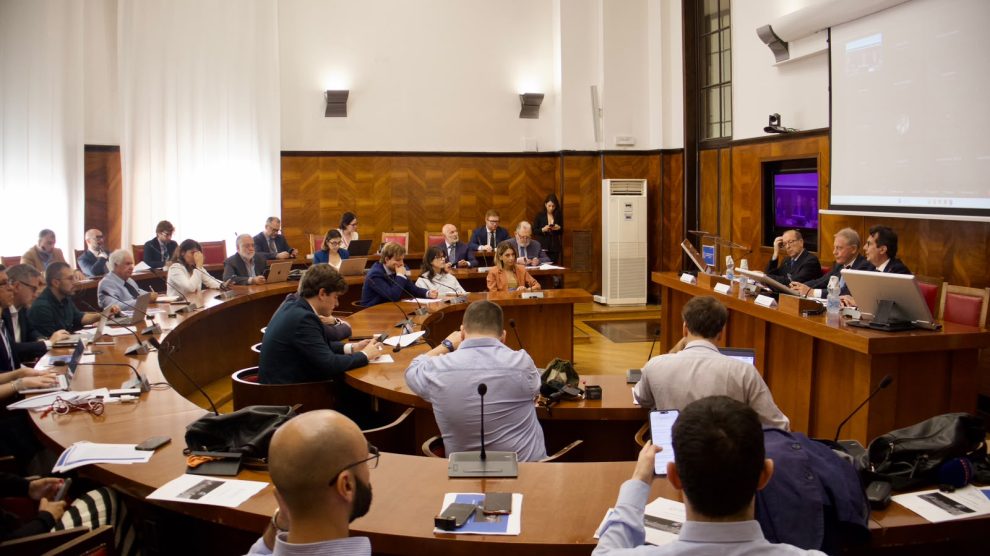
The launch of the Stati Generali dello Spazio (Space General Assembly), presented Tuesday at the Ministry of Enterprises and Made in Italy, comes as Rome increasingly frames space as a strategic sector tied to industrial competitiveness, technological sovereignty and security.
Why it matters: Italy is positioning space as a core component of its industrial policy.
- The government sees the sector as a driver of growth, innovation and high-skilled employment.
- Rome is seeking a larger role in both European and international space initiatives.
- Public investments are being paired with efforts to expand the country’s industrial ecosystem, from large companies to startups.
The big picture: The initiative, promoted by the Parliamentary Intergroup on Space, will bring together industry, universities, research centers, startups and local institutions through 20 events across 16 Italian regions that host aerospace industrial districts.
- Officials presented the program as a national effort that cuts across political lines. According to Industry Minister and Italy’s delegated authority for space and aerospace policies, Minister Adolfo Urso, the participation of lawmakers from both the governing coalition and the opposition reflects a broader push to “make a system” around a sector seen as increasingly strategic.
What they’re saying: “These figures confirm that space is one of the new emerging sectors of Made in Italy and a decisive driver of national industrial policy,” Minister Urso said.
- “Behind this growth lies a complete industrial ecosystem, from Earth observation to launchers, from satellites to downstream applications and services, all the way to exploration missions. It is on this ability to cover the entire value chain that Italy is building its renewed role in the new space economy.”
Follow the money. Urso used the event to highlight the growth of Italy’s space sector between 2021 and 2024.
- According to figures presented by the minister:
- Space-sector revenues increased from €1.9 billion to €3.1 billion.
- Employment rose from 5,900 to 8,900 workers.
- Aerospace exports grew 23.3% compared with 2022.
- Foreign direct investment in the sector increased 37.1%.
- Italy’s Earth Observation services market reached €340 million in 2025, up 73% from 2022.
- The government has allocated €7.8 billion through 2028 to the aerospace ecosystem through national and European funding streams.
- That includes:
- €3.5 billion for Italy’s contribution to the European Space Agency (ESA);
- €2.3 billion for the Italian Space Agency (ASI);
- €2 billion through Italy’s recovery plan and other national administrations.
Zoom in: Building a national ecosystem. Officials argue that the sector’s growth rests on an increasingly complete industrial base spanning Earth observation, launch systems, satellites, applications and exploration missions.
- Funding from Italy’s post-pandemic recovery plan has supported the creation of four Space Factory facilities in:
- Piedmont;
- Lombardy;
- Lazio;
- Puglia.
- The facilities are designed to support supply chains, small and medium-sized enterprises, and startups operating in the sector.
The European angle. The government is also using the sector to reinforce Italy’s role in shaping European space policy.
- Urso pointed to Italy’s contribution to the development of the EU’s planned Space Act and highlighted the country’s presidency of the ESA Ministerial Council through 2028.
- The message from Rome is that industrial expansion at home should be matched by greater influence in the governance of Europe’s space sector.
Beyond Europe. Italian officials also highlighted growing cooperation with the United States.
- Urso cited the strengthening of strategic ties with NASA and Italy’s participation in the Artemis lunar exploration program.
- As part of that effort, Italy is involved in the construction of a habitation module intended to support a long-term human presence on the Moon.
What to watch. The nationwide events will test the government’s effort to turn space into a broader industrial and political priority, linking regional aerospace clusters with national investment plans and international partnerships.
- They will also provide a platform for Rome to promote a sector it increasingly presents as central to future economic competitiveness and technological sovereignty.
The bottom line: Italy is using the growth of its aerospace industry to advance a wider strategic narrative: that space is no longer a niche scientific domain, but a key arena for industrial policy, innovation and international influence.
(Photo: X, @mimit_gov)