As US Secretary of War Pete Hegseth urged European allies to prepare for a future “NATO 3.0” and assume greater responsibility for the continent’s conventional defence, a parallel discussion was taking shape in Rome: how to turn rising defence budgets into actual industrial capability.
The timing was hardly coincidental. On one side, Washington continues to push European allies to do more for their own security. On the other, governments and industry are grappling with an increasingly urgent question: if Europe is expected to become more autonomous, does it have the industrial tools required to support that ambition?
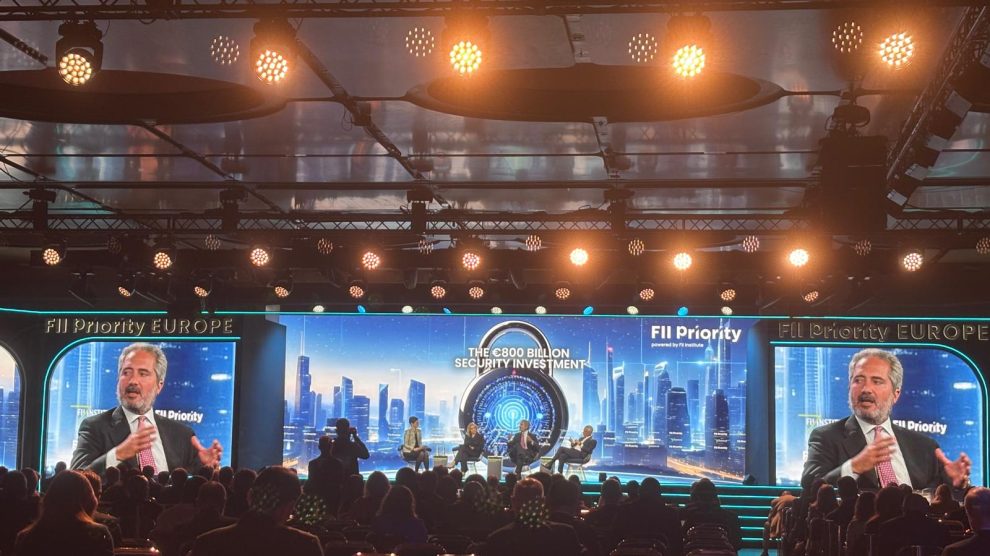
- The discussion took place at FII Priority Europe, the Rome summit organized by the Future Investment Initiative Institute, the platform linked to Saudi Arabia’s Public Investment Fund ecosystem. The event brought together investors, policymakers and business leaders to discuss the intersection of capital, competitiveness and strategic sovereignty — a fitting backdrop at a moment when security, technology and finance are becoming increasingly interconnected.
Complexity and the Need for Integration. The panel featured Lorenzo Mariani, Co-General Manager of Leonardo, Domitilla Benigni, CEO and COO of ELT Group, and Pierroberto Folgiero, CEO and Managing Director of Fincantieri. While approaching the issue from different angles, all three executives pointed to the same underlying challenge: Europe today enjoys stronger political momentum and greater financial resources than in the past, but turning those resources into capability remains a far more complex task.
For Mariani, the defining word was “complexity”. Recent conflicts have demonstrated how traditional military threats now coexist with drones, cyberattacks, hypersonic systems and hybrid warfare. That evolving threat environment, he argued, makes purely national responses increasingly inadequate and reinforces the case for common programmes, harmonised requirements and deeper industrial cooperation across Europe.
- From this perspective, initiatives such as SAFE and broader EU efforts to strengthen defence production represent early attempts to address a longstanding issue: the fragmentation of Europe’s defence market. The challenge is not simply how much money is available, but how effectively resources can be coordinated and deployed.
The human capital bottleneck. If industrial integration was one theme of the discussion, human capital was another.
- Benigni identified talent and skills as one of the key constraints on Europe’s defence ambitions. While investment levels and procurement plans dominate public debate, future capabilities will depend increasingly on expertise in areas such as electronic warfare, cyber, artificial intelligence and space.
- The keyword was “people”: For a company operating at the intersection of electromagnetic technologies, electronic warfare and intelligence systems, the transformation underway is not only technological but also organisational. The skills required to operate in these emerging domains cannot be developed overnight. Building the necessary talent base requires long-term investment in education, training and specialised expertise.
- The implication is straightforward: financial resources may be mobilised relatively quickly, but the human capital required to support Europe’s technological ambitions develops on a much longer timeline.
Incentives and industrial execution. Integration and skills, however, still need mechanisms capable of translating ambition into execution. That was the focus of Folgiero’s intervention.
- For the Fincantieri chief executive, the key concept is incentives. Europe’s effort to expand its defence industrial base will depend on policies that encourage cooperation, accelerate procurement and strengthen European production capacity.
- In that regard, SAFE was presented as more than a financing instrument. Its structure is designed to encourage joint initiatives among member states, speed up acquisitions and support European industrial content. The broader objective is to align economic incentives with strategic priorities and create conditions that favour cooperation across the continent.
- The discussion also highlighted the role of industry in expanding production capacity while pursuing greater interoperability and coordination among European defence programmes.
Beyond Spending. A common theme emerged across the panel: increasing defence expenditure is only one part of the equation.
- Much of the conversation focused on industrial capacity, technological development, workforce skills and the mechanisms required to connect them. Cooperation, human capital and incentives were presented not as separate issues but as interdependent elements of the same effort.
Why the venue matters: FII Priority Europe was built around the idea that competitiveness, security and technological sovereignty are increasingly linked to capital allocation. The discussion among Europe’s leading defence companies suggested that the same dynamic is now shaping the defence sector, where investment, innovation and talent development are becoming part of a single strategic agenda.
- As Europe takes on a larger role in its own security, the debate is gradually shifting from defining objectives to building the industrial, technological and human foundations needed to sustain them over the long term.