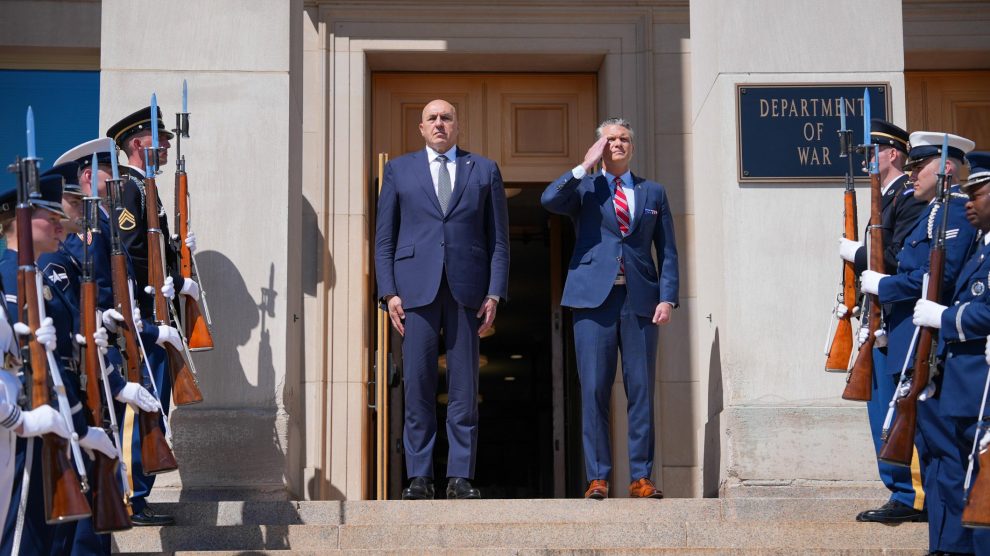
U.S. Defense Secretary Pete Hegseth and Italian Defense Minister Guido Crosetto used a meeting at the Pentagon on Tuesday to reaffirm the strategic partnership between Rome and Washington, with talks ranging from NATO’s future and defense spending to Ukraine, defense industry cooperation and maritime security.
Why it matters: The meeting offered a public display of alignment between two key NATO allies.
- Hegseth singled out Italy as one of the European partners taking on a larger security role within the Alliance.
- Both sides framed a stronger European defense posture as complementary to NATO.
- The talks highlighted growing cooperation not only on military operations but also on defense industrial capacity.
The big picture: The Pentagon meeting comes as NATO allies prepare for a new phase of burden sharing and defense investment, with Washington pushing European partners to assume greater responsibility for their own security.
- At the outset of the talks, Hegseth praised Italy’s growing role in European defense and thanked Rome for hosting U.S. forces.
- “It’s a longstanding partnership, and in today’s vital global landscape, our partnership is more important than ever,” Hegseth said.
- Italy hosts roughly 30,000 U.S. service members, civilian personnel and family members, making it one of Washington’s most important military hubs in Europe.
Zoom in: NATO 3.0. A central theme of the discussion was what Hegseth described as “NATO 3.0” — an evolution of the Alliance in which European allies take primary responsibility for their conventional defense while remaining anchored to the transatlantic partnership.
- Hegseth pointed to the new NATO spending target of 5% of GDP as the benchmark for allies and highlighted Italy as one of the countries stepping up its contribution.
- “We see partners — and Italy’s certainly one of them — leaning forward in that aspect,” he said.
- The U.S. defense secretary also cited Italy’s leadership of NATO’s Multinational Battlegroup in Bulgaria as evidence of Rome’s growing operational role on the Alliance’s eastern flank.
Defense and industry. Beyond operational commitments, the two sides discussed defense industrial cooperation, an area increasingly viewed by both governments as critical to sustaining military readiness and collective security.
- Hegseth stressed the importance of reinvesting in defense production capacity and said closer industrial cooperation would be essential to strengthening the Alliance in the years ahead.
- The meeting also covered support for Ukraine, defense investment and broader security challenges facing NATO allies.
What Crosetto is saying. Crosetto used the visit to underscore Italy’s commitment to the transatlantic relationship while arguing that NATO must adapt to a changing geopolitical environment.
- “There is no alternative to the Atlantic relationship for us,” Crosetto said.
- The Italian minister argued that the Alliance must increasingly look beyond its traditional geographic focus as global economic, technological and security dynamics shift toward the Indo-Pacific.
- “A stronger Europe, working together with the United States and taking greater responsibility for its own security, strengthens NATO’s credibility and effectiveness.”
- Crosetto also highlighted Italy’s role on both NATO’s eastern and southern flanks, particularly in the Wider Mediterranean, and welcomed what he described as a shared desire to deepen cooperation in the defense industry sector.
The bottom line: The Pentagon meeting underscored strong U.S.-Italy alignment on NATO’s future, defense investment and industrial cooperation, with both sides presenting Rome as an increasingly important contributor to European and transatlantic security.
(Foto: X, @MinisteroDifesa)