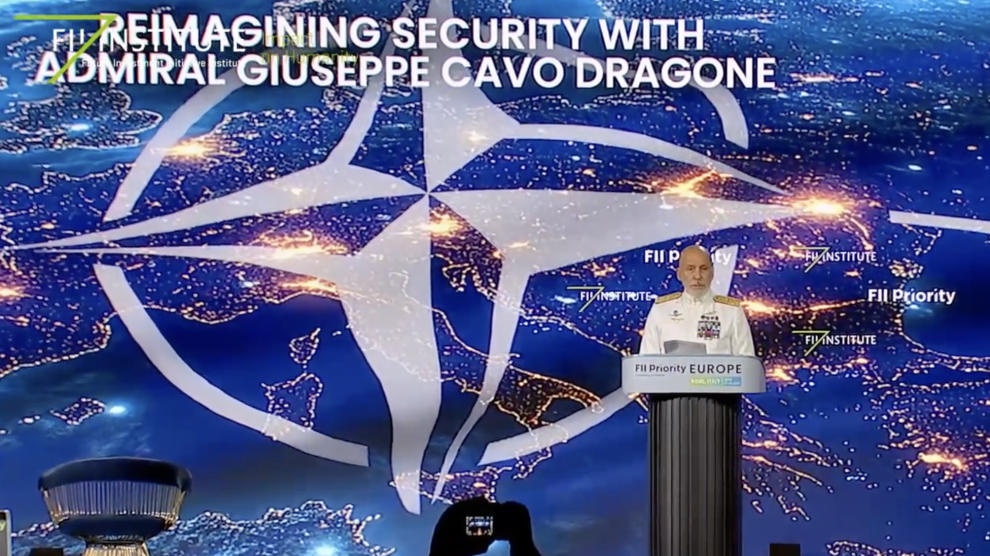
ROME — Deterrence is no longer measured solely in troops, tanks or missile systems. It increasingly depends on industrial capacity, technological innovation, resilient supply chains and trusted partnerships. That was the central message delivered by Admiral Giuseppe Cavo Dragone, Chair of the NATO Military Committee, during the Future Investment Initiative (FII) Europe conference in Rome, where policymakers, investors and business leaders gathered to discuss Europe’s economic future.
Security as an economic asset. Speaking to an audience more accustomed to discussing capital flows than military planning, Cavo Dragone argued that the geopolitical environment confronting Europe has changed profoundly.
- Russia’s large scale invasion of Ukraine continues to reshape the continent’s security architecture, while developments in the Indo-Pacific and the Middle East increasingly affect European interests. Challenges once viewed as separate have become interconnected.
- For decades, Europe benefited from what he described as a security dividend: that environment has disappeared. Today, deterrence extends well beyond military power. Armed forces remain indispensable, but they operate within a broader ecosystem that includes technological leadership, industrial readiness, societal resilience and the capacity to absorb disruption.
- “Security and prosperity are not in competition. They are the same investment.”
The economics of deterrence. A recurring theme throughout the discussion was the relationship between economic strength and security. In Cavo Dragone’s view, the credibility of deterrence increasingly depends on a country’s ability to generate and sustain military capability over time.
- Factories, logistics networks, energy systems, universities, skilled workers and capital markets all contribute to national and collective security. The challenge, therefore, is not simply to allocate more resources, but to use them effectively.
- That theme also emerged elsewhere during the FII Europe conference, including a panel featuring executives from Leonardo, Fincantieri and ELT Group, who stressed that Europe’s defence ambitions will depend not only on higher spending but also on stronger industrial cooperation, technological innovation and the ability to scale production across the continent.
- To explain this point, Cavo Dragone referred to what he called the “three Es”: effectiveness, efficiency and economy. The objective is to achieve strategic outcomes, transform resources into operational readiness and invest in critical capabilities in a financially sustainable way.
The war in Ukraine has reinforced this lesson. Industrial capacity cannot be improvised during a crisis. Ammunition stocks require years to rebuild. Engineers, software developers, shipbuilders and secure supply chains are the product of long-term investment. In this context, time itself becomes a strategic factor.
The same logic applies to economic security. Cavo Dragone also highlighted the importance of “friend-shoring” and the need to develop trusted networks for critical technologies, energy resources and strategic materials. In an increasingly contested international environment, resilience depends not only on what countries produce, but also on the reliability of the partners on whom they depend.
Beyond the Euro-Atlantic space. The discussion also reflected NATO’s growing awareness that security developments in distant regions increasingly affect the Euro-Atlantic area.
- Referring to conversations held recently at the Shangri-La Dialogue in Singapore, Cavo Dragone noted that Asia has become a central arena for technology, manufacturing, trade and strategic competition. Security, he argued, can no longer be understood through a purely regional lens.
- This helps explain NATO’s expanding cooperation with partners such as Japan, Australia, New Zealand and South Korea (the “IP-4”). The goal is not enlargement, but greater interoperability, technological cooperation and stronger deterrence.
- A similar logic applies to the Gulf region. Cavo Dragone described Gulf countries not simply as investors, but as strategic partners whose importance extends across security, technology, innovation and economic development. Durable partnerships, he suggested, should be able to withstand political cycles and periods of international tension.
A stronger Europe, a stronger Alliance. The fireside conversation that followed the keynote offered perhaps the clearest political message of the day.
- Asked about Europe’s push to strengthen its defence capabilities and the debate surrounding strategic autonomy, Cavo Dragone rejected the idea that a stronger European defence identity should come at the expense of NATO. “A stronger Europe means a stronger Alliance.”
- “Strategic autonomy is the ability to act, whenever and wherever necessary. But complete self-sufficiency is not realistic: scenarios are too interconnected, technology too complex, supply chains too global. “
- ”The real question is not who can act alone, but who can build trusted networks.” He argued that the relationship between European defence initiatives and NATO should be viewed as complementary rather than competitive. Europe brings industrial capacity, financial resources and regulatory tools. NATO provides political cohesion, military planning, operational structures and collective defence.
In that context, Cavo Dragone offered a definition that may resonate well beyond the conference hall. “This is transatlantic strategic autonomy.”
- The concept reflects a view that Europe should strengthen its capabilities while remaining firmly embedded within the transatlantic framework. It also responds to a long-standing American request for greater European responsibility in defence, a demand that has spanned multiple U.S. administrations, even if it is expressed today in more forceful terms.
- Pointing to recent European efforts, he argued that the continent has already made significant progress in strengthening its defence posture and increasing its level of commitment.
From resilience to anti-fragility. Beyond defence spending and military capabilities, Cavo Dragone’s remarks pointed to a broader transformation in how security is understood.
- Traditional multilateral institutions remain important, but they are increasingly complemented by more flexible forms of cooperation built around shared interests, trusted relationships and practical outcomes. In a fragmented international environment, resilience remains essential, but he suggested that policymakers should aim for something more ambitious.
- Drawing on the concept of anti-fragility, he argued that successful systems should not simply absorb shocks. They should learn from crises, adapt and emerge stronger.
The bottom line: The observation provides a useful framework for understanding the wider message delivered in Rome. Security is no longer a standalone military function. It is closely connected to industrial strength, technological leadership, trusted supply chains, innovation ecosystems and long-term economic confidence.
- “The most successful deterrence is the one that never needs to be used — the one that looks, from the outside, exactly like peace..”
- In today’s strategic environment, that deterrence depends as much on capital, technology and trust as it does on military power.