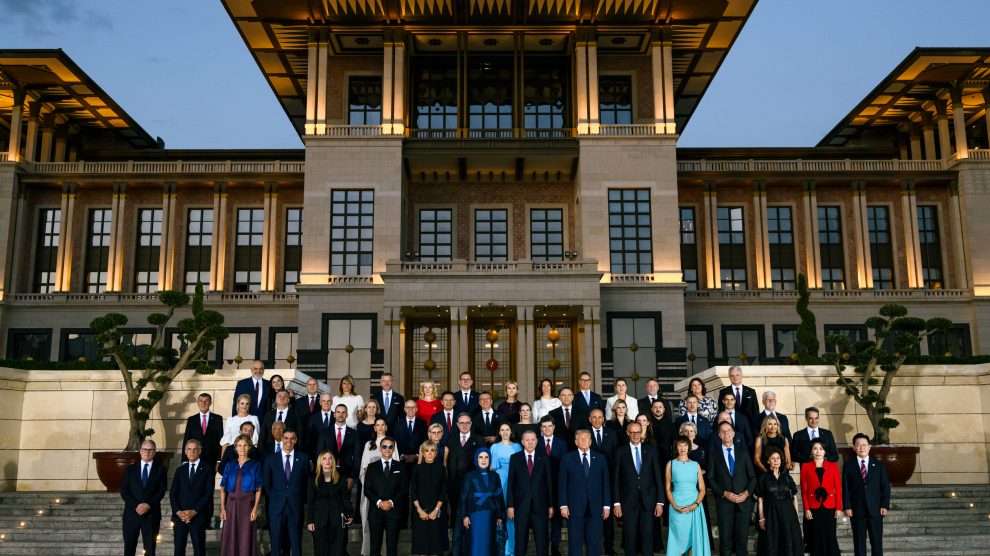
U.S. President Donald Trump ordered a new round of strikes against Iran from the NATO summit in Ankara, exposing the central dilemma facing his administration: He needs to demonstrate that U.S. military pressure is working, even as the political cost of the war gives him growing reason to bring it to an end.
Why it matters: Less than four months before the midterm elections, President Trump is caught between an Iran confrontation that continues to generate new rounds of controlled escalation, an electorate increasingly skeptical of the war and European allies unwilling to formally share its political and military costs.
- The result is a foreign policy paradox. The longer the confrontation continues, the more Trump needs allied support to make the U.S. effort sustainable. But the allies’ refusal to join the campaign in any way is reinforcing the president’s longstanding suspicion of NATO — and pushing him back towards the isolationist instincts that the war itself had forced him to set aside.
Driving the news: Trump authorised the latest strikes after Iran attacked three commercial vessels that crossed the Strait of Hormuz without following the route prescribed by Tehran.
- The decision came after a meeting in Ankara with senior administration and national security officials attending the NATO summit as part of the U.S. delegation. Among them is Secretary of War Pete Hegseth, who is leaving Ankara to travel to Israel on Wednesday.
- Central Command said American forces struck more than 80 targets, including air defence systems, command and control networks, coastal radar sites, anti-ship missile capabilities and more than 60 vessels belonging to Iran’s Revolutionary Guards.
- A U.S. official said the operation was four or five times larger than the previous strikes in the area 10 days earlier.
The scale of the response carried a message: Washington remains prepared to impose significant costs on Tehran and protect commercial shipping through one of the world’s most important trade corridors.
- But it also exposed Trump’s increasingly narrow room for manoeuvre.
The big picture: The memorandum of understanding reached by Washington and Tehran less than three weeks ago was supposed to restore safe passage through Hormuz and open the way for nuclear negotiations.
- Yes but… Oil is flowing through the Strait of Hormuz again, but the shipping industry isn’t convinced the crisis is over. The clearest signal won’t come from oil prices or diplomacy—it will come when empty tankers start sailing back into the Gulf.
- Instead, Iran’s attacks on commercial vessels, the subsequent U.S. retaliation and Tehran’s promise of a “crushing response” have restarted the cycle of escalation, even if the truce has not formally collapsed.
Stop playin’. That is precisely the dynamic Trump has a growing political interest in stopping.
- The more the president uses American military power to demonstrate that his strategy against Iran is working, the greater the risk of prolonging a conflict that voters increasingly believe has already gone too far.
By the numbers: A Financial Times/FocalData poll published this week found that 58% of registered voters believe the war against Iran has not been worth the cost.
- Another 44% said the conflict had left the U.S. in a weaker position against Tehran, compared with 31% who believed Washington was stronger.
- Trump’s approval rating has fallen to 36%. Among independents, support dropped eight points in one month to 21%. Democrats, meanwhile, have extended their advantage over Republicans in the congressional ballot to six points.
Follow the money. The White House has also asked Congress to authorise $67 billion in additional spending to cover the costs of the war so far, while the conflict has contributed to higher petrol prices and other consumer costs.
Between the lines: Trump’s problem is not America’s ability to inflict damage on Iran. U.S. military superiority — particularly its technological advantage, demonstrated by the use of artificial intelligence in targeting operations — allows Washington to impose significant costs on Tehran.
- The problem is converting military superiority into a political outcome. American strikes have not prevented Iran from continuing to challenge Washington. Nor have they persuaded U.S. voters that an indefinite succession of attacks and counter-attacks is worth sustaining.
- Trump therefore faces a dilemma that stretches from Tehran to Washington: He must continue using force to prove that military pressure works, while ending the confrontation quickly enough to prevent its costs from weighing further on the midterms.
The NATO problem. The president’s tensions with European allies are a reflection of the same dilemma.
- During a meeting with Turkish President Recep Tayyip Erdoğan, Trump said he had considered staying away from the NATO summit and refused to rule out further reductions in the U.S. military presence in Europe.
- He singled out Britain, France, Germany and Italy for failing to do enough to support the war against Iran. The issue, according to people familiar with the matter, has also contributed to tensions with Italian Prime Minister Giorgia Meloni.
Trump’s criticism exposes another paradox: The president wanted allies to shoulder a greater share of the effort against Tehran. Their refusal to formally participate in the campaign left Washington more exposed to the military, economic and political costs of the conflict.
- But rather than making Trump more convinced of the need for stronger alliances, that refusal appears to be reinforcing his longstanding suspicion of NATO.
The other side. NATO Secretary-General Mark Rutte offers a different account of the allies’ contribution.
- Ahead of the summit, Rutte repeatedly pointed out that allied co-operation and access to European bases supported almost 5,000 U.S. sorties during operations against Iran between February and April.
- In other words, European allies provided significant operational support while maintaining political distance from a military intervention they did not regard as falling within NATO’s collective defence framework.
- The disagreement reveals two competing views of what an alliance is supposed to do. Trump appears to measure allied contributions primarily through their willingness to fight alongside the U.S. Europeans argue that they provided the logistical and strategic infrastructure that allowed Washington to project military power without formally assuming responsibility for the war.
The twist. American voters may be closer to the European position than to Trump’s. The same FT poll that found widespread opposition to the cost of the Iran war showed that 53% of voters want the U.S. to remain in NATO. Just 23% favour leaving the alliance.
- Collectively, the findings suggest that the U.S. is not necessarily experiencing a new isolationist turn.
- Voters appear to distinguish between maintaining alliances and fighting wars with uncertain outcomes. They want the U.S. to retain its international role, but are less willing to bear the costs when military force fails to produce a rapid and recognisable political result.
- Trump increasingly finds himself on the other side of that divide. The absence of greater allied participation in the Iran war is fuelling his resentment towards NATO. Growing domestic opposition to the conflict, meanwhile, is increasing the pressure on him to reduce America’s exposure abroad.
What we’re watching: The Iran crisis is testing two central elements of Trump’s foreign policy.
- One is his belief that military force can compel adversaries to negotiate from a position of weakness — the administration’s “peace through strength” doctrine. The other is his promise to keep the U.S. out of long and costly conflicts, the “endless wars” against which he campaigned during his first term.
- The latest raids in the Strait of Hormuz show how difficult it has become to reconcile the two.
- Trump entered the confrontation seeking to demonstrate the reach of American power. He now faces an electorate increasingly sceptical of its costs and allies unwilling to formally share them.
- Several European countries are due to hold elections over the next 12 months, making close alignment with Trump politically risky at home, particularly while the U.S. president’s approval ratings in Europe remain below 20%.
The bottom line: Trump needs the Iran campaign to end as a demonstration of American strength. Instead, each new round of escalation risks turning it into the kind of prolonged, costly and predominantly American conflict he built his political identity on opposing.
(Photo: X, @WhiteHouse)