Italian Prime Minister Giorgia Meloni said Italy intends to meet its defense commitments, but will decide the timing, methods and priorities of higher spending based on the national context.
Why it matters: Meloni linked higher defense spending directly to Italy’s industrial base, research and skilled jobs.
- She defended her political investment in Western unity despite recent tensions with U.S. President Donald Trump.
- Rome plans to continue supporting Ukraine while ruling out direct participation in attacks against Iran.
- Italy is also seeking a role in the Israel-Lebanon dossier and discussions over a possible post-UNIFIL framework.
Defense first: “We want to respect our commitments” on defense spending, Meloni said. “We are doing so and we will continue to do so, but in a sustainable way, establishing ourselves the timing, methods and priorities based on the context.”
- The Italian prime minister also made clear where she wants the economic benefits of that spending to go.
- “If we invest in defense, that money must remain in Italy, in our factories, in our research, in our territories,” she said, arguing that higher spending should mean “more security, but also more skilled jobs, more research and not checks sent abroad.”
- Setting the terms: “I will never take money away from hospitals to buy tanks. The idea that Italy is closing hospitals to buy weapons is ridiculous,” she said.
The critical minerals chapter. “Of the twelve critical raw materials identified by NATO, at least six are controlled by a single country. We must ensure that the resources we are investing are going toward things that we fully control and over which we remain sovereign,” added Meloni.
- The focus on critical minerals is one of the key elements shaping this phase of Italy’s transatlantic policy.
The Trump factor: Italian Prime Minister declined to reopen the issue of her recent tensions with Trump. “I said I would not return to the subject, and I will not return to the subject,” she said. But she defended her broader approach to Washington and the transatlantic relationship.
- “I regret nothing that I have done,” Meloni said. “I made the political investment out of conviction in the unity of the West.”
- She added that her approach was not a strategy developed after Trump’s arrival and pointed to areas of affinity with the U.S. president, including migration and opposition to “woke culture.” “The way things are going is there for everyone to see, but I do not change my mind,” she said.
Zoom in: Ukraine. Meloni said she expects Italy to continue providing military assistance to Kyiv, adding that Defense Minister Guido Crosetto is assessing the issue.
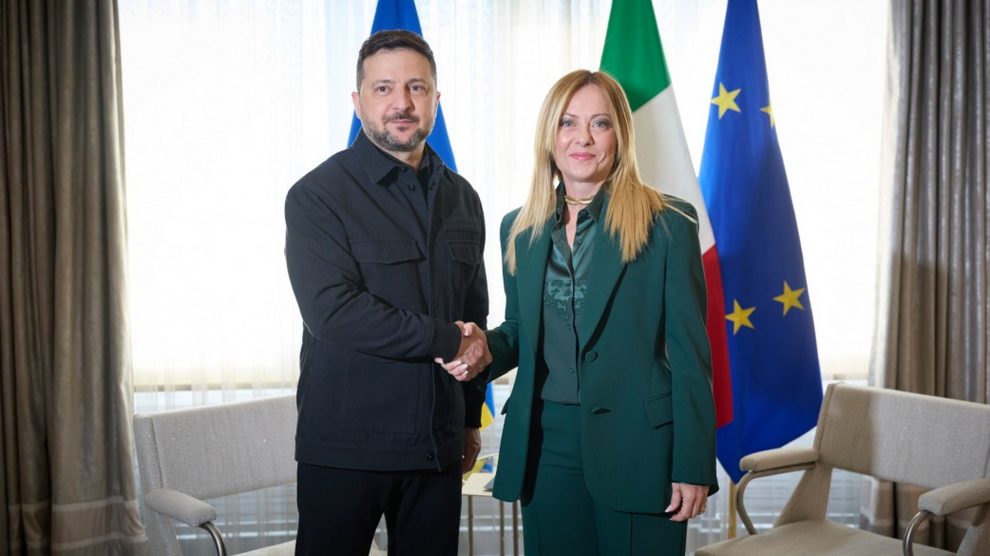
- Earlier in the day, she met Ukrainian President Volodymyr Zelensky on the sidelines of the NATO summit.
- Italy will also attend Monday’s meeting of the “Coalition of the Willing” in Paris, Meloni said, likely represented by Foreign Minister Antonio Tajani.
- “After six summits in three and a half weeks, I’ll pass,” she said. “There is no disengagement from Ukraine. But neither can I afford to disengage from Italy.”
The Iran line. On the U.S. offensive against Iran, Meloni stopped short of endorsing NATO Secretary General Mark Rutte’s assessment that the operation had been necessary.
- “I was not at the negotiating table,” she said. “I do not know how much room there was, or was not, to continue negotiations.”
- Meloni also reiterated Italy’s position on U.S. bases in the country. “We respect our commitments, as serious nations do, but we said that we would not participate in attacks against Iran, and we did not participate in attacks against Iran,” she said.
-
Italian Prime Minister said that she has not lost hope for the possibility of negotiations with Iran. “I believe that the military option has not produced particularly concrete results.”
The regional angle. Meloni called the continuation of talks between Israel and Lebanon in Rome “excellent news.”
- At the same time, Italy is working on what Meloni described as a possible “post-UNIFIL coalition.”
- Rome is discussing the proposal with France at the sherpa and technical levels, and Meloni said she had also raised the issue with Turkish President Recep Tayyip Erdoğan.
- “There is a lot of interest,” she said, adding that Italy intends to present the proposal before UNIFIL’s mandate expires.
The bottom line. The message from Ankara was one of continuity with conditions: Italy intends to meet its NATO commitments, maintain support for Ukraine and respect its alliances, while seeking greater control over how defense money is spent and setting limits on its involvement in regional conflicts.
(Photo: Youtube, Palazzo Chigi)