National security increasingly runs through infrastructure, digital networks, value chains and industrial capacity. It extends to the seabed, where the cables underpinning the digital economy are laid; into shipyards and research centres; and across energy and critical raw material supply chains. Increasingly, it is also measured by the ability to develop and govern technologies such as artificial intelligence. This expanded strategic landscape is becoming a central arena of competition between national systems.
For Italy, this transformation carries particular significance. Its position at the centre of the Mediterranean, the presence of major industrial groups operating in strategic sectors and an economy deeply integrated into global networks expose the country to emerging vulnerabilities while also providing assets that could strengthen its international role. The challenge is to turn those assets into a strategy capable of bringing together security, technology and industrial policy.
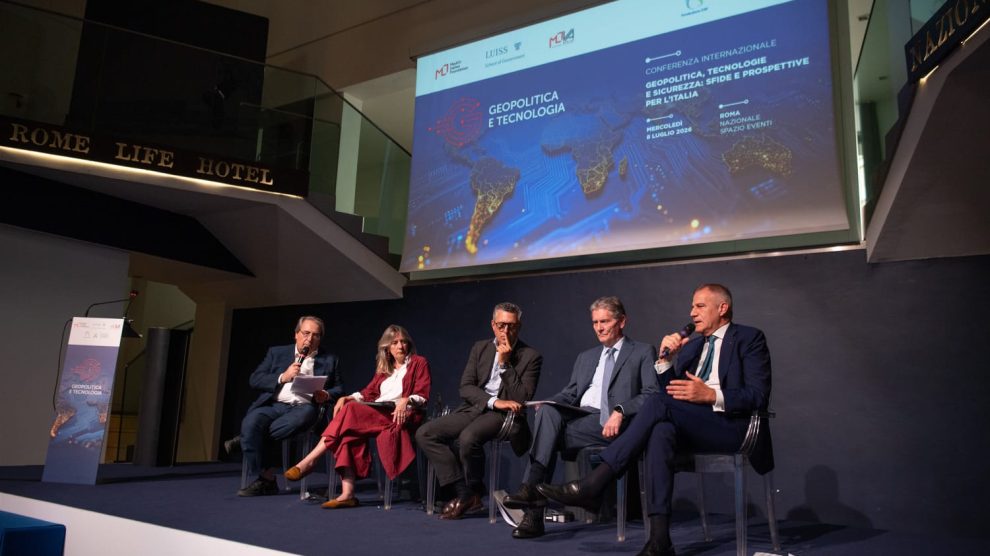
This was the overarching theme of the international conference “Geopolitics, Technologies and Security: Challenges and Prospects for Italy”, organised in Rome on Wednesday by Med-Or Italian Foundation in collaboration with the Luiss School of Government. The event was held as part of the “Geopolitics and Technology” initiative promoted by Fondazione Compagnia di San Paolo and the Foundation CSF. Bringing together representatives from institutions, industry and academia, the conference forms part of a research project examining the evolution of global security in the Wider Mediterranean, whose findings will be published in a scientific volume scheduled for November.
The event: The discussion promoted by Med-Or and Luiss examined this transformation through two roundtables focusing, respectively, on the Mediterranean as a global frontier for connectivity, technology, energy and security, and on the implications of geopolitical and technological competition for Italy’s national system.
- Participants included Hoda A. Al Khzaimi of New York University Abu Dhabi; Giuseppe Calabrò, energy security adviser to Italy’s defence minister; Mohamed Ali Chihi of the Global Institute for Strategic Research in Doha; Stefano Del Col, director of the Secretariat of the Supreme Defence Council; and Gaetano Quagliariello, dean of the Luiss School of Government.
The new geography of security. The starting point is an international system that has entered what Marco Minniti, president of Med-Or Italian Foundation, described as a genuine “age of uncertainty”. The war in Ukraine, conflicts across the Mediterranean and the Middle East, the latest escalation involving Iran and crises in Africa are creating a geography of instability in which it is becoming increasingly difficult to isolate one theatre from another.
- “The old world order is over for good,” Minniti said. The consequence is the need to develop a strategic vision capable of connecting crises and transformations that increasingly share the same strategic factors: control over technology, infrastructure security, access to resources and the ability to project influence.
- Against this backdrop, the Mediterranean has regained a centrality that once appeared likely to diminish as global attention shifted towards the Indo-Pacific. “The Mediterranean is the meeting point between the West and the Global South,” Minniti said, identifying the region as one of Europe’s main strategic assets.
When factories and networks become strategic assets. The widening concept of security has direct consequences for industrial policy. A country’s ability to withstand a crisis depends on the strength of its supply chains, the resilience of its infrastructure and its capacity to control essential technologies and skills.
- “It is no longer a matter of looking at control over territory, but of understanding who designs, who builds and who maintains the physical and technological infrastructure of an economic system,” said Biagio Mazzotta, chairman of Fincantieri.
- This shift brings shipyards, factories and research centres into the architecture of national security, alongside energy and digital infrastructure. Revitalising industrial capacity therefore takes on a dimension that extends beyond individual companies and concerns the resilience of the national system as a whole.
- The same logic applies to the networks connecting Italy and Europe to the rest of the world. Enrico Bagnasco, president of Confindustria Assafrica & Mediterraneo and chief executive of Sparkle, highlighted the role of connectivity and strategic infrastructure in a region that concentrates energy, trade and digital routes that are crucial to global balances.
- The Mediterranean thus emerges as a space where geography retains its full importance, while the strategic value of territories increasingly depends on the density and resilience of the networks running through them.
Security as industrial policy. The issue takes on a European dimension as defence spending rises and the search for greater strategic autonomy accelerates. According to Francesco Macrì, chairman of Leonardo, Europe must develop a new innovation economy “that places security at the heart of European industrial policy”.
- The challenge is to close the gap accumulated in strategic sectors ranging from energy and critical raw materials to the cyber domain, while strengthening the European pillar of the Atlantic Alliance. Investment in security and defence can become a vehicle for developing technologies, skills and industrial supply chains within Europe.
- “If we have to invest, we cannot move from one dependency to another, but must invest in something that makes us more autonomous and independent, and therefore freer,” Macrì said.
- The issue is directly linked to the debate opened by the NATO summit in Ankara. According to Minniti, the emphasis on Article 5 confirmed the Alliance’s central role, while the prospect of a reduced US military presence requires Europe to strengthen its own defence and power-projection capabilities. For European industry, increased spending on security therefore raises a strategic question: how much of that investment will generate innovation and productive capacity within the continent?
From cyber security to artificial intelligence. The transformation of security is even more evident in the digital domain. “Cyber security today can no longer be understood as one security sector alongside others, but as an enabling factor for the very existence of our societies, which are now all structurally digital,” said Nunzia Ciardi, deputy director general of Italy’s National Cybersecurity Agency.
- Protecting hospitals, electricity grids and energy infrastructure increasingly depends on the ability to defend digital systems exposed to ever more sophisticated threats. Artificial intelligence further expands this landscape, accelerating innovation while providing new tools for cognitive warfare and the manipulation of the information environment.
- According to Ciardi, a technology as powerful and pervasive as AI requires “agile, intelligent regulation capable of containing the extreme aspects of certain technologies without becoming an obstacle to digital and technological development”.
- It is precisely here that one of Europe’s main weaknesses becomes apparent. The United States retains its advantage in frontier research, while China has built an increasingly strong position in the application of technologies and control over strategic resources. Europe, by contrast, risks approaching the competition primarily through regulation.
- “Europe is not present in this race. It isn’t. We only deal with regulation,” Minniti warned. “If you are not a protagonist and only want to regulate, regulations are like Manzoni’s edicts: they are absolutely useless.”
Turning centrality into capacity. This is perhaps where the different themes discussed in Rome ultimately converge. Geographic centrality retains strategic value only when it is matched by the capacity to protect infrastructure, develop technology, sustain industrial production and build relationships with other actors across the region.
- For Italy, the Mediterranean is where these dimensions overlap with particular intensity. Energy, digital connectivity, the defence industry, maritime security and technological competition have become parts of the same strategic landscape.
- The country has a privileged geographic position and companies capable of operating in sectors that are becoming decisive to international competition. The challenge is to connect these assets through a long-term strategic vision. In the “age of uncertainty” described by Minniti, the ability to respond to crises remains essential. The ability to prepare for the transformations that produce them will matter even more.