
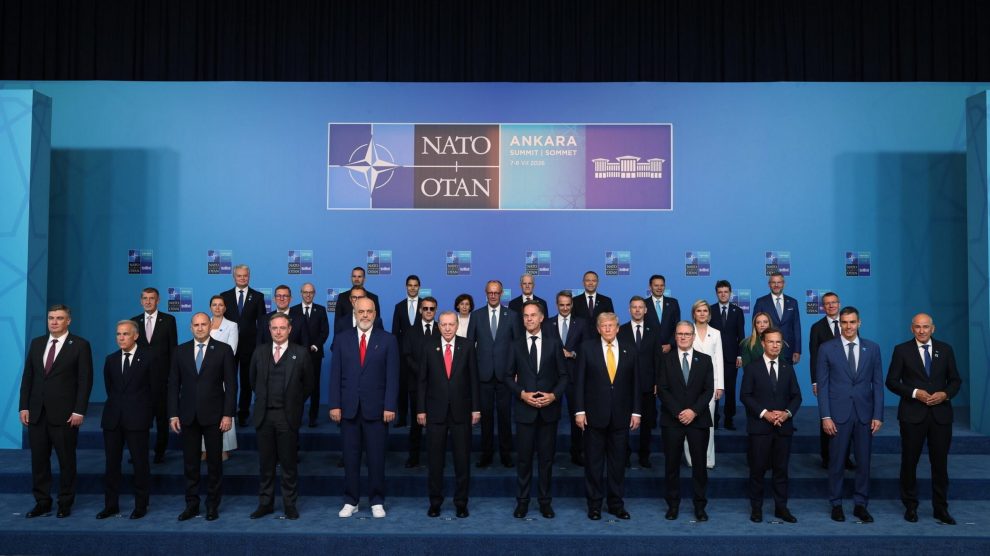
Ankara was not a display of unity, but it avoided confrontation. The Patriot license matters more symbolically than militarily. And there is no room for negotiations with Moscow.
These are just some of the points addressed by Ian Bremmer, president of Eurasia Group, who spoke to Decode39 about the NATO summit held in Turkey, viewing it as a political barometer of the health of the Atlantic Alliance while also addressing other closely related issues.
Q: Let’s start with Ankara. Was it a genuine display of unity, or mainly a successful summit because it avoided the clashes that could have exposed the Alliance’s divisions?
A: I don’t think Ankara was a genuine display of unity, but at least most of the clashes were avoided. Erdogan likes Trump, which is why Trump decided to make the trip.
- He was positive on the F-35s, positive on lifting sanctions on Turkey. And you don’t show up at a summit Turkey has invited you to in order to have a good relationship and then say, “Oh, I’m leaving NATO.” It seemed to me like a more normal, more constructive group than expected. Along the lines of the G7 in Evian a few weeks ago.
Q: If confrontation was avoided, something concrete did move forward: Trump gave Kyiv the green light for a license to produce Patriots. How much will this really affect Ukraine’s air defense capabilities and the military balance of the conflict?
A: The fact that Trump is about to grant Ukraine a license for Patriots is a significant improvement. But I don’t think this will change their air defense capabilities, or the military balance, in the short term. I think it will literally take years to put that supply chain in place.
- But I do think it is symbolically very important, because it shows that Zelensky does hold the cards, that Trump was wrong last April when he kicked him out of the White House and suspended intelligence cooperation, and that Trump’s willingness to court the Russian president is perceived as unproductive.
- And this will give Europeans much more confidence in their NATO alliance and in their relationship with the United States.
Q: On the diplomatic front, after the phone call with Putin and the bilateral meeting with Zelensky, does that political capital open up real negotiating space, or do Moscow’s terms remain incompatible with anything Kyiv could accept?
A: I don’t think there is negotiating space. But I think the United States is now closer to the European position, because Zelensky is showing that he is capable of fighting and fighting hard, and that they are striking deep inside Russian territory.
- The Ukrainians are not suffering the losses they were suffering, while the Russians are, and they are taking back some of their territory.
- I don’t think Putin is willing to sit down at the table and accept an unconditional ceasefire, as Zelensky did when pushed by the Americans.
- So no, I think the Russian terms are still incompatible. But I think the Ukrainians’ ability to continue fighting with European and American support is high. And I think Zelensky’s meeting with Trump was very positive in that respect as well.
Q: Let’s go back to Ankara and relations among allies. Do you think Europe is finally closing the gap in its dependence on the United States, or does it remain very far behind?
A: Structurally, I don’t think the Europeans are closing the gap in their dependence on the United States, because the Americans are too far ahead, particularly on technology. Look at how much Mistral can actually spend on a new artificial intelligence model and compare it with what happens with American companies: there is simply no contest.
- I think there is a reason why the Europeans decided to join Pax Silica. And as concerned as they are that the Americans might turn off the taps, they recognize that they have to align with the United States on advanced technology. That is the future of national security, it is the future of sovereignty, that is where dependence will come from.
- Diplomatically, however, the fact that the Ukrainians are able to defend themselves against the Russians and effectively attack them in return is making Europe much stronger. And this reduces European dependence on the United States in NATO terms, when Europeans feel they are backing a winner in Ukraine, and Trump is increasingly aligning himself.
Q: The Greenland issue also resurfaced in Ankara. How do you manage, within NATO, pressure on an ally’s territory that comes from within the Alliance itself?
A: The fact that Trump brings up the issue does not make it a renewed imminent threat. He has no ability to actually take Greenland. There is no plan. There is certainly no willingness on the part of the Danes or Greenlanders to accept what he is asking for.
- And there is no credible threat, there is no “or else” if things do not move forward. So he talks about it, he is frustrated about it, but it is not going anywhere. It is like threatening to cut off all trade with Spain.
- He says these things when he is frustrated because the things he has demanded are not materializing, but they do not necessarily mean very much. And then he moves on.
Q: What would happen if, in the coming months and years, we saw electoral gains by right-wing populism in Europe? I am thinking of the United Kingdom, France and, above all, Germany.
A: I think the only real risk there is France. And I think the French election is the most important election, the most important vote in Europe since Brexit. It is very significant.
- And now that Le Pen is running, there is a real possibility that she could win. That would be a very serious threat to the EU from within, from one of its leaders.
- Germany does not represent that threat: the AfD can perform well, but any government in Germany will still be led by the center-right or the center-left. And the United Kingdom is becoming a multiparty system; it will not end up dominated by Reform. Moreover, they have already left the European Union, and their economy has suffered as a result. Something they will not forget anytime soon.