ROME — Italy is stepping up its push to accelerate the Western Balkans’ integration into the European Union, rallying a group of EU countries behind a set of principles designed to keep enlargement credible and prevent second-tier membership.
The move comes as the EU prepares for further steps in accession talks with several candidate countries in the coming weeks, while progress with Serbia remains stalled.
Why it matters: Rome is trying to give the Western Balkans greater political priority as the EU’s enlargement agenda advances on several fronts.
- The Italian-backed “Rome Charter” seeks to ensure that new members enjoy full equality after accession and face no additional layers of conditionality.
- Italy is also linking enlargement to Europe’s strategic autonomy through transport, energy and digital connectivity, supply-chain resilience and food security.
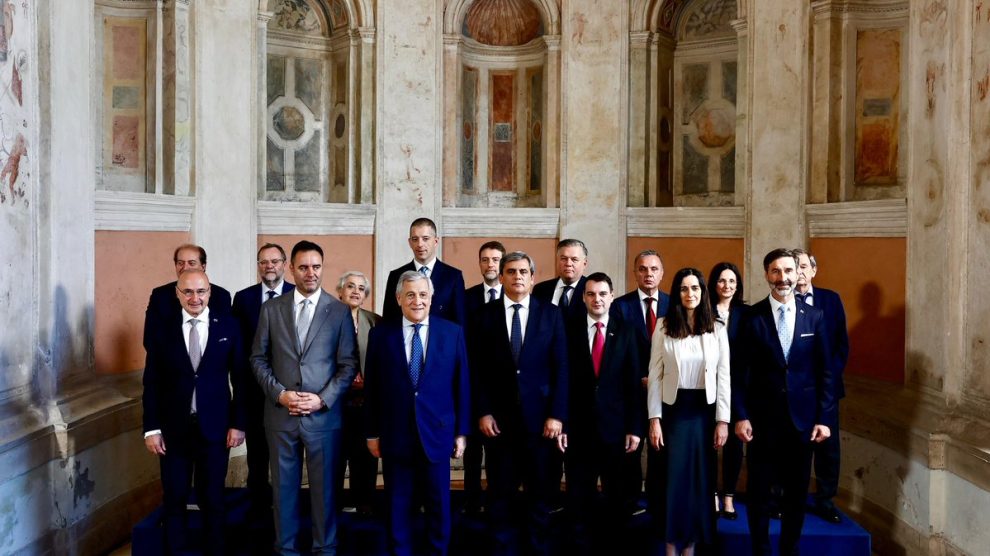
The big picture: Italian Foreign Minister Antonio Tajani hosted the “Friends of the Western Balkans” and the region’s foreign ministers at Villa Madama in Rome.
- The group brings together Italy, Austria, Croatia, Greece, the Czech Republic, Slovakia and Slovenia in support of the EU accession of Albania, Bosnia and Herzegovina, Kosovo, North Macedonia, Montenegro and Serbia.
- Hungary was invited for the first time because of its support for Western Balkan integration.
- The Rome meeting came two months after a previous ministerial gathering in Bratislava and sought to inject new momentum into enlargement while strengthening the region’s contribution to European strategic autonomy.
Zoom in: The Rome Charter. The group adopted an Italian-sponsored political document on future accession treaties that Rome plans to present in Brussels.
- According to the Italian Foreign Ministry, the goal is to “preserve the credibility, predictability and unity of the enlargement process.”
- The charter reaffirms the principle of full equality among member states after accession, rejecting differentiated participation or forms of second-tier membership.
- It also calls for a clear and stable end goal for candidate countries and opposes additional layers of accession conditionality. Any safeguard clauses or transitional measures, the document says, should be based on objective needs and remain proportionate, temporary and tailored to individual candidates.
- “We are convinced of the need to give political priority to the reunification of the European family with the Balkans,” Tajani said.
Between the lines: Italy is seeking to shape not only the pace of enlargement but also the terms of the debate. Rome’s message is that accelerating accession should not mean creating different categories of EU membership. “Italy intends to lead this process, with a clear and determined strategic vision,” Tajani said.
The wider enlargement push. The initiative comes as the EU advances accession talks with other candidates. EU ambassadors have agreed to move forward with Ukraine and Moldova by opening the external relations cluster, while also provisionally closing negotiating chapters for Albania and Montenegro.
- Further intergovernmental conferences with Ukraine, Moldova, Montenegro and Albania are expected in the coming weeks. Serbia remains a different case. EU ambassadors have discussed opening three negotiating chapters but have yet to reach an agreement.
The connectivity play. Rome is also placing infrastructure at the center of its Western Balkans strategy.
- The meeting covered transport infrastructure, energy networks, digital links, food security, supply-chain resilience and connectivity.
- Tajani specifically linked the push to projects stretching “from IMEC to Corridor VIII.” It’s not the first time.
- The connection reflects Italy’s effort to position the Western Balkans within a wider infrastructure architecture linking the Adriatic and Europe to the Indo-Mediterranean. In Rome’s framing, Corridor VIII and IMEC can form parts of a broader connectivity strategy in which Italy acts as a bridge between European markets and emerging east-west trade and infrastructure routes.
What we’re watching: The next test will be whether Italy can translate the Rome Charter into broader support in Brussels while the EU moves ahead with accession negotiations on several parallel tracks.
The bottom line: Italy is making the case that Western Balkan enlargement should move faster, preserve full membership rights and become part of Europe’s wider strategy on security, resilience and connectivity.
(Photo: X, @Antonio_Tajani)