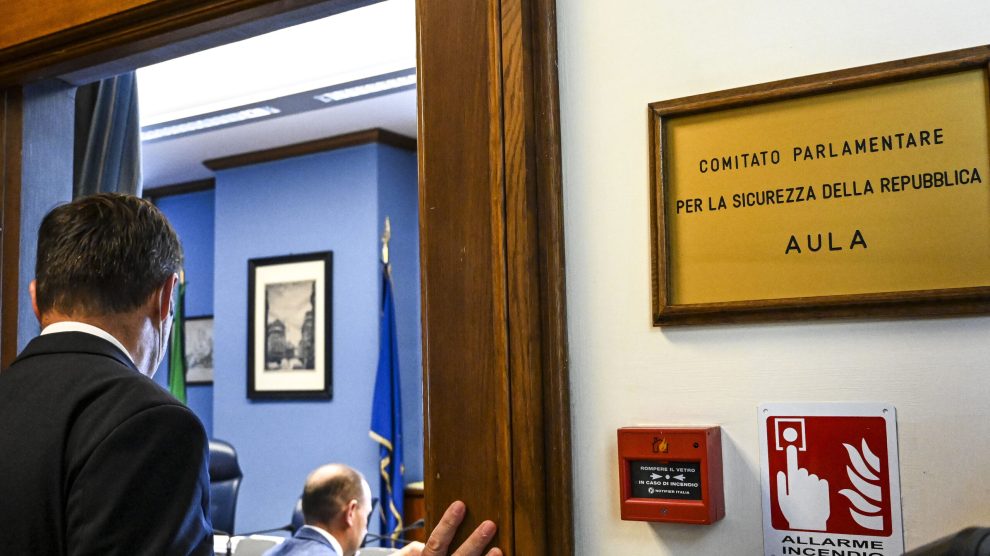
Energy security is no longer treated solely as an economic or industrial issue. According to the latest annual report by Italy’s Parliamentary Committee for the Security of the Republic (COPASIR), it has become a core component of national security.
Why it matters: The Committee devoted significant attention during 2025 to the protection of critical energy infrastructure and the resilience of supply chains, reflecting a broader understanding that vulnerabilities in the energy sector can have direct implications for the country’s strategic autonomy and security.
- Rather than focusing on immediate crises, the report points to a sustained oversight effort that is expected to continue beyond the reporting period.
The big picture: Energy appears throughout the report as part of a wider concept of economic security.
- COPASIR dedicates an entire section to national security issues related to the economy, including specific chapters on energy security, the protection of energy networks and the security of energy supplies. The organization of the report suggests that safeguarding critical infrastructure has become an integral part of the Committee’s assessment of Italy’s resilience.
- The document does not present operational findings or intelligence assessments. Instead, it outlines the areas that lawmakers considered sufficiently strategic to warrant dedicated scrutiny during the year.
Zoom in: A new cycle of oversight. One of the report’s most concrete developments is the launch of a new series of hearings focused on critical energy infrastructure.
- According to COPASIR, the Committee heard from the chief executives of SNAM and ENI as part of an in-depth examination of critical energy infrastructure and related supply chains. The report notes that this work was still ongoing at the end of 2025 and is expected to continue during 2026.
- The decision to dedicate a specific cycle of hearings to the sector highlights the Committee’s intention to deepen parliamentary oversight of an area increasingly viewed through a national security lens rather than exclusively through energy policy.
Between the lines: The report reflects a broader evolution in how Italy defines strategic security.
- Alongside cybersecurity, artificial intelligence, economic resilience and the defense industry, energy infrastructure is presented as one of the pillars supporting the country’s overall security architecture.
- That approach mirrors the Committee’s effort to broaden its oversight beyond traditional intelligence matters. Protecting pipelines, energy networks and supply chains is increasingly viewed as part of safeguarding the functioning of the state itself.
What we’re watching: The report makes clear that COPASIR’s work on energy security is far from complete.
- The hearings with major energy companies represent the beginning of a broader assessment rather than its conclusion, with the Committee explicitly stating that the cycle of hearings will continue into 2026.
- Future findings may offer a clearer picture of how lawmakers assess the resilience of Italy’s energy infrastructure in an increasingly complex geopolitical environment. For now, the report primarily signals that the issue has secured a permanent place on the parliamentary oversight agenda.
The bottom line: COPASIR’s latest report confirms that energy has become more than a matter of supply and prices.
- By dedicating sustained attention to critical infrastructure and energy supply chains, the Committee underscores a broader shift in Italy’s security thinking: resilience now depends as much on protecting strategic assets as on responding to traditional intelligence threats.