The EU’s nine Mediterranean countries (MED9) are coordinating their positions ahead of crucial negotiations over the bloc’s next long-term budget, seeking to protect cohesion and agricultural funding while securing resources for new strategic priorities.
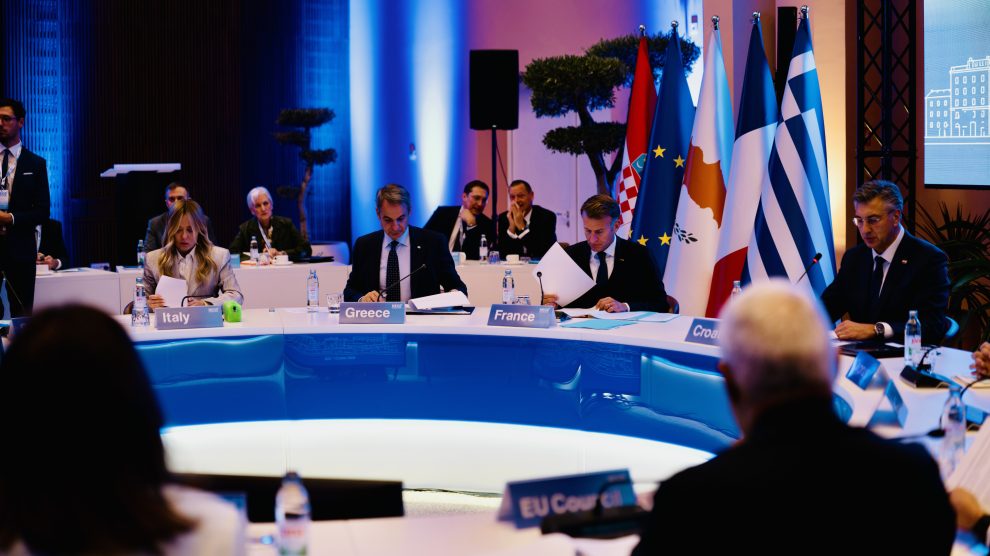
Why it matters: The MED9 summit in Split, which concluded Croatia’s presidency of the group, offered a chance to consolidate a Mediterranean position before the October 15–16 European Council, where leaders will discuss the 2028–2034 Multiannual Financial Framework (MFF).
- The group represents roughly 205 million people, nearly 45% of the EU population, and accounts for around 41% of its GDP, according to Croatian Prime Minister Andrej Plenković.
- Its shared priorities include economic competitiveness, energy security, migration management and ensuring that Europe’s southern flank receives attention alongside its eastern one.
The big picture: Plenković argued that Mediterranean countries can bring an integrated regional perspective to the EU’s broader strategic decisions. Italian Prime Minister Giorgia Meloni echoed that position, stressing the importance of aligning national priorities in the interest of Europe as a whole.
- “We must not forget how important our southern flank is,” Meloni said.
The budget battle: The main issue is how to finance defence, competitiveness, energy and migration without weakening the EU’s traditional cohesion and agricultural policies.
- Slovenia and Italy have pushed to preserve cohesion funding and the Common Agricultural Policy, a position also supported by the Friends of Cohesion initiative.
- Portuguese Prime Minister Luís Montenegro argued that “there is no European competitiveness without cohesion,” rejecting the idea that the budget debate should simply pit contributors against recipients.
- Greek Prime Minister Kyriakos Mitsotakis called for a budget commensurate with the EU’s ambitions.
- French President Emmanuel Macron advocated flexibility and savings while warning against creating a two-tier Europe from the outset.
Italy’s additional request: Meloni raised a separate issue concerning national fiscal rules and the impact of inflation on mandatory public spending.
- National spending plans were based on projected inflation of 1.8%, she explained, while higher prices have automatically increased costs for indexed pensions, benefits and projects under Italy’s National Recovery and Resilience Plan.
- “We are not asking for unrestricted spending,” Meloni said, arguing that unavoidable additional costs should be considered when applying public expenditure limits.
- She said she had discussed the issue with European Commission President Ursula von der Leyen and identified common ground with Greece. No agreement has yet been reached.
Energy: A common European response? High energy prices are undermining industrial competitiveness, increasing inflationary pressures and limiting governments’ fiscal room for manoeuvre.
- Croatia emphasised supply diversification, regional infrastructure and connectivity.
- Greece highlighted the importance of preserving refining capacity within the EU.
- Italy signalled its readiness to address rising fuel costs domestically while calling for structural European solutions.
- Portugal urged a coordinated EU response rather than leaving member states to act individually.
Zoom out: Energy security and sustainability are increasingly treated as interconnected priorities. Croatia’s MED9 presidency focused on building a safer, more sustainable and more resilient Mediterranean, including through water management, marine ecosystem protection, industrial decarbonisation and climate adaptation.
- Von der Leyen described the Mediterranean as “the blue heart of our Union,” linking lower energy costs with enlargement and more integrated, sustainable economies.
On migration: Agreement remains more difficult, although leaders share an interest in strengthening external border protection and cooperation with countries of origin and transit.
- Mitsotakis welcomed the Commission’s willingness to examine a Greek proposal for an EU emergency mechanism addressing sudden migration surges, the instrumentalisation of migration and hybrid threats.
- Italy, Slovenia and Croatia also emphasised border security, returns and combating irregular migration and cross-border crime.
Beyond migration: Regional instability featured prominently in discussions with Jordanian Crown Prince Al Hussein bin Abdullah II, who joined a working lunch focused on Middle Eastern developments, humanitarian assistance, and maritime and energy security.
- The summit coincided with the third anniversary of the October 7, 2023, Hamas attacks, prompting renewed discussion of Israel, Palestine and regional stability.
- Leaders also placed these challenges alongside Russia’s war against Ukraine, hybrid threats and wider global economic uncertainty.
The bottom line: Split produced a recognisable Mediterranean agenda: protect cohesion funding, finance new European priorities, coordinate energy policy and keep the southern flank on Brussels’ strategic radar.
- But political alignment is only the starting point. The real test comes at the October 15–16 European Council, when MED9 countries will have to turn their shared positions into negotiating leverage over money, fiscal constraints and competing priorities.
(Photo: Palazzo Chigi)