
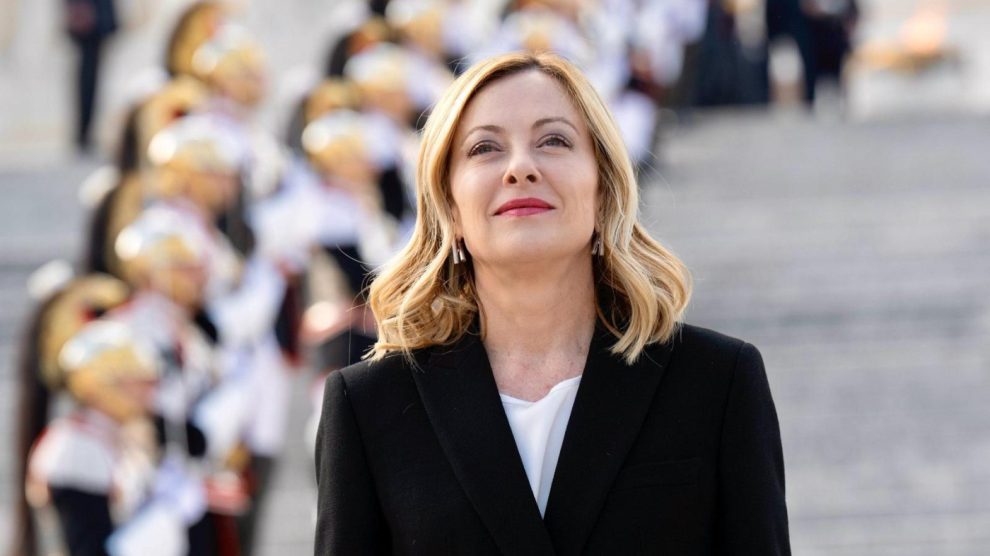
BARI (Puglia, Italy) – Giorgia Meloni is celebrating a milestone rare in Italian politics on Friday: 1,413 days in office, making her government the longest-lasting of Italy’s Second Republic and overtaking Silvio Berlusconi’s second government.
The prime minister will mark the record at a major event in the southern city of Bari, where some 10,000 people are expected and Meloni will deliver the centerpiece speech of a gathering designed to turn longevity into a political message: stability.
- But the celebration also comes as the government enters a more complicated stretch ahead of elections due in 2027, with economic pressures at home, tensions on the right and Meloni’s junior coalition partners facing challenges of their own.
Why it matters:
- Stability has become part of Meloni’s political brand. In a country long associated with short-lived governments, Brothers of Italy is presenting longevity as evidence that Italy can pursue longer-term political and economic strategies.
- Meloni remains the dominant force in the coalition. Her allies are increasingly in the background, while Brothers of Italy has widened the gap with its governing partners.
- The next test is electoral. The coalition must manage dissatisfaction over wages, health care and the economy, as well as competition from Roberto Vannacci on its right.
- Bari is both a celebration and a campaign marker. With elections due by October 2027 — and an earlier vote already being discussed — Meloni is starting to frame the case for another term.
Zoom in: The Bari show. Friday’s event is built around Meloni. The prime minister is expected to address the crowd at around 7:15 p.m. from the port of Bari, with a roughly 45-minute speech divided between the government’s record and its final stretch in office.
- The choice of Bari carries political weight. Brothers of Italy is performing strongly in Puglia, and the region is home to Raffaele Fitto, a Meloni loyalist who now serves as an executive vice president of the European Commission and is also due to speak.
- Meloni’s coalition partners will have a less prominent role. Noi Moderati leader Maurizio Lupi will appear in person, while Deputy Prime Ministers Antonio Tajani and Matteo Salvini are expected to join remotely.
- Both face pressures within their own political camps, while Vannacci has emerged as another competitor for votes on the right.
The big picture: Stability as policy. Brothers of Italy is making “stability” the central claim around the anniversary.
- The word appears five times in a 28-page document released by the party ahead of the event, which connects political continuity with Italy’s economic credibility and ability to navigate wars, tariffs and tensions with Donald Trump.
- The government is also highlighting employment. Its celebratory material points to 1.305 million additional permanent jobs during its 1,413 days in office and says more than half a million more stable jobs were created in less than four years than during the previous decade under left-led governments.
- The message is straightforward: longevity is not only a political record but an economic asset.
Between the lines: That stability has also required political caution.
- Carlo Galli, a political scientist at the University of Bologna, told our sister website Formiche.net that Meloni’s staying power rests on a combination of weak opposition, her own tactical skills and Brothers of Italy’s dominant position inside the center-right coalition.
- “There is a fairly close alignment between the government’s actions and what society wants,” Galli said. “Meloni will not be swept away by social protest. She will last the entire legislature, barring unforeseen events.”
- His broader point is that Meloni has governed incrementally rather than through abrupt political change.
Several of the right’s flagship projects remain unfinished, including differentiated regional autonomy, the bridge across the Strait of Messina and a reform strengthening the premiership.
- But for Galli, the absence of dramatic breaks is also part of the explanation for the government’s survival: Meloni has maintained a conservative direction while avoiding confrontations capable of destabilizing her coalition.
The other side of the record. Longevity does not remove the government’s vulnerabilities.
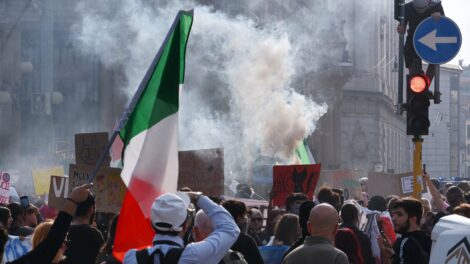
- The defeat in the recent referendum on judicial reform was a warning sign. Opposition parties are focusing their attacks on low wages, weak growth, falling industrial production, high energy costs and strains on the health care system.
- Democratic Party leader Elly Schlein argues that while Meloni celebrates, “Italy does not,” pointing to a stagnant economy. Five Star Movement leader Giuseppe Conte has framed the government’s four-year record more starkly: “Four years, zero reforms.”
- Galli also identifies low wages and health care as weaknesses in the government’s political narrative. “The government’s blanket does not cover all of society,” he told.
- The problem for the opposition is that discontent does not necessarily translate into support for the left.
Watch the right. Some dissatisfied voters, Galli argues, are instead moving toward abstention or Vannacci.
- That creates a challenge different from the one Meloni faced at the beginning of her term. Her coalition remains intact, but a section of the right-wing electorate may want a more radical political break than the prime minister has delivered in government.
- At the same time, Salvini faces pressure from the League’s northern wing, while Tajani’s Forza Italia is navigating its own internal evolution.
- “The real question,” Galli said, “is whether the fracture on the right will be repaired or whether, if it persists and deepens, it will benefit the current majority’s opponents.”
Follow the money. Bari could also offer clues about how Meloni plans to approach that electoral challenge.
- The prime minister is expected to focus on families and businesses, with a possible new targeted measure to cushion the impact of higher costs on households and struggling sectors.
- Other measures under discussion for the next budget include expanding income-tax relief, reducing taxes on 13th-month salary payments and increasing spending on urban security.
- The government is counting on Italy exiting the EU’s excessive deficit procedure to create more room for maneuver.
What we’re watching: Italy’s next general election is formally due by October 2027, but an earlier vote is already part of the political discussion.
- For Meloni, the logic of going early would be to capitalize on a more voter-friendly budget while limiting the time available for new divisions to emerge inside the coalition.
- That makes the Bari celebration more than a look back at 1,413 days in power.
The bottom line: Meloni has already broken the longevity record. The next challenge is turning stability from the defining achievement of her first term into the argument for a second.