Norway is already a key part of Italy’s energy security. Giorgia Meloni’s visit to Oslo showed that Rome now wants to turn that relationship into something broader — spanning critical raw materials, defence, space, subsea infrastructure and industrial cooperation.
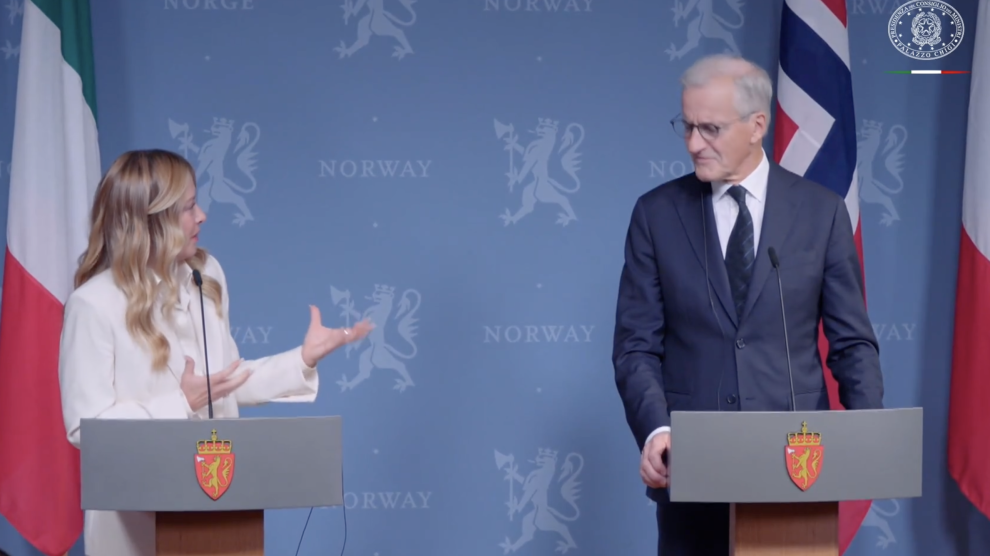
“For us, Norway is a first-tier partner in Europe, certainly because of the role it plays in diversifying Italy’s energy supplies: it is our fourth-largest gas supplier,” Meloni said after meeting Norwegian Prime Minister Jonas Gahr Støre.
Why it matters: The timing gives the energy relationship renewed strategic weight. Italy is trying to protect diversified oil and gas supplies as instability in the Middle East — from the conflict involving Iran to disruptions around the Strait of Hormuz and Houthi pressure on alternative shipping routes — increases uncertainty around traditional supply chains.
- But the Oslo talks also showed that Rome and Oslo increasingly see energy security as part of a much larger economic and security agenda.
Beyond energy. “Our two countries also have great potential in other areas,” Meloni said, pointing to bilateral economic cooperation.
- The Norwegian government echoed that message. Støre described Italy as “an increasingly important partner for Norway,” arguing that growing geopolitical instability requires greater European cooperation on “security, preparedness, energy and economic development.”
- The visit concluded with a working dinner bringing together leading Italian and Norwegian companies, designed to deepen direct links between the two industrial systems. Representatives from Saipem, Leonardo and Fincantieri were among the Italian companies in Oslo.
Zoom in: Critical raw materials are emerging as one of the most important areas for deeper cooperation.
- Rare earths, metals and minerals have become essential to the technological and energy transitions, while Europe remains heavily dependent on a limited number of external suppliers. Norway’s resource base and advanced industrial capabilities make it a natural partner for Italy as it looks to build more secure supply chains.
- The same logic extends to defence, space and the underwater domain. Protecting subsea infrastructure has become an increasingly important European security priority amid growing concerns over cables, pipelines and other critical assets beneath northern European waters.
- Rome and Oslo had already tested the appetite for deeper industrial cooperation at the Italy-Norway Business Forum held in Rome in June. The Oslo visit is intended to push that process further, particularly in energy, maritime technologies, space and defence-related industries.
Don’t react to Russian provocations. Ukraine was another central part of the talks. “Italy and Norway are working to strengthen the resilience of the Ukrainian people, supporting a negotiating perspective towards a peace that must be just and lasting,” Meloni said.
- Asked about Russian “provocations” recorded across Europe in recent weeks, the Italian prime minister warned against allowing Moscow to dictate the dynamics of escalation.
- “We have to ask ourselves who would benefit from a possible escalation and act accordingly,” Meloni said. “I don’t think we should respond to these provocations. I think responding to these provocations would be more in Moscow’s interest than Europe’s.”
The Arctic connection. The visit also carried a symbolic dimension, coinciding with the centenary of the 1926 Arctic flight of the airship Norge, led by Roald Amundsen and Umberto Nobile — an early example of cooperation between two countries geographically distant but increasingly connected by strategic interests.
- Today, the Arctic itself is becoming part of that relationship. Meloni and Støre discussed security in the High North, while Italy’s new Arctic strategy and its observer status in the Arctic Council give Rome a platform for deeper engagement with Norway.
- The region is becoming more consequential for European security, natural resources, scientific research and maritime connectivity, adding another layer to a partnership traditionally dominated by energy.
The big picture: Norway’s importance for Italy has grown as Rome has diversified away from unstable or geopolitically risky energy suppliers. Oslo offers something particularly valuable: a major hydrocarbon producer embedded in Europe’s economic and security architecture, even though it is outside the EU.
- That explains why the relationship is expanding beyond gas. Critical minerals, defence, maritime technology, space and subsea infrastructure all fit into the same broader effort to make European supply chains and strategic industries more resilient.
- Støre summed up the logic of the visit: Norway and Italy have companies that are leaders in their respective sectors, and greater cooperation can help provide “solutions to some of the major challenges Europe faces today.”
What’s next: Africa could provide another area of convergence. Rome sees its Mattei Plan as a framework for partnerships on energy, infrastructure and development, while Norway brings a long-established development cooperation footprint.
The bottom line: The Oslo meeting suggests that Italy and Norway increasingly see their relationship through the same lens: energy remains the foundation, but security, technology and industrial resilience are becoming the structure built on top of it.