
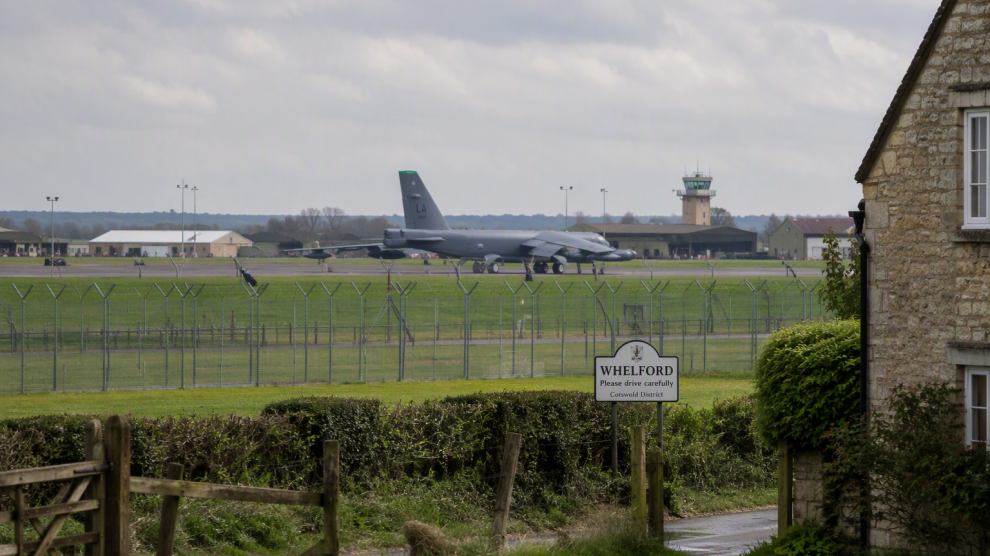
The five men detained Sunday near RAF Fairford in Gloucestershire are British nationals in their mid-twenties who live in London, police said Monday. They were arrested on suspicion of terrorism and explosives offences. What they were allegedly planning — and why — remains unclear.
“At this time, we are working to establish the full circumstances of the activity of those arrested, their knowledge and any motivation behind this incident,” Counter Terrorism Police said Monday, explicitly warning against speculation over its geopolitical implications.
Why it matters: Fairford is no ordinary airfield. The base has been used by U.S. bombers and support aircraft during operations “Epic Fury” against Iran, making an incident on its doorstep particularly sensitive.
- For Italy, the case touches a potentially uncomfortable distinction. Rome is formally outside Operation Epic Fury, but hosts some of Europe’s most important U.S. and NATO military infrastructure.
- Staying out of the conflict, in other words, does not necessarily remove the security risks associated with allied operations.
What happened: The arrests triggered a major security response around Fairford. Police and bomb disposal teams moved into the area and 85 nearby homes were evacuated.
- U.S. President Donald Trump said the suspects wanted to “do great damage to our base” and had been under surveillance.
- British investigators have been considerably more cautious. Police said Monday they were still working to establish the men’s activities, knowledge and motivations.
- It is important to note that no charges have been filed, and no public link to Iran has been established at this time.
The big picture: The alarm at Fairford comes amid growing concern over hostile activity around Western military infrastructure in Europe. European authorities have confronted Iranian intelligence activity, threats against dissidents and alleged plots involving intermediaries and criminal networks.
- At RAF Akrotiri in Cyprus, a Shahed drone of Iranian manufacture crashed near the British base in March without causing casualties.
- At Souda Bay in Crete, Greek authorities arrested a man suspected of photographing the U.S. aircraft carrier Gerald R. Ford and other military facilities.
- Tehran has also protested the use of Bulgaria’s Bezmer airbase by U.S. tanker aircraft.
- None of those cases establishes what happened at Fairford. Together, however, they help explain why an unexplained incident near a base involved in operations against Iran immediately carries wider security implications.
Zoom out: The vulnerability is broader than Iran. The separate case involving an armed Russian-linked drone at Leipzig airport belongs to a different threat stream. But both point towards a European security problem that increasingly extends beyond the conventional battlefield: protecting military and critical infrastructure from surveillance, sabotage, drones and operations designed to remain difficult to attribute.
The experts’ take: Fairford is reviving a debate over both the vulnerability of Europe’s rear areas and how governments should define the threat.
- For Raffaele Volpi, a former Italian undersecretary of defense and former head of Parliament’s intelligence oversight committee, Fairford challenges an assumption that has long shaped European security: that bases far from the battlefield constitute a safe rear area.
- An adversary unable to reach an aircraft in the air can try to reach it on the ground, Volpi explaines, potentially using cheap means and locally available operatives. Even a failed attack can impose costs, disrupt civilian life and create political pressure around the presence of allied forces.
- That lesson applies directly to Italy, he argues. The country hosts major U.S., NATO and Italian installations, including Aviano, Sigonella, Vicenza, Naples and Ghedi. Protecting them, in Volpi’s view, requires coordination between defense, interior and intelligence authorities that extends beyond the perimeter of the bases themselves.
- Ivan Caruso, a general and military adviser to the Italian Society for International Organization, offers a complementary warning: do not call every hostile act “war.”
- Caruso argues that sabotage, terrorism and state-sponsored covert activity occupy a sub-threshold space in which attribution is crucial. Fairford, at least on the facts currently available, remains a counterterrorism and criminal investigation — not an armed attack.
The distinction determines the response. Treat every incident as war and governments risk escalation and blurred institutional responsibilities; treat each as an isolated crime and they risk missing a coordinated campaign. Caruso’s prescription is less dramatic but demanding: intelligence, investigation, surveillance, resilience and careful attribution before political action against any state sponsor.
The Italian angle: Britain and Italy start from different positions. Britain has allowed Fairford to support operations connected to the conflict with Iran. Italy remains formally outside Epic Fury.
- But Italy also hosts a network of strategically important U.S. and NATO facilities, where American forces operate under existing arrangements. The relevant dividing line may therefore not be simply between countries that joined the campaign and those that did not.
- It is between political non-participation and physical exposure. That exposure does not imply that Italian bases are currently targets.
- It does mean that Fairford poses a practical question for Rome: whether the changing threat environment requires greater protection around facilities that could acquire relevance in a confrontation involving Italy’s allies.
- In an interview at Corriere della Sera, former Italian defense chief Vincenzo Camporini has pointed to the difficulty of protecting large military installations continuously, highlighting the need for stronger surveillance and measures against drones, as well as protection for ammunition and other sensitive assets.
Between the lines: One source familiar with security activities told Decode39 that a confirmed attempt to attack Fairford on behalf of Iran would amount to a “real turning point,” describing an attack on a U.S.-UK base as an act with few precedents since the Cold War.
- The source’s question for Italy is more immediate than that debate over terminology. “Can Parliament still maintain the illusion that this matter does not directly affect us?” the source inquired. “Furthermore, what are our recommendations for preparing for this situation?”
The bottom line: Fairford could fuel the argument that hosting allied bases means importing the risks of conflicts fought elsewhere. Volpi draws the opposite lesson: that is precisely the political effect an adversary would seek. The answer, he argues, is stronger protection and Euro-Atlantic solidarity.
- “Fairford reminds us that the front can reach the fence outside our homes,” Volpi writes. “It also reminds us that, when the state works and citizens trust the state, that is exactly where the front stops.”