
Donald Trump welcomed Xi Jinping with red carpets, bombers flying over the White House and a state dinner attended by some of the biggest names in American business, particularly the technology industry. On the thorniest issues in the US-China relationship, however, the Chinese president’s visit to Washington delivered far less.
The most tangible economic outcome was an extension of the trade truce until January 10 2027. The disputes that have defined the competition between the world’s two leading powers remain unresolved: tariffs, rare earths, Chinese agricultural purchases and US controls on advanced technologies.
There was no significant agreement on semiconductors, while on artificial intelligence the two governments largely committed to continue talks on managing risks.
- Nor were there new understandings over Taiwan. But the island — which Beijing regards as part of China and has vowed to bring under its control — remains the most sensitive of the red lines in the relationship.
The gulf between the ceremony and the deliverables was striking. Trump had already broken with decades of protocol by personally greeting Xi on his arrival at Joint Base Andrews. The following day, a B-2 bomber and four F-22 fighter jets flew over the White House during the welcoming ceremony.
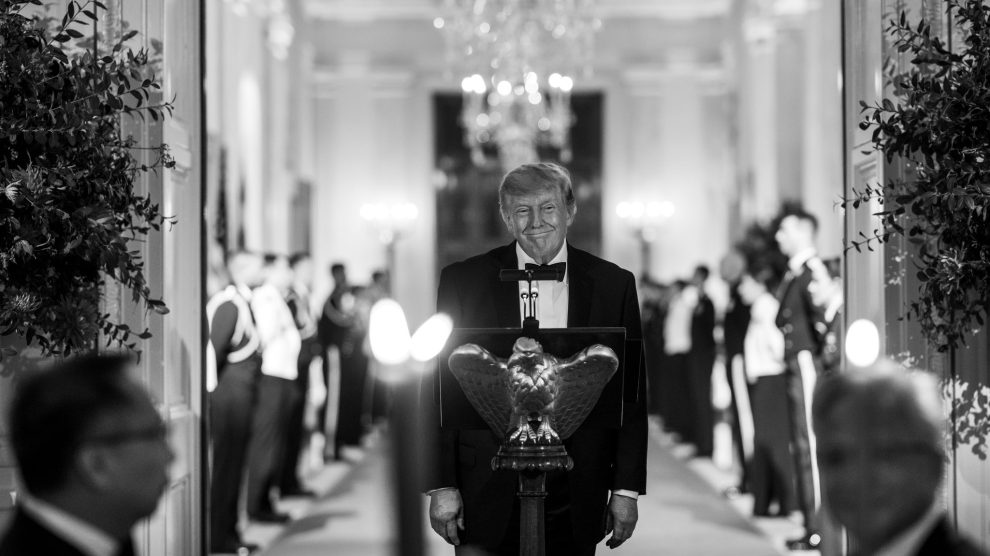
- After their meetings, Trump showed Xi Marine One, the presidential helicopter, and his new White House ballroom, before hosting the Chinese leader and his wife Peng Liyuan at a ceremonial dinner overseen by the office of First Lady Melania Trump.
Beyond the deal. Yet reading the visit simply as an exercise in pomp with little substance risks missing part of Beijing’s calculation.
- For Enrico Fardella, professor at the University of Naples L’Orientale and associate director of the Guarini Institute for Public Affairs at John Cabot University, the Chinese perspective rests on a different distinction: the most important outcome of the summit may not be the deal, but the framework intended to govern a rivalry that neither side expects to disappear.
- Xi has emphasised what Beijing calls a “constructive relationship of strategic stability” between China and the US. The Chinese readout of the meeting framed it around four ideas: co-operation as the prevailing orientation, competition within limits, manageable differences and a predictable peace.
- The aim, in this reading, is not to eliminate competition but to place political boundaries around it — preventing every dispute between the two powers from becoming a zero-sum confrontation.
Seen from Beijing, the extraordinary welcome in Washington therefore carries a different political meaning. After years of tariffs, technology controls and de-risking, Xi can present the images from the visit as evidence that the US must still treat China as a strategic interlocutor that can neither be isolated nor simply forced to accept American terms.
Xi’s midterm calculus. There is another factor that may be shaping Beijing’s calculations: domestic US politics.
- Drawing on the analysis of Wu Xinbo, director of the Center for American Studies at Fudan University, Fardella notes that Beijing is also watching the American electoral calendar.
- With the midterm elections approaching, Trump may see a successful Xi visit accompanied by visible economic gains as something that could, in Wu’s words, “add points” for him politically.
- That does not mean Beijing is seeking to determine the outcome of US elections. Rather, it suggests that Trump’s need to demonstrate tangible results before November could give Xi additional negotiating leverage.
- China, under this interpretation, does not necessarily need to offer one sweeping agreement.
Larger purchases of soyabeans can generate billions of dollars in trade that can be readily showcased in US farming states. New Boeing orders mean exports and jobs. Greater access to rare earths could ease pressure on American industry, while further action on fentanyl precursors would allow the White House to claim a result that is immediately intelligible to voters.
- Beijing could therefore give Trump visible economic wins without surrendering its most important strategic levers. The question then becomes what Xi might seek in return.
The Taiwan test. This is where Taiwan begins to look different. Fardella sees the island as a longstanding test of the balance within the US-China relationship. The historical parallel is imperfect, but previous negotiations between Washington and Beijing suggest a pattern: when one side has a stronger interest in securing an agreement, its willingness to compromise can become visible first over Taiwan.
- There have already been signals. An arms package for Taiwan worth about $14bn has remained on hold, and Trump has described it as a “very good negotiating chip”. After the May summit, the US president also said he had discussed arms sales to Taiwan “in great detail” with Xi.
- Asked how such an approach squared with the Six Assurances given to Taipei by the Reagan administration in 1982, Trump replied: “1982 is a long way away.”
- None of this amounts to a formal abandonment of Washington’s longstanding commitments. But in Fardella’s analysis, it raises the possibility that parts of US policy towards Taiwan could be handled by the White House in more explicitly transactional terms.
Beijing, meanwhile, is also focusing on language. Xi is not simply asking Washington to reiterate its traditional formulation that the US “does not support Taiwan independence”. The Chinese formulation seeks instead a US position that would “oppose Taiwan independence”.
- The distinction may appear narrow, but it could carry much broader political significance. The traditional American formulation stops short of opposing independence as a possible political outcome in itself, while also rejecting unilateral changes to the status quo. Adopting Beijing’s preferred language could therefore be presented in China as a meaningful shift even if Washington argued that the fundamentals of its policy had not changed.
The bottom line: The real test of the stabilisation sought by Xi and Trump may therefore come far from the White House red carpets — and beyond the trade files on which both sides can manufacture immediately marketable wins.
- “The history of US-China relations suggests that when Beijing and Washington are trying to understand which side wants an agreement more, Taiwan is often the first place where the answer becomes visible,” Fardella said.
(Photo: X, @WhiteHouse)