“The West stands at a crossroads: the next decade will determine whether it maintains its place at the top of the world or settles for a future of decline, submission and weakness.”
The big picture: US Secretary of State Marco Rubio chose Athens’ historic Pnyx Hill, overlooking the Acropolis, to deliver a speech that went well beyond US-Greek relations.
- The Pnyx was the meeting place of the ecclesia, the citizens’ assembly of ancient Athens.
- Rubio used that historical setting to frame a contemporary strategic challenge: how the West can preserve its position amid economic pressure from China and security threats from Russia and Iran.
Why it matters: Rubio linked Western identity to a strategic agenda that increasingly shapes both American and European policy: industrial resilience, critical minerals, technological leadership and defence.
What he said: “We choose to strengthen our country, without apology, to regain control of our critical supply chains, to reindustrialise our economy, to rebuild our defences and to pursue dominance in the technologies and industries of the future.”
Zoom in: Supply chains, critical raw materials and technological leadership were central to Rubio’s message.
- Washington’s Pax Silica initiative reflects this approach, seeking to reduce strategic dependencies and strengthen cooperation among trusted partners in AI, semiconductors and critical minerals.
The historical connection: Rubio recalled how ancient Greece shaped American political institutions and even Washington’s architecture.
- “Athens gave us democracy. Plato and Aristotle gave us philosophy. In Athens, we witnessed the first full expression of what came to define the West,” he said.
- For Rubio, the Greek pursuit of excellence offers a lesson for the present: Western countries must recover the ambition that once drove their development.
A message for Europe: Rubio’s argument was not simply about American renewal. It also challenged Europe to reconsider its ambitions at a time when competitiveness, industrial resilience and security are increasingly interconnected.
- “Great ruins exist all over the world. In many cases, they are places where history seems to have run its course, remnants of distant civilisations long vanished from collective memory. But the Acropolis is different,” Rubio said.
The key passage: The Secretary of State expressed his belief that Europe could “awaken from its long slumber and rekindle the flame that was lit here millennia ago.”
- For the EU, the question is how to translate that ambition into stronger industrial capabilities, more resilient supply chains and a credible role in global technological competition.
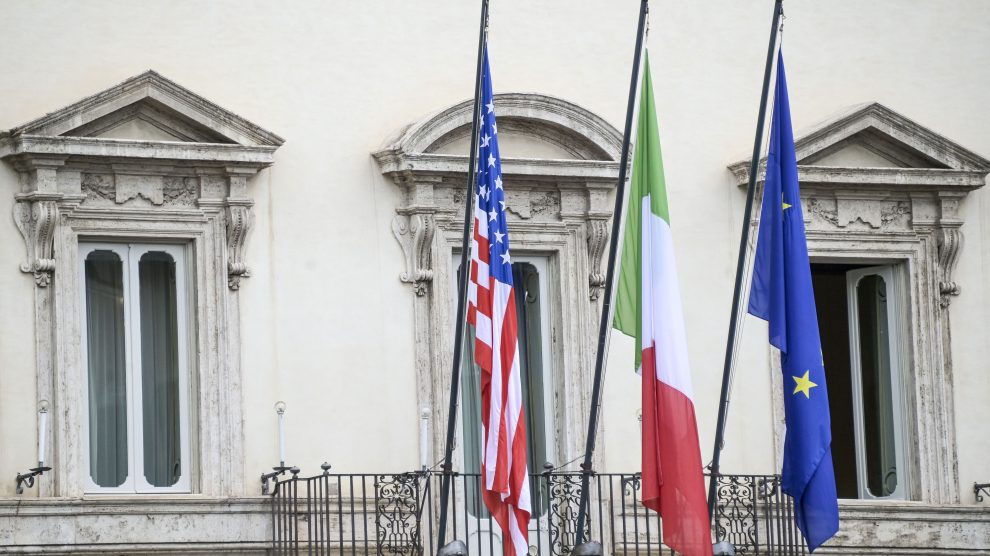
The Italian angle: Rubio’s message comes as Rome and Washington are reinforcing their strategic ties, particularly on defence, advanced technologies and economic security.
- Italy–US relations remain strong, supported by the diplomatic work of the Italian Embassy in Washington. Trump’s recent Columbus Day remarks reinforced that connection, praising Italian Americans for their “unwavering love of country and deep faith in God” and their contribution to America’s ambitions.
- From Trump’s celebration of Columbus to Rubio’s invocation of ancient Athens, both leaders draw on history to frame Western identity and ambition. For Italy, that legacy also carries a contemporary strategic dimension.
Why Rome is listening: As a major European manufacturing economy and a participant in the US-led Pax Silica initiative, Italy is directly involved in the choices Rubio outlined: securing critical supply chains, strengthening industrial capabilities and advancing technological leadership.
- The challenge: Turning closer alignment with Washington into economic and industrial opportunities while maintaining Italy’s European commitments and avoiding new strategic dependencies.
The bottom line: Rubio’s speech turned the Acropolis into a metaphor for Western renewal. His message was that preserving the West’s global position will require more than celebrating its historical legacy: it will demand industrial strength, technological leadership, secure supply chains and renewed strategic ambition on both sides of the Atlantic.