As tensions in the Strait of Hormuz continue to unsettle energy markets and renewed fighting in Yemen draws attention to security in the Red Sea, a question is emerging among observers of the Middle Eastern crisis: why have Iran and its regional allies not yet deliberately targeted the subsea cables that underpin global communications?
A threat beneath the surface. The question has acquired new urgency following statements by Mohsen Rezaei, secretary of Iran’s Supreme National Security Council, who warned on October 11 that Tehran could target subsea cables, data centres and artificial intelligence infrastructure should the conflict with the United States escalate again.
- For Fabrizio Bozzato, a geopolitical and international security analyst, Senior Research Fellow at Sasakawa Peace Foundation and Sovereign Military Order of Malta’s diplomat, the issue requires a different perspective. Before examining Iran’s capacity to sabotage digital infrastructure, it is worth considering what Tehran would actually gain from doing so.
- “Being able to damage something does not necessarily mean that doing so is a particularly intelligent choice,” Bozzato observes. The distinction is central to understanding the logic of Iranian coercion and its limitations.
The strategic value of an unfulfilled threat. The Strait of Hormuz is generally viewed through the prism of energy security. Tanker movements, liquefied natural gas exports and the American military presence dominate the debate. Yet the Gulf is also a critical space for digital connectivity, crossed by subsea infrastructure supporting financial services, logistics, communications and technological investment.
- Its importance is growing alongside the expansion of data centres and artificial intelligence projects, particularly in the United Arab Emirates and Saudi Arabia. In this environment, the vulnerability of digital networks provides Tehran with leverage without necessarily requiring military action.
- “A credible threat can create uncertainty, influence investment decisions, complicate insurance calculations and encourage regional governments to reconsider the possible consequences of a military confrontation,” Bozzato explains. “All of this can happen without a single cable being cut.”
The strategic paradox is that threatening essential infrastructure may generate greater deterrent value than actually attacking it.
- Iran can increase the perceived costs of American escalation while reminding Gulf governments how exposed their economic and technological ambitions remain.
- Destroying a cable, however, would introduce consequences far more difficult to control.
The limits of coercion. Subsea networks do not follow geopolitical divisions. They connect rival countries, trading partners, financial institutions and technology operators through interdependent systems. An operation intended to damage American interests could also disrupt communications in countries Tehran would prefer to keep neutral, or affect economies with which Iran maintains diplomatic and commercial relations.
- “Once the damage has been done, Tehran would have much less control over what happens next,” Bozzato points out.
- This consideration is particularly relevant in the Gulf, where strategic rivalries coexist with economic interdependence. Iran has an interest in imposing costs on its adversaries, but must also weigh the consequences of alienating neighbouring states or provoking a broader military response.
- Its decision not to deliberately target subsea infrastructure may therefore reflect strategic calculation rather than political restraint or a lack of operational capability.
That calculation, however, is contingent. Should the Iranian leadership perceive an existential threat, or conclude that its existing deterrent instruments are no longer effective, the balance between costs and benefits could change rapidly.
- Bozzato therefore cautions against interpreting Iranian warnings as announcements of imminent operations. Political signalling and operational intent remain distinct, even when a crisis makes the boundary between them increasingly difficult to identify.
Attribution and the risk of escalation. The problem of attribution adds another layer of uncertainty.
- Subsea cables can be damaged by anchors, fishing equipment, geological events or maritime accidents. Establishing whether a disruption was accidental or deliberate can require complex investigations, particularly in areas affected by military operations.
- Such uncertainty creates opportunities for actors seeking to exert pressure through ambiguous operations. Yet it can also become a source of unintended escalation.
- “In a highly tense regional environment, even an accidental fault could generate suspicions of sabotage,” Bozzato observes. A deliberately ambiguous operation, he adds, could provoke a response based on political assessments before conclusive technical evidence becomes available.
- The danger, therefore, lies not only in the possibility of an attack, but also in the risk that an incident might be interpreted as one.
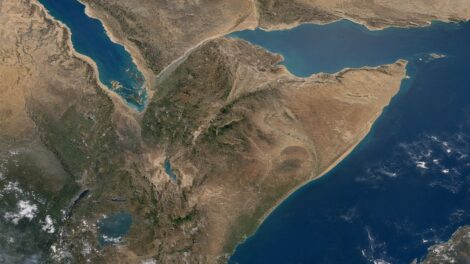
The Indo-Mediterranean dimension. Geography considerably expands the implications. Hormuz, the Arabian Sea, Bab el-Mandeb, the Red Sea and the Mediterranean form an interconnected strategic system in which energy flows, maritime trade and digital communications overlap.
- The Red Sea is one of the principal telecommunications corridors between Europe and Asia. Tensions along the Yemeni coast and the presence of the Houthis increase the exposure of subsea infrastructure, while potential disruptions could have consequences far beyond the immediate region.
- “The Gulf cannot be examined in isolation,” Bozzato argues, emphasising the strategic continuity linking Hormuz, the Arabian Sea, Bab el-Mandeb, the Red Sea and the Mediterranean. A disruption at one of these passages can have consequences far removed from where it occurs.
The Italian angle: This perspective places digital infrastructure security within the broader geography of the Indo-Mediterranean, the space of economic and strategic interconnection linking Europe, the Middle East and the Indo-Pacific.
- For countries such as Italy and Japan, whose prosperity depends heavily on international trade and reliable communications, the vulnerability of subsea cables is therefore a matter of both economic and national security.
Resilience as a strategic imperative. The response cannot rely exclusively on military instruments. Naval surveillance, monitoring of suspicious activities and intervention capabilities remain essential, but the scale of subsea networks makes permanent physical protection impracticable.
- “No navy, however capable, can permanently patrol every kilometre of cable laid on the seabed,” Bozzato notes.
- Resilience therefore becomes central: diversification of routes, redundancy of connections, repair capabilities, cooperation between governments and private operators, and timely information sharing.
The policy recommendation: These measures must be accompanied by diplomatic mechanisms for managing incidents, particularly when responsibility remains uncertain. Preventing a technical failure or an ambiguous episode from escalating into an international confrontation is itself an essential component of infrastructure security.
- The vulnerability of subsea cables exposes a fundamental contradiction in contemporary geopolitical competition. Digital infrastructure has become an essential strategic asset, yet its transnational nature makes it difficult to target an adversary selectively without affecting a much wider economic system.
- For Tehran, this interdependence represents both an opportunity for coercion and a constraint on the use of force. Threatening to interrupt communications may strengthen Iran’s negotiating position; carrying out that threat could undermine the regional balances its leadership seeks to influence.
The bottom line: Bozzato’s assessment is that the absence of deliberate attacks may reflect the intersection of strategic calculation, economic interdependence and concern over unintended consequences. None of these factors, however, guarantees that restraint will continue.
- The decisive question is therefore not simply why Iran has refrained from striking so far. It is whether governments and economies are prepared for a scenario in which Tehran, or one of its regional allies, concludes that the benefits of an attack finally outweigh the risks.
- “Understanding why something has not happened is useful,” Bozzato concludes. “Making sure we are able to deal with the consequences, should it happen, is considerably more important.”