
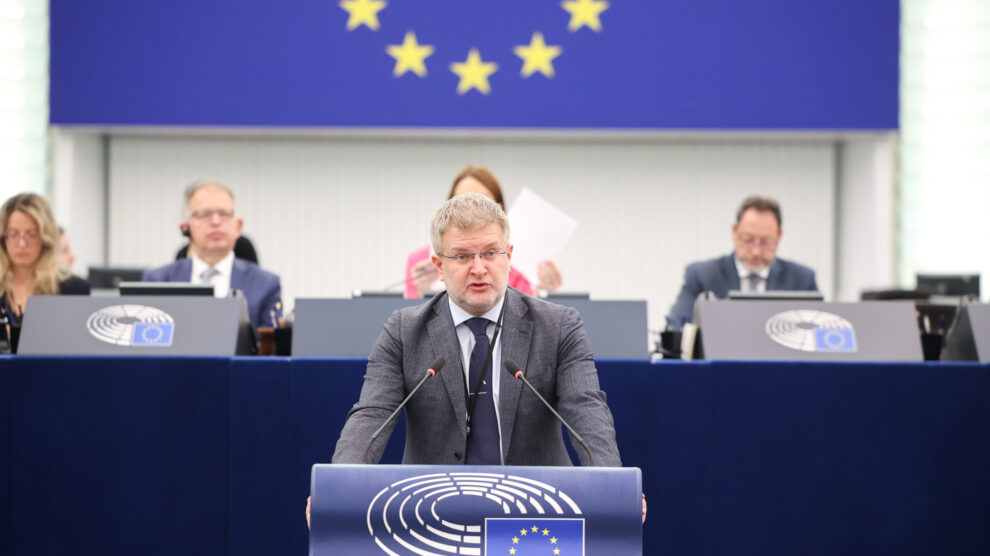
As every year, the event organised by NIAF with the thriving Italian-American community, as part of the Columbus Day celebrations, also provides an opportunity to take stock of bilateral relations between Italy and the United States. Relations that remain extremely strong, despite the recent disagreements between Trump and Meloni. This is what Carlo Fidanza, head of Fratelli d’Italia’s delegation to the European Parliament, told Formiche.net.
Q: What is the state of Italy-US relations following the recent controversies?
A: Work on concrete matters has never stopped, also thanks to the excellent contribution of the Italian Embassy in the US, led by Ambassador Marco Peronaci, and the American Ambassador in Rome, Tillman Fertitta, as well as the commitment of established organisations such as the American Chamber of Commerce in Italy.
- Investment flows continue in both directions. And the two governments have successfully concluded the agreement on Pax Silica, with Italy joining this strategic alliance on critical minerals, which is truly decisive if we want to carry out the transitions without increasing our dependence on China.
Q: What geopolitical role can Italy play?
A: Italy continues to believe in NATO, which today, more than ever, must evolve from a military alliance into a geopolitical alliance, involving like-minded countries that are still outside China’s orbit.
- Italy brings to the table its projection into the Mediterranean, the extraordinary vision behind the Mattei Plan for Africa, the strength of its relations with the Gulf countries, and an increasingly prominent role in Latin America thanks to political alignment with the continent’s new conservative governments, while awaiting further good news from Brazil. This is the result of the stability of our government and Giorgia Meloni’s extraordinary ability.
Q: How is Italian export performance holding up in the US market?
A: Our export figures are exceptional and continue to grow even in the US despite tariffs. We are suffering somewhat in the food and wine sector, but we are growing thanks to the extraordinary adaptability of our manufacturing industry and the results achieved by the pharmaceutical sector.
- On the latter, however, action is needed to limit the damage resulting from the American application of the Most Favoured Nation principle, which risks undermining competitiveness and research.
Q: Which sectors offer the greatest opportunities?
A: Beyond pharmaceuticals and life sciences, we obviously remain extremely strong in mechanical engineering. We have significant development opportunities in defense, extending this concept to space and the underwater domain, without forgetting shipbuilding, where Fincantieri has now established a consolidated presence in the US.
- And then we have the great opportunity to carve out a role in physical superintelligence, starting with humanoid robotics, which is where generative super-intelligence intersects with manufacturing, a field in which we excel.
- Nor should we forget that Giorgia Meloni was the first to raise the issue of global AI governance, to which she devoted an important part of Italy’s G7 presidency, and which is now enriched by a new opportunity promoted by AmCham Italy: making Milan not only Italy’s AI hub but also the headquarters of a new global agency for the ethical governance of superintelligence.
Q: What should the EU do?
A: Consolidating the Turnberry agreements is fundamental. We have always argued, rightly, that an agreement, even an imperfect one, would be better than no agreement and a consequent trade war.
- The EU has equipped itself with additional safeguards. We must continue working on sectors such as steel and aluminium, as well as on the list of food products exempted from the 15% tariffs.
- And we must handle carefully the big elephant in the room: digital taxation and fines imposed on Big Tech companies.
- Clear rules and simplification are the answer.
- Finally, we must not underestimate the potential impact that the new customs regulations introduced by the US administration at the end of September could have on our exporters, particularly SMEs.
Q: How should European strategic autonomy be pursued?
A: The EU is right to try to build supply chains with a higher percentage of Made in Europe content, but strategic autonomy must remain open and differentiated by sector, according to our ability to build genuinely European value chains, rather than merely French ones, as some would like.
- Moreover, European strategic autonomy must not become a daily act of retaliation against an ally deemed no longer reliable, but rather an intelligent industrial policy.
- The opposite of what the EU did with the Green Deal, which devastated our businesses and handed us over to China. Hence Giorgia Meloni’s courageous battle against the ETS system. On the green transition, I believe some of the hard blows delivered by Trump should help Europe open its eyes.
Q: Ukraine and Iran: Italy’s contribution and Brussels’ next moves.
A: Meloni has clearly expressed our assessment of this agreement and our support for the mutual ceasefire on energy infrastructure.
- I hope that, once the midterm elections are over, we can return to considering a strong push for peace in Ukraine without humiliating Kyiv.
- And then a dignified way must be found to bring this adventure in Iran to an end, putting the Tehran regime in a position where it can do no harm. The burden of the dual geopolitical crisis is proving too heavy, for Europe and for Italy in particular.