
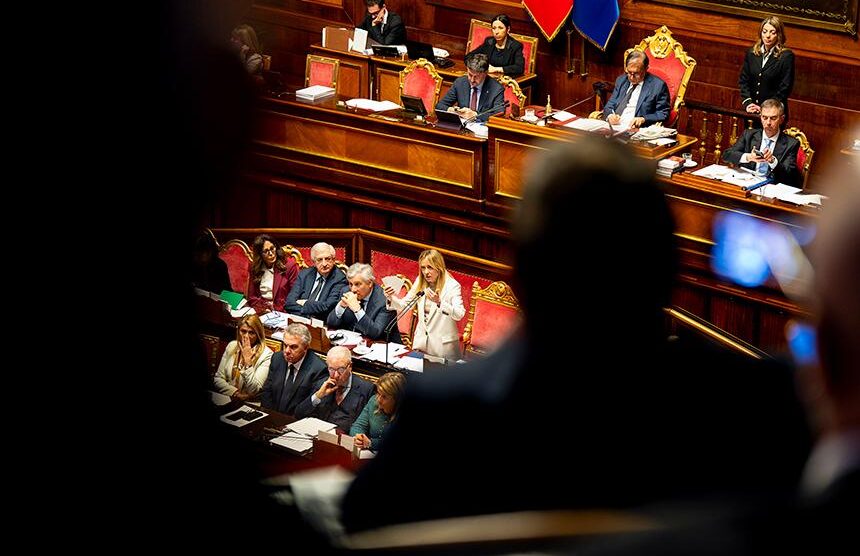
Speaking before the Italian Senate on Wednesday, Meloni framed the challenges facing Europe as interconnected, arguing that energy costs, industrial competitiveness, military security, geopolitical instability and migration pressures can no longer be addressed separately.
Why it matters: Meloni’s remarks offer a broader picture of how Rome intends to shape Europe’s strategic direction. Italy is pushing for an EU that is more pragmatic in its regulations, more assertive internationally and more attentive to the relationship between economic resilience and national security.
- The underlying message is that protecting national interests requires actively shaping European decisions rather than simply adapting to them.
Competitiveness becomes a security priority. Meloni placed Europe’s industrial competitiveness at the center of her agenda, linking the future of the single market to the continent’s ability to withstand external economic and geopolitical shocks.
- Energy first. European companies cannot compete globally while facing structurally higher energy prices than their international competitors, she argued.
- Regulatory reform. Rome is advocating faster authorization procedures for strategic projects, reduced bureaucratic burdens and fewer reporting requirements, particularly for small and medium-sized enterprises.
- Strategic supply chains. Italy wants Europe to reduce its dependence on foreign suppliers of critical raw materials, which are essential for both defense capabilities and the energy transition.
Zoom in: Italy has proposed hosting one of Europe’s first strategic critical raw materials storage facilities at Porto Marghera, potentially establishing a pilot project for broader European cooperation.
- Meloni also called for reconsidering European rules designed for a different economic environment, including aspects of the EU Emissions Trading System.
- Her argument is that Europe’s regulatory framework must support industrial production rather than undermine it.
Ukraine: European unity over diplomatic formats. Meloni reaffirmed Italy’s commitment to supporting Kyiv, maintaining pressure on Moscow and preserving transatlantic unity.
- She warned that Russia’s strategy increasingly relies on targeting civilian infrastructure and exploiting the vulnerability of Ukrainian society to energy disruptions.
- But her most politically significant remarks concerned Europe’s diplomatic coordination. Meloni criticized the fragmentation of European initiatives and questioned whether the E3 format — France, Germany and the United Kingdom — should operate without a broader European mandate.
- What she’s saying: If the E3 believes it can negotiate more effectively, it should do so on behalf of all European partners and with their explicit authorization, she argued.
- For Rome, the central question is not which countries occupy a seat at the negotiating table, but whom they represent and what common position they advance.
- Why it matters: The remarks highlight Italy’s determination to prevent Europe’s major powers from monopolizing diplomatic initiatives on Ukraine, while maintaining a unified position toward Russia.
- Meloni also described the recent U.S.-announced agreement concerning Russian diesel as a highly risky decision.
Middle East: A political opening for Europe. Meloni combined a reaffirmation of Israel’s right to security with criticism of several Israeli policies and military deployments.
- She condemned the October 7, 2023, Hamas attacks while expressing concern over Israel’s continued presence in southern Lebanon, Syria and Gaza.
- She also reiterated Italy’s opposition to Israeli settlements in the West Bank, annexation proposals and the forced displacement of Palestinians.
- What we’re watching on it: Meloni suggested that the formation of a new Israeli government, regardless of the election outcome, could create an opportunity for Europe to regain diplomatic influence.
- Rome wants the EU to pursue concrete initiatives, including:
- Facilitating the transfer of Palestinian tax revenues currently withheld by Israel to the Palestinian Authority.
- Freezing the E1 settlement project in the West Bank.
- Increasing humanitarian assistance to Gaza while preventing its diversion by Hamas.
- Exploring whether Hamas is genuinely prepared to disarm as part of a broader political process.
- Italy appears to be advocating a more operational European role in the region, built around specific diplomatic objectives rather than general declarations.
Migration as a hybrid security challenge. Meloni linked migration management to Europe’s wider security environment, warning that irregular migration flows can be deliberately manipulated by criminal networks and hostile actors.
- Referring to tensions around Ceuta, she described how traffickers, social media and disinformation can combine to amplify pressure on European borders.
- The prime minister defended Italy’s approach to migration management, citing Frontex figures showing that irregular crossings of the EU’s external borders have more than halved over two years.
- She also reiterated support for external migration-management mechanisms, including the Albania centers and return hubs in third countries.
Zoom out: The Mattei Plan for Africa remains central to Rome’s strategy, combining investment, economic partnerships and development cooperation with efforts to address the structural drivers of migration.
Defense is no longer just about military capabilities. Meloni presented an expanded concept of European defense, encompassing not only conventional military capabilities but also the protection of critical infrastructure and the resilience of civilian systems.
Rome’s priorities for the security agenda include:
- Protecting energy networks, undersea cables, ports and airports.
- Strengthening European anti-drone and missile-defense capabilities, with a significant contribution from Italian industry.
- Expanding cybersecurity and resilience against hybrid threats.
- Ensuring that the security of Europe’s external borders is treated as indivisible.
The bigger picture: Meloni argued that the distinction between economic security and military security is becoming increasingly artificial.
- An airport disrupted by drones, a hospital targeted by cyberattacks or an energy facility forced offline can generate strategic consequences without a conventional military confrontation.
- This perspective also informs Italy’s push to extend fiscal flexibility beyond defense spending to measures addressing the energy crisis.
- The prime minister defended military expenditure as an investment in national resilience and industrial capacity, stressing the economic role of Italy’s defense supply chain.
The bottom line: Meloni’s European agenda reflects a broader strategic proposition. The EU must become more capable of acting collectively on major geopolitical and economic challenges while allowing member states greater flexibility where national action is more effective.
- This approach combines industrial competitiveness, energy resilience, defense modernization, border security and diplomatic coordination within a single political framework.
- It also positions Italy as an advocate of a Europe that is stronger internationally without necessarily becoming more centralized internally.
- As Meloni put it, the objective is an EU that is ambitious on major strategic questions and restrained elsewhere — a Europe whose strength ultimately depends on the strength of its member states.