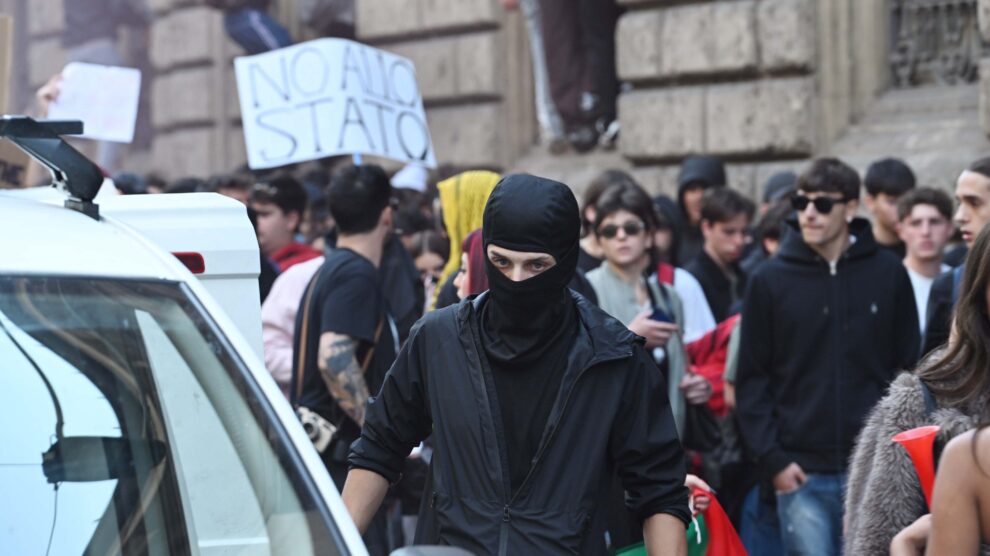
The protests that have swept across several European countries in recent weeks, from France and Belgium to Spain and Italy, where they have dominated public and political debate since the weekend, have exposed a discontent that extends well beyond the economic grievances from which many of them originated. Rising living costs, pressure on household incomes and difficulties accessing housing are feeding a sense of declining prosperity, while episodes of violence in several cities point to deeper social tensions.
The fractures in European prosperity. In Italy, these developments are compounded by longstanding structural weaknesses: stagnant productivity, sluggish real wage growth and limited opportunities for social mobility. Energy and inflationary shocks, partly linked to the regional war in the Indo-Mediterranean, have heightened economic insecurity, not least because national governments have limited scope to influence the international forces driving these pressures.
- Alongside material hardship lies a sociocultural dimension, particularly visible among certain segments of younger generations. Distrust of institutions, the erosion of shared reference points and uncertainty about personal prospects can foster resentment that lacks any recognisable political representation. In some settings, identity tensions among sections of second- and third-generation communities with migrant backgrounds intersect with social marginalisation and antagonistic national, cultural or religious narratives. These are distinct phenomena that should neither be generalised nor automatically associated with violence, but they add to the complexity of Europe’s social divisions.
Politics has not always managed these transformations effectively. Parties from different ideological traditions have often found it more rewarding to mobilise discontent than to develop sustainable responses. When the pursuit of electoral support takes precedence over confronting economic and institutional constraints, it encourages expectations that cannot be met and deepens distrust of the political system.
- This combination of economic, social and institutional vulnerabilities now carries implications beyond domestic politics. Amid intensifying geopolitical competition, divisions within democratic societies also present opportunities for external actors to exert strategic pressure.
The geopolitical exploitation of discontent. Russia has developed considerable experience in exploiting tensions within Western democracies. Disputes over immigration, support for Ukraine and, earlier, the management of the Covid pandemic, alongside broader questions of identity and institutional trust, provide fertile ground for influence operations designed to intensify polarisation and weaken European political cohesion.
- An illustrative example comes from Rybar, an influential Russian information network with close ties to the military establishment, which circulated a map of recent European protests, bringing together demonstrations, arrests and injuries across several countries. Events differing widely in their causes, scale and intensity are presented as elements of a single picture of a continent experiencing mounting instability.
- The significance of this exercise lies in how genuine events are selected, partially stripped of their context and assembled into a narrative consistent with Moscow’s strategic interests. Through Telegram and the circulation of material across multiple platforms, such representations can reach different audiences and reinforce interpretations that deepen existing divisions.
Why it matters: The dissemination of such a map does not establish Russian involvement in organising the protests. It demonstrates, rather, how those protests can be used to portray Europe as a politically fragile system. Readers are presented with an image of a dysfunctional model, corroded from within and therefore unworthy of aspiration, particularly for Russian society itself.
- This approach belongs to the broader repertoire of information warfare, in which deliberate disinformation, the circulation of misleading material, coordinated amplification and astroturfing — the artificial creation of apparently spontaneous grassroots support — can be combined to manipulate public debate. The same incidents of violence can be portrayed as evidence of protester extremism, authoritarian repression by governments or widespread European discontent. These competing interpretations ultimately serve to erode confidence in democratic institutions.
The algorithmic dimension extends these possibilities. Coordinated influence operations involving inauthentic accounts and content distributed through TikTok — whose powerful recommendation algorithm is controlled by a Chinese company — and other platforms have been documented on several occasions. Such precedents demonstrate how digital networks can amplify particular protest movements and shape public perceptions of political confrontation.
- Recommendation algorithms can also direct politically sensitive material towards specific audiences, potentially affecting patterns of mobilisation. The distinction between algorithmic amplification, coordinated manipulation and deliberate intervention by state actors remains essential, even as it is often difficult to establish in practice.
From information operations to hybrid threats. The exploitation of democratic vulnerabilities forms part of a strategic competition that has moved well beyond traditional propaganda. Information operations can accompany cyberattacks, sabotage, provocations and other covert activities, in combinations associated with hybrid warfare.
- Hostile operations attributed to Russia in Europe in recent years have demonstrated how different instruments can be deployed to put pressure on Western societies, complicate the work of public authorities and foster insecurity. Large demonstrations may offer particularly favourable conditions for provocations whose origins are difficult to establish immediately, especially where existing tensions make rapid escalation more likely.
- The potential convergence of physical interference and digital amplification presents a particularly sensitive vulnerability. Through the selective circulation of images, an isolated incident can acquire disproportionate political significance, further radicalising relations between demonstrators, law enforcement and political institutions.
None of this justifies automatically attributing episodes of violence to foreign actors. Distinguishing between the opportunistic exploitation of unrest, coordinated operations and the direct involvement of state agencies remains essential, although certainty is not always attainable.
- The complexity of hybrid operations, the overlap between actors, instruments and levels of intervention, and the use of intermediaries and networks that cannot readily be traced to a single decision-making centre can make responsibility exceptionally difficult to establish. Part of their strategic effectiveness lies precisely in this ambiguity: uncertainty constrains the ability of institutions to respond and can itself become an instrument of destabilisation.
The transatlantic dimension. Europe’s vulnerabilities are also unfolding against a broader transformation of the Western order, itself frequently exploited in rival powers’ narratives. For much of the postwar period, American leadership sustained a system in which collective security, economic prosperity and democratic institutions formed part of a shared political project.
- Donald Trump’s first and second administrations have introduced a significant departure from this tradition. Their emphasis on national sovereignty, transactional approach to alliances and criticism of multilateral institutions have helped shift the focus from preserving a collective order towards a more immediate conception of American national interests.
- This evolution does not explain Europe’s social tensions, but it has made the common political vision that served for decades as a source of Western cohesion less clearly defined. For societies already experiencing economic uncertainty and crises of political representation and belonging, the changing American role introduces another layer of insecurity. It also gives rival powers further material with which to challenge the credibility and durability of the West.
Social cohesion as a security imperative. The growing interdependence of social cohesion, the quality of democratic debate and strategic security calls for a broader understanding of European resilience. Domestic vulnerabilities, traditionally addressed through economic and social policy or public-order measures, can now become instruments of pressure for actors pursuing hostile geopolitical objectives.
- Countering this requires action on the conditions that make influence operations effective. Purchasing power, essential public services, opportunities for younger generations and confidence in political representation have acquired direct strategic significance. At the same time, European governments should strengthen their ability to detect coordinated campaigns, improve transparency around algorithmic systems and integrate information security into their strategies for countering hybrid threats.
The difficulty lies in preserving a fundamental distinction. The freedom to demonstrate and challenge government decisions is an essential feature of liberal democracy. Conflating dissent with foreign interference, or responding to vulnerabilities through indiscriminate restrictions on civil liberties, would weaken the very political model that such measures are intended to protect.
- That model continues to exert influence around the world and, for this reason, remains a target of strategic rivals whose opposition to it also serves to justify their own tight control over political power and the populations they govern.
The bottom line: The ability of rival powers to exploit Western divisions depends in part on how deep those divisions run. The security of European democracies will therefore increasingly rest on their capacity to address internal contradictions, preserve the integrity of public debate and restore a credible prospect of prosperity and belonging.
- In an era of intensifying strategic competition, the quality of democratic life has become an integral part of European security.