
National security is increasingly about the ability of societies to withstand disruption, manipulation and polarization. That places new responsibilities on technology companies, local institutions and civil society, while raising difficult questions about how democracies can protect themselves without compromising their openness.
The big picture: In his October 13 threat update, MI5 Director General Ken McCallum described a generational shift in national security, with hostile states, terrorism and emerging technologies exposing vulnerabilities that extend into everyday life.
- MI5 has elevated “Protect” to a third core mission, alongside counterterrorism and countering state threats.
- McCallum identified three dimensions of resilience: systemic, covering critical infrastructure; societal, addressing attempts to divide communities; and technological, particularly concerning artificial intelligence.
- His proposed response is a “team of teams” involving government agencies, businesses and wider society.
The shift: Security agencies are increasingly confronting threats whose effects depend on conditions they cannot directly control, from the design of digital platforms to public trust in democratic institutions.
Where the warning falls short. In their Council on Foreign Relations analysis, Farah Pandith and Ezra Hess identify gaps in McCallum’s assessment concerning algorithm-driven echo chambers, youth radicalization and hate crimes.
- Their broader argument is that polarization, distrust and prejudice can create vulnerabilities exploited by extremists and hostile states, making community-level resilience and social cohesion essential to national security, even though they largely fall outside the intelligence services’ remit.
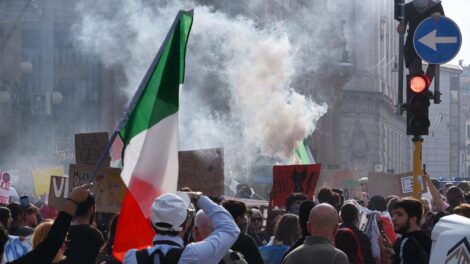
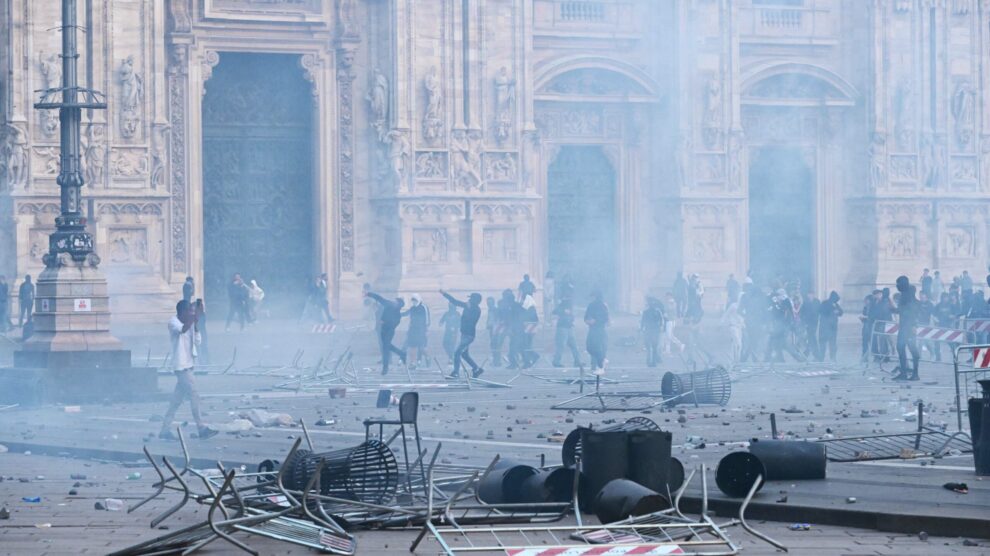
Europe offers a test case. The protests and violent incidents that unfolded across several European cities after McCallum’s speech have given the debate immediate relevance. European authorities are examining possible foreign online interference, including activity involving pro-Russian networks and other suspected actors.
- The investigations concern possible efforts to exploit and amplify unrest, rather than established foreign responsibility for the demonstrations.
- Political grievances can be genuine even when outside actors attempt to manipulate their visibility or intensity.
- Digital amplification, operational coordination and direct involvement in violence remain separate questions requiring separate evidence.
Why it matters: Hostile actors may be able to exploit domestic tensions without organizing them. Their strategic advantage can lie in aggravating existing divisions, complicating political decision-making and undermining institutional credibility. That possibility also makes attribution particularly difficult.
The Italian dimension. Italian Defense Minister Guido Crosetto has repeatedly warned about hybrid warfare and the potential use of social media platforms by foreign states to monitor, profile and influence users.
- His concerns highlight the strategic importance of digital infrastructure: platforms collect behavioral data and shape information exposure through systems that governments do not directly control.
- Italy’s recent protest-related security debate adds another layer. Officials have raised concerns about organized crime exploiting domestic unrest, alongside wider European scrutiny of suspected foreign-linked online campaigns.
- These allegations require independent verification and should not be treated as evidence of coordination between criminal organizations and foreign governments.
The distinction matters: Foreign states, criminal networks and domestic protest movements may pursue entirely different objectives while contributing to similar patterns of disruption.
- For security agencies, identifying those differences is essential. For policymakers, addressing the underlying grievances remains a separate responsibility.
The democratic dilemma. McCallum’s whole-of-society approach presents an institutional challenge: how far should national security responsibilities extend into areas traditionally governed by politics, education, technology regulation and civil society? The risk is that an increasingly broad definition of security could encourage authorities to interpret legitimate disagreement as a potential source of instability.
- Intelligence agencies need stronger capabilities to identify hostile influence operations, even if uncertainty over attribution cannot justify presumptions of foreign involvement.
- Technology companies may need to cooperate more closely with governments, under clear rules for information sharing, accountability and oversight.
- Local institutions need resources to address the conditions that make communities vulnerable, without turning social cohesion into an exercise in political conformity.
The strategic stakes: A democracy’s international influence depends partly on its ability to sustain difficult decisions, from defense spending and sanctions to long-term support for allies.
- Polarization and declining institutional trust can complicate those choices even when military and economic capabilities remain intact.
- But democratic disagreement is also an essential safeguard against poor decisions. Protecting political debate cannot mean insulating governments from criticism.
What we’re watching:
- In Britain: Whether MI5’s expanded Protect mission produces concrete partnerships, measurable outcomes and clear accountability.
- Across Europe: Whether investigations establish the scale and effectiveness of suspected foreign interference.
- In Italy: How authorities distinguish criminal infiltration, foreign influence and legitimate protest while responding to underlying economic grievances.
The bottom line: MI5’s warning points to a growing paradox in democratic security. The ability to resist hostile interference depends increasingly on public trust, institutional credibility and social resilience — conditions that intelligence agencies can help protect but cannot create on their own. How democracies build that resilience will matter as much as the threats they are preparing to confront.