
Italy is positioning the Arctic and Antarctic as long-term strategic priorities, seeking a greater role in regions increasingly central to global trade, economic security and geopolitical competition.
Why it matters: For Rome, the stakes extend well beyond scientific research. The opening of new maritime routes, competition over natural resources and growing military activity are turning the polar regions into areas of direct national interest.
- Italy’s government sees engagement today as essential to securing economic and political influence over the coming decades.
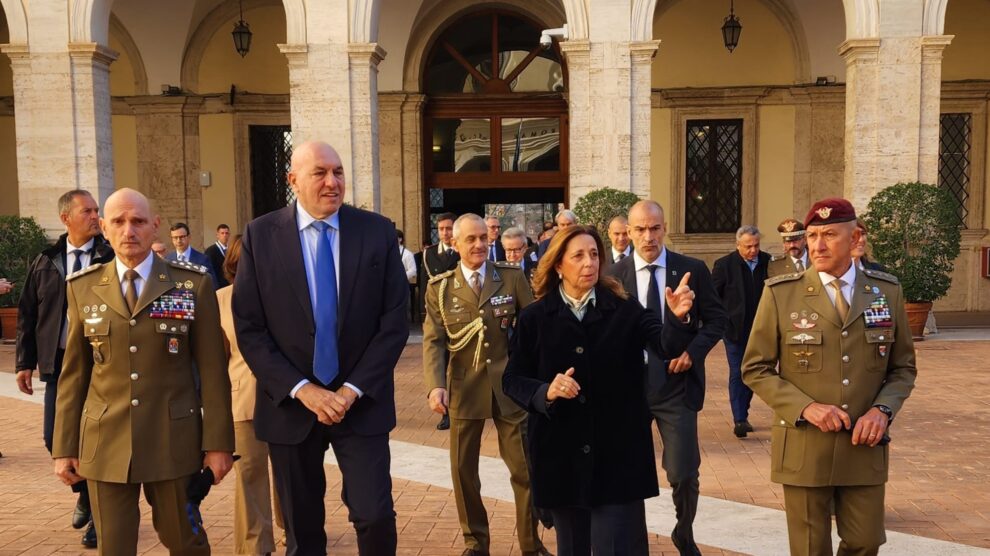
Driving the news: Italy’s second national conference on “Arctic and Antarctic – The National System in the International Scenario and the New Challenges of Global Competition” brought together senior government officials and military leaders, including Defence Minister Guido Crosetto, Foreign Minister Antonio Tajani and Chief of Defence Staff General Luciano Portolano.
- The discussions marked another step in Rome’s efforts to translate its Arctic strategy into a coordinated national approach, bringing together diplomacy, defence, scientific research and industrial interests.
What they’re saying: Crosetto stressed the strategic importance of maintaining a presence in areas that could become critical to potential adversaries.
- “The region must be monitored because anything that is fundamental to a potential future enemy becomes important to us,” he said.
- Tajani called for a more assertive Italian approach to the competition over resources, commercial routes and security. Italy must become “an increasingly active player,” he said, rather than reacting to initiatives taken by others.
- The competition, he added, has both military and economic dimensions, particularly given Russia’s and China’s growing involvement.
The trade dimension: For Italy, one of Europe’s major manufacturing and trading economies, the potential development of Arctic shipping routes carries particular significance.
- Tajani argued that diversifying maritime connections has become a strategic necessity following disruptions affecting the Strait of Hormuz and the Bab el-Mandeb Strait, two critical chokepoints linking European markets to global supply chains.
- “For Italy, opening an alternative route for goods is vital,” he said, emphasizing freedom of navigation as a fundamental national interest.
- The issue was also discussed during recent talks in Istanbul involving Germany, France, the United Kingdom, Saudi Arabia, Egypt, Türkiye and Pakistan.
The bigger picture: Arctic maritime routes could eventually provide alternative connections between Europe and Asia, although their commercial viability remains constrained by seasonal conditions, infrastructure limitations and significant operational costs.
- The geopolitical implications are already emerging. China’s growing interest in Arctic shipping and its connections with Indo-Pacific trade illustrate how developments in the High North could affect commercial flows and strategic balances far beyond the polar region.
- For Italy, the calculation is therefore broader than the immediate prospect of shorter shipping distances. It concerns the ability to influence future transport networks, protect supply-chain resilience and participate in decisions affecting the global trading system.
The security angle: General Portolano warned that Russia and China are demonstrating greater initiative in the Arctic than NATO, underscoring the region’s growing importance for military planning.
- Deterrence, he argued, “is also played out in the polar regions.” The assessment reflects wider concerns about military activity, critical infrastructure protection and the implications of geopolitical competition for the Euro-Atlantic security architecture.These concerns also extend below the surface.
- In a recent interview with Decode39, General Carlo Di Somma, Chairman of the Joint Steering Committee for the Arctic, Sub-Arctic and Antarctic Environments, highlighted the risks facing underwater infrastructure and the importance of Italy’s technological and defence capabilities in addressing emerging threats.
Zoom in: Under Prime Minister Giorgia Meloni, Italy has sought to give the Arctic a more prominent place in its strategic outlook.
- Defense Undersecretary Isabella Rauti recalled that Italy’s Arctic strategy identifies the region’s transformation from a primarily geographical concern into a strategic issue. She also pointed to the European Union’s recently presented Arctic strategy, highlighting its emphasis on security, infrastructure resilience, defensive deterrence and countering hybrid threats.
- The EU increasingly recognizes the Arctic as both a strategically important and vulnerable region, Rauti said, calling attention to the need for a more proactive European role in the High North.
- Rauti has previously outlined Italy’s approach to Arctic security, emphasizing the connections between the High North, Mediterranean security and NATO’s broader deterrence posture.
The scientific foundation: Italy’s growing strategic ambitions build on decades of polar research and international scientific cooperation. The country maintains an established research presence in both the Arctic and Antarctica, providing a foundation for its diplomatic credibility and participation in polar governance.
- As highlighted during the National Polar Conference earlier this month, Italy’s scientific community is working to consolidate its priorities through a White Paper covering the Arctic, Antarctica and the Himalayan Third Pole.
- The initiative reflects an increasingly integrated approach to climate research, technological development and the geopolitical implications of environmental change.
- Italy’s Antarctic engagement also has a diplomatic dimension, reinforced by its hosting of the Antarctic Treaty Consultative Meeting in Milan in 2025.
What’s next: Rome intends to increase investment in its Arctic and Antarctic policies, combining diplomatic engagement, defence planning and scientific research.
- Tajani described these investments as necessary to protect Italy’s vital interests, pointing to research initiatives promoted by University and Research Minister Anna Maria Bernini and the work coordinated by Rauti within the Defence Ministry.
- The challenge will be to sustain these efforts over time, aligning national capabilities with NATO and EU priorities while strengthening Italy’s participation in emerging polar economic and governance frameworks.
The bottom line: Italy’s polar ambitions reflect a broader reassessment of its international role as geopolitical competition extends into regions once largely associated with scientific cooperation and environmental research.
- For Rome, the challenge will be translating strategic attention into sustained political influence, research capabilities and economic opportunities — ensuring that Italy has a voice in shaping the polar regions’ future rather than adapting to decisions made elsewhere.