Defense demand is putting Italy’s small and medium-sized defense companies under increasing pressure. Many have strong technological expertise and solid order books, but lack the financial resources and managerial structures needed to support sustained growth.
A changing landscape is exposing the limits of traditional family-owned business models, as companies struggle to meet rapidly expanding demand and maintain production capacity.
Tekne, the Abruzzo-based company specializing in military mobility and electronic warfare, has entered the orbit of US-listed Nuburu. Its new CEO, Gianluca Trezza, aims to turn the arrival of fresh capital into an industrial acceleration while safeguarding the company’s Italian identity, technological sovereignty and local roots.
Q: You took over as Tekne’s new CEO just a few weeks ago. What kind of company did you find?
A: Since 2023, Tekne had been going through a financial crisis, primarily related to cash flow. This is what can happen to small, family-run companies that grow rapidly without having the managerial structures and resources to support that expansion. Orders increase exponentially – which should be good news – but the business struggles to keep up, burns through cash and, particularly in recent months, had effectively ground to a halt.
- Tekne has a substantial order backlog and a promising pipeline, but its engine has stopped and needs restarting. Two things are needed: financing and stronger management, which also means a change in governance. The goal is not to change Tekne’s value proposition, but to relaunch it, fully respecting the direction set by the ownership and founder while making the necessary adjustments and, above all, accelerating growth.
Q: This new direction was made possible by Nuburu’s entry into the company’s shareholder structure. Will this compromise Tekne’s Italian identity?
A: Nuburu is an American company listed on the New York Stock Exchange, but it is Italian-led. Its two co-CEOs are Alessandro Zamboni, originally from Turin and now based in Bergamo, who leads the group’s financial and strategic activities and conceived the project for an Italian defense and security platform, and Dario Barisoni, a Milanese executive with a background in the defense industry.
- Founded years ago as a research and development spin-off focused on laser technology, Nuburu subsequently went public. It first strengthened its financial position, after which its executive team launched an acquisition program. The strategy is to leverage the company’s ability, through its Defense and Security program, to raise capital on Wall Street – the world’s most liquid financial market – and invest it not only in the United States but also in Italy and Europe, supporting the defense industrial base.
- The situation in Italy is well known. Many outstanding small companies are now facing a sudden surge in demand that their traditional family-business models can no longer sustain. The country has yet to develop a fully-fledged defense finance ecosystem. That process is now underway, but existing resources are insufficient.
- Part of the industrial sector is being absorbed by national champions such as Leonardo and Fincantieri, but a significant portion remains uncovered. Without an injection of capital and managerial expertise, these companies risk falling into difficulty or even disappearing, taking sovereign technological capabilities with them. That would represent an unacceptable loss for Italy’s national defense capabilities.
Q: When a foreign group acquires a stake in a strategic defense-sector company, concerns about sovereignty are understandable. How do you address them?
A: I would say those concerns are legitimate. That is precisely why the acquisition was made subject to Italy’s golden power requirements, following several assessments at government level. In our case, however, those concerns are unfounded.
- Nuburu is building an ecosystem of different but complementary companies, with the aim of industrializing an Italian industrial base. Alongside Tekne, there are two other companies:
- Lyocon, which specializes in photonics and laser technology.
- Orbit, a software company developing advanced software for operational resilience management. Its solutions can be integrated with conventional command-and-control systems, potentially enabling advanced decision orchestration for defense and security strategies.
- The industrial base is Italian, the financial base is American, and the target market is essentially global. In the future, we intend to use Nuburu’s US presence to access the American market, which remains the world’s largest in terms of wealth and opportunities. For now, however, all our efforts are focused on Italy.
Q: So how is the company’s governance structured today?
A: It is entirely Italian and has an institutional profile. The designated chairman of the board is Pietro Serino, a general and former Chief of Staff of the Italian Army.
- His appointment serves two purposes: it provides a bridge to the armed forces and represents an institutional guarantee. Despite having a foreign majority shareholder, Tekne remains committed to serving the Italian armed forces and operating as a national industrial player.
- We have made a commitment to preserve jobs in Italy and continue investing locally, particularly in the Chieti area and the supply chain surrounding Abruzzo.
- Collaborations with universities in Abruzzo have already been launched. Other initiatives are being considered, although it is too early to provide details. Our approach is that of a company committed to its local community, building roots and creating synergies with institutions, academia and the national supply chain.
Q: And what about the company’s business activities? Will there be any changes?
A: Tekne was already operating across five business verticals, and we intend to relaunch all of them.
- The first is the military sector, covering armored and armed vehicles, including the MLS Shield. It is currently operating in Ukraine, where it has received very positive feedback, saved lives and demonstrated considerable resistance to drone attacks.
- The second is the civilian government sector. The Graelion, which also has a military version, is a typical example. It addresses a niche market requiring a combination of size, agility and mobility that only a handful of companies worldwide can provide. Tekne is a leader in this segment. Where highly capable 4×4 mobility is required, such as in mountain environments, national and foreign fire services see the Graelion as a solution to an otherwise unmet operational need.
- The remaining three verticals are:
- Special-purpose industrial vehicles: platforms designed for specific industrial applications.
- One-off vehicles: bespoke projects developed for individual customers with specific requirements. These range from emergency escape shuttles for mines to armored vehicles for special forces. This highly customized engineering capability is at the very heart of Tekne’s origins.
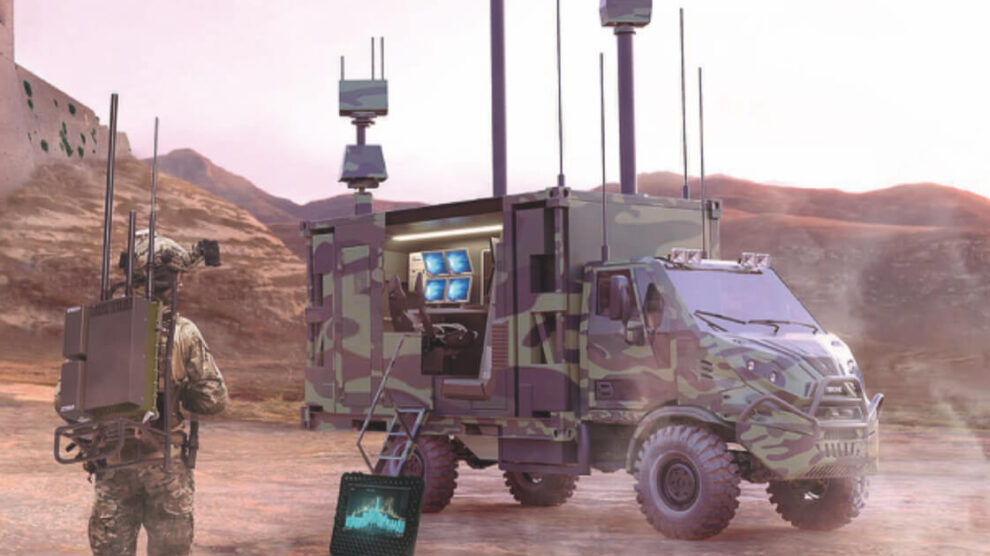
- Electronic warfare: the company has advanced capabilities in communications-band jamming systems, which have become essential assets in countering drones.
- These five areas are interconnected, with expertise developed in one vertical feeding into the others. Together, they form a single industrial, technological and manufacturing capability.
Q: What are the advantages of treating dual-use applications as a starting point rather than an end goal?
A: The advantages are partly self-evident: two interconnected markets, offering both diversification and shared technological and industrial capabilities. Dual use is one of the industrial responses to the paradigm of hybrid warfare, which is not fought exclusively on the battlefield but across multiple domains. Having not only dual-use capabilities but also a dual-use mindset means avoiding an exclusive focus on military products and broadening the scope of technologies, markets, needs and adjacent requirements.
- This expands the perspective of both engineers and management, allowing them to develop solutions better suited to countering today’s threats, which are not exclusively military in nature.
- Working for police forces, fire services or certain industrial sectors still falls within the broader security and critical infrastructure domain. This is the approach of expanded defense, which today represents the appropriate response to expanded warfare.
Q: Another distinctive feature is that Tekne directly manufactures both its own platforms and effectors.
A: Yes, and this is a combination rarely found in a company of this size, making it a significant competitive advantage.
- The Tactical Bubble project, in which Tekne played a central role, is the clearest expression of this approach. The idea is to develop the two components synergistically by creating a missionized mobility platform: the four-wheeled vehicle, currently crewed but potentially unmanned or optionally piloted in the future, becomes the native platform on which the payload is designed and developed.
- This is different from the conventional model in which one company builds the vehicle and another develops the payload, with the two components integrated only at a later stage. Here, they are designed together from the outset. The added value benefits the customer first and foremost, but also generates industrial and economic advantages.
- The electronic warfare business stems from the 2016 acquisition of Thales Italia, previously known as Telettra, a company specializing in electronic warfare. These systems have recently become essential and widespread tools for countering drones, and they represent the technological core of this part of Tekne’s business.
Q: Let’s turn to priorities. What is the first goal in the very short term?
A: At the moment, the company is like a Ferrari standing still: it needs to get moving again. The shareholder will provide an initial boost, and my priority is to unblock the orders that have been put on hold.
- Customers and suppliers have been waiting patiently for a long time, while employees are eager to get back to work. Tekne’s stakeholders have consistently demonstrated a cooperative attitude, and the workforce has shown remarkable professionalism even during the most difficult periods.
- I recently met with the trade unions and came away reassured. I encountered people who feel such a strong attachment to the company that they see it almost as an extension of their own family. Since I arrived on October 26, expectations have understandably been high, and the restart will be immediate.
- We have already resumed work on the first orders. Concrete responses to customers, suppliers and employees will begin to follow shortly. The company will not go from zero to full speed overnight. Production will ramp up progressively.
Q: Looking further ahead, what are the company’s prospects?
A: The acceleration will continue over the coming months, through the end of the year and beyond, with the aim of reaching full operating capacity in 2027.
- From the end of 2027, with Nuburu’s continued support, we expect Tekne to become self-sufficient and start generating value independently. That value will be reinvested in growth, in terms of both revenue and workforce, and above all in technological development. Today, any company that stops investing in research and development is bound to fall behind.
- We currently have an excellent position in special mobility and electronic warfare, but we must continue investing to remain at the cutting edge. Threats do not stand still: they grow and evolve, and we must evolve with them. The market is favorable and, if we get our own house in order, we aim to achieve multiple growth within the next five years.
- We have an industrial plan running through 2030, which we are now reviewing and adapting to the actual situation of the company we have taken over. We expect significant growth rates over that period.
- Our goal is not to conquer a new market. Tekne already has a technological proposition and an established customer base. Our priority is to preserve and improve what we already have.